


- BARAN DESTAN
- NEWS DESK
- Sunday, 30 August 2026, 13:27
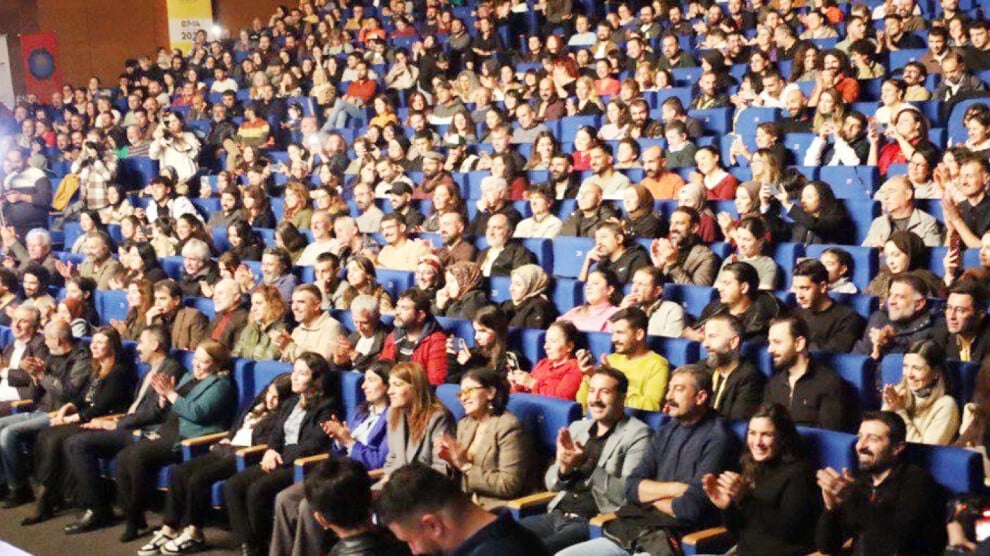
Film festivals are held every year across all four parts of Kurdistan. The Amed Film Festival, held again this year in Diyarbakır (Amed), is one of the best known. Admission is free. Yet a large section of society remains absent from these crowds: women living in rural areas and those in the city’s informal settlements and poor neighbourhoods. The festival may be “open to everyone and free of charge,” but for these women, the door remains effectively closed. This suggests that money is not the real barrier. Even when cost is removed entirely, there is a broader social structure that still prevents women from reaching the cinema. This reality did not emerge overnight. The village evacuations and forced displacement of the 1990s uprooted families from their land and pushed them to the outskirts of cities, creating a common historical root for the two groups now described as the “rural population” and the “urban poor.”
Why, then, are women from rural areas and poor urban neighbourhoods not attending? The answer is clear: the barrier is not money, but women’s lack of time, access to transport and safety at night. In villages, a woman’s day is spent working in the fields or tending to animals; in informal settlements, housework and childcare are often compounded by informal employment. There is simply no space in her day to say, “I’m free today, I can go.” There is no childcare, and often no one else to look after the children. If screenings take place in the evening, travelling alone at night presents another safety concern. Even if a woman makes it as far as the festival door, she must first overcome three overlapping barriers: time, childcare and transport. Across both rural Kurdistan and the poorer districts of its cities, economic conditions continue to structure women’s time and mobility around the family, and often around men. Behind the question of time lies an even deeper constraint: the social disapproval women face for travelling alone into the city, going out at night or entering crowded public spaces.
Women who cannot find themselves on screen
Even if a woman overcomes all these barriers and makes it into the cinema, one question remains: does she see herself on screen? The everyday lives and labour of women in rural areas and informal settlements are rarely portrayed. In Kurdish films, female characters are often written by male directors; women tend to be depicted either through their suffering or as bearers of tradition. This is no coincidence. It is a consequence of how filmmaking itself is structured: who gets to make films, whose projects receive funding and which directors are given visibility. From the outset, this system leaves women from rural communities and poor urban neighbourhoods outside the frame.
There is yet another barrier: language. Festival programmes are largely conducted in Turkish. For rural women who speak no language other than Kurdish and have had limited access to formal education, this creates an additional layer of exclusion. A woman who has grown up speaking her own language is forced to watch even her own story through another language. Eventually, she comes to see cinema as something that “does not belong to me,” while cinema continues to tell her story in her absence. For these women, television has become the only screen available at home. For those unable to reach a cinema, their relationship with moving images is almost entirely confined to television. Yet television reproduces the same problem: series and programmes portray an urban, middle-class way of life, once again pushing women from rural communities and informal settlements to the margins. Whether at the cinema or in front of the television at home, women do not see their own stories reflected at them. Whichever screen they look at, the life they see is always someone else’s.
Geared towards middle- and upper-income audiences
This is not unique to Diyarbakır. The Amed Film Festival is one of the region’s longest-established cultural events, but it has always been held in the city centre, effectively excluding women in villages and informal settlements from the outset. In Southern Kurdistan (Başur), the Duhok International Film Festival has become a well-known event, but its reach has not extended to villages and poor neighbourhoods to the same extent. The festival is increasingly geared towards an urban, educated, middle and upper income audience.
In Rojava, the Rojava Film Festival, held annually in Qamishlo, places women’s liberation at the heart of its message. Yet the destruction left by the war and continuing infrastructure problems have not yet allowed that message to translate into meaningful access for women in rural areas.
The situation is even more difficult in Eastern Kurdistan (Rojhilat). State repression in Iran has prevented the establishment of an independent Kurdish film festival comparable to those in the other three parts of Kurdistan. Women face a double barrier, stemming both from gender inequality and political repression. Conditions may differ across the four parts of Kurdistan, but the outcome is similar: festival culture is increasingly concentrated in urban centres and among educated audiences. A structure capable of genuinely including poor women from rural communities and informal urban settlements has yet to emerge.
What needs to be done?
The Kurdish women’s movement has long addressed the exclusion of women from public life and decision-making mechanisms, with jineolojî studies and women’s assemblies examining the issue at both theoretical and organisational levels. Yet much of this debate has centred on politics and the economy, while cultural participation has not received the same degree of attention. An organisation that seeks out women at the ballot box or the local health centre has yet to seek them out in the cinema.
Those observing the issue from outside are not the only ones to have recognised this gap. At the Kurdish Cinema Workshop held in Diyarbakır in July 2026, filmmakers discussed a similar picture. Alongside institutionalisation, education and distribution, gender equality was also placed on the agenda. At the end of the workshop, participants agreed on an organisational model based on democratic decision-making and established the Kurdish Filmmakers Initiative. This step points to a growing awareness on the production side, but the real test will be whether that awareness reaches audiences, particularly women in rural communities and poor urban neighbourhoods. Democratising what happens behind the screen is one thing; opening up the space in front of it to women is another.
If seats remain empty even when admission is free, the problem runs far deeper than money. It is the combined result of a system that deprives women of control over their time and mobility, a social mindset that seeks to control them, and a mode of filmmaking that also leaves them outside the frame. The absence of women from both rural communities and informal urban settlements at film festivals is not a matter of choice, but the result of overlapping barriers. Changing this picture requires a cultural landscape in which women can see their own stories on screen. Until that exists, festival posters may reach all the way to village roads, but whether in Diyarbakır, Duhok, Qamishlo or Mahabad, the doors of the cinema will remain closed to poor women from both rural communities and the city.
