


Published August 26, 2026 12:45PM
If no one else will say it, I will. From Phoenix to New York, London to Geneva, more than half of the gyms I’ve visited in the past few years seem to be infected by the same strain of cowardice: a fear of grading their own boulders. Instead of slapping a V-grade on a problem that might get called soft, gyms have begun inventing their own scales that amalgamate multiple grades and blur the differences between them.
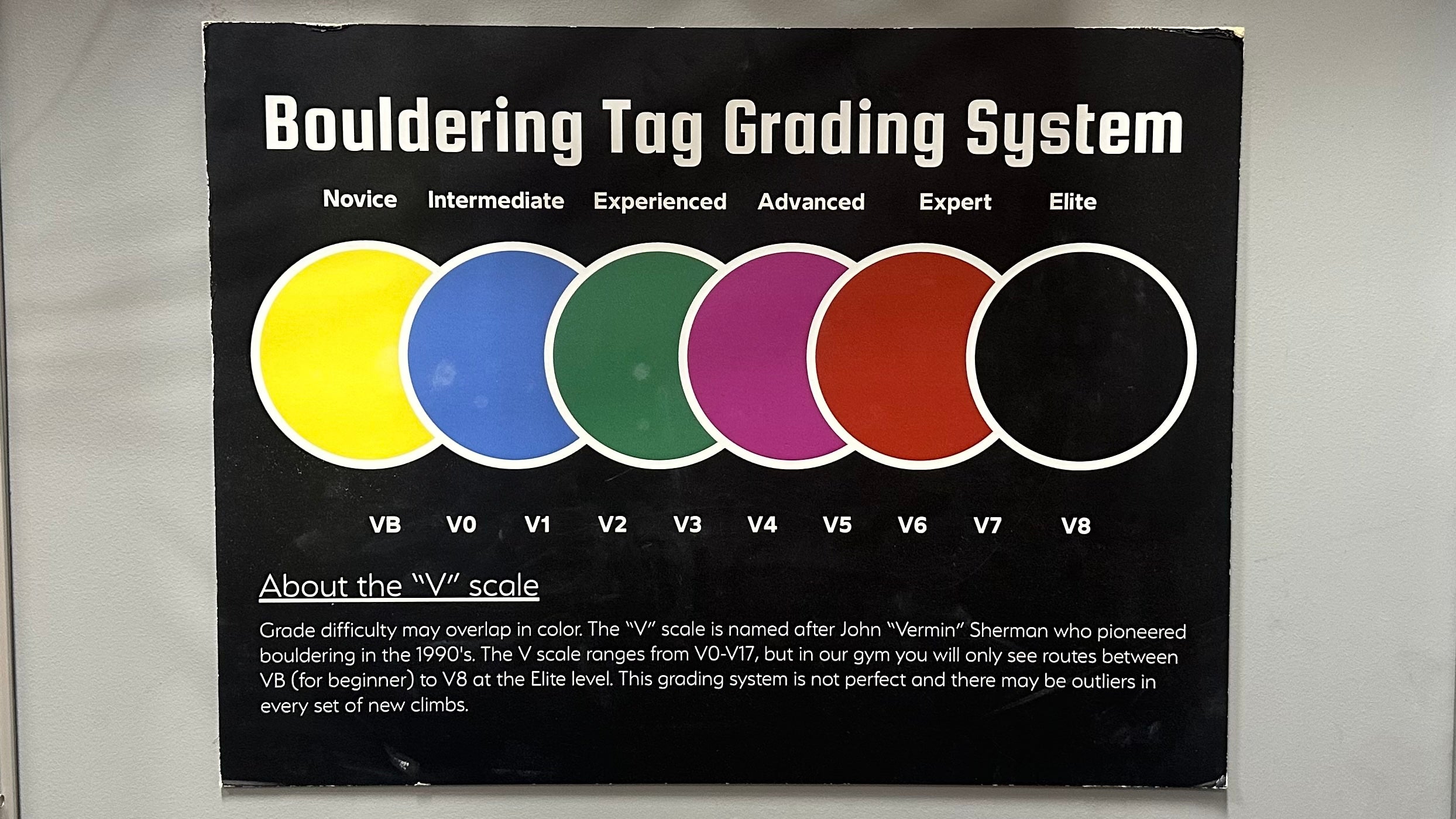
Back in 2019, my old gyms in New York used the regular V-scale. So did the Movement gyms in Denver in 2021. When one of Movement’s Denver locations, RiNo, switched from V-grades to colors that represented grade ranges, I thought it was just a RiNo thing. Then I started noticing it at even more of my favorite spots: Phoenix Bouldering Club, Westway Climbing in London, and even the small, independently owned Climb Moab that I call my home gym. Today, walking into a new gym in a new city, I’ll hedge a 50% chance of encountering a new, original grading scale instead of the good ‘ol V-grades.
So what exactly do these invented gym bouldering scales consist of? Some of them transmute V-grades into another set of numbers (e.g. one to four-and-a-half “dots” at The Spot in Boulder, Colorado). But the most popular choice that I’ve seen is color-coded labels—although never, it seems, in an intuitive or easily memorizable rainbow order. Either way, the result is that I practically get whiplash from constantly checking for the posters showing the in-house grading scale between every boulder, just to recall what “red” versus “purple” is supposed to mean.
Perhaps this rising trend in indoor bouldering grades is more irritating for nomads. Most climbers stick with a home gym and need only to memorize one grading chart. But even within multi-gym memberships like Movement in Denver, the grading scales can change from gym to gym. After finally sending a tricky “pink” slab at RiNo, for example, I couldn’t help but ask myself: Did I just climb a normal V6 for me, or punch up to V8? And more importantly, why does the answer to that question have to be so elusive?
So why are gyms inventing their own bouldering grades?
As far as I can tell, this is all being done in the name of acknowledging the general subjectivity of routesetter-assigned grades. Inventing a grading scale that merges V3 and V4, for example, allows climbers that disagree on whether a problem is V3 or V4 to each walk away satisfied rather than immersed in a tense debate. Some may even toss around the phrase “reduce the focus on grades,” suggesting that the desire to know a boulder’s difficulty is synonymous with making the grades you climb your entire identity.
But in reality, erasing V-grades solves neither of those issues. Ego-chasing climbers will simply commit themselves to the highest color grade that feels onsightable, just like they would with the V-scale. Comparison and criticism of routesetting doesn’t disappear just because you force your clientele to memorize new grading systems. At my regular gym in London, for example, where grades have been replaced by color ranges, I constantly notice that harder slabs will be slightly out of reach for my 5’6” span, but not a problem at all for my 6’2” boyfriend. That height-based advantage isn’t less noticeable when the boulder is labeled “white” or “blue” instead of V6. And the absence of a V-grade doesn’t make me any less likely to point it out when the routesetters ask how I’m finding the set.
So what’s the realreason gyms refuse to use the V-scale? Does the terror of potential disagreement with a grade really justify not even suggesting one? When I first started climbing in New York—in mid-2019, before the Covid shutdowns—it was well-known across the city that boulders at the Cliffs LIC were at least two grades harder than anywhere else. And you know what? That was fine. Sure, it stung a bit to remember that flashing V5 at my beloved Central Rock didn’t mean I’d come close to a V3 at the Cliffs, but I never actually believed I was getting worse at bouldering when I happened to trek out to Queens on my friend Sophia’s guest pass.
Differences between grading in gyms are acknowledged and understood—just as they are outdoors. I would argue these differences can even help climbers stay humble. What matters most is consistency within a certain gym. As long as most V4s one week match the difficulty of most V4s another week, grades can be taken as a general measure of skill. Back in Denver, if I was able to send a few of Movement Baker’s V6s in a single session, I’d celebrate that as a new development, signalling a slight yet stable improvement from my usual triumph of knocking out V5s. Now, though, I’m stuck in these ever-too-broad color ranges. It takes months, even years, to taste the thrill of moving up.
The real problem with swapping V-grades for invented scales
With the spread of ever broader color ranges, I can barely tell when I’m making any improvement. New, vague scales add unnecessary guesswork to a process of climbing that already has plenty of both. And for what? The condescending knowledge that routesetters think I’m too emotionally fragile to handle their grade suggestion? Please. I’ve survived sandbags before and I’ll do it again. What I can’t stand is this intentional ambiguity.

For new climbers especially, V-grades are one of the most powerful tools for measuring progress. Refusing to reveal a V-grade deprives climbers of that tool. In many indoor training plans, for example, power endurance exercises will ask you to choose boulders “1-2 grades below your onsight level” to repeat in a loop. But if your onsight is V4, and the grading scale is “V2 to V4,” you’re left with a frustrating, half-assed ability to do the exercise accurately. The same goes for any sort of circuit-based training plan that relies on the ability to quickly estimate a boulder’s difficulty—something that routesetters already must do, even with the ranges. If you have to hem and haw over labeling a boulder with the “yellow” (V4 to V6) or “blue” (V6 to V8) categories, you can at least have the decency of telling us it’s not V4 or V8.
V-grades aren’t perfect, but they’re certainly better than this
Imagine if we brought this anti-grade squeamishness to the outdoors. Instead of celebrating Katie Lamb’s ascent of The Dark Side as the first female V16 in history, we’d be nodding politely at another “orange,” representing V14 to V17. If you were aiming for your first outdoor V3, you’d be forced to choose from among “purple” V1 to V3 routes only. Every small step up you’ve ever celebrated, from your first V8 to your first time flashing a V5, would disappear into the who-knows shrug of the local crag’s color-coded grading scale.
Where a precise, linear grading scale can still be subjective, it’s still universally recognized and requires no distracting reminders between tries. More importantly, its specificity at least forces people to think carefully about their grading decision. Over time, with a common, numerical scale, the community’s understanding of what a certain grade really is can evolve to something nuanced and repeatable. By contrast, grade ranges represent a lazy anti-evolution, an excuse to halt one’s own analysis before it gets too right.
So here’s my call: If you’re a climbing gym manager or routesetter lead who has hopped on the “grade range” trend or invented your own scale, this is your sign to turn back from this foolishness. Cast off ye ranges, shun thy solid-color tags, and bring back the plain yet sacred transparency of the V-scale that everyone knows—or whatever your standard, local bouldering scale is (e.g. the Font scale in Europe). If you’re a gym climber, say something to your gym’s management; don’t be part of the sad, passive slide into grade-agnostic problems across the world.
In conclusion, pick a grade and say it with your chest. After all, I’d rather be sandbagged every damn day than realize, once again, that I’ve forgotten what a “green” route is and go find the poster to check.
BoulderingClimbing Gradesclimbing gymsindoor climbingop-edOpinion
Add Climbing as a preferred
Our Picks
<img src="https://cinemamix360.com/wp-content/uploads/2026/08/Untitled-design-2025-09-19T114405.928.jpg" alt="International Climbing Grades: Everything You Need to Know”>
International Climbing Grades: Everything You Need to Know
Opinion: Why I Love and Hate Livestreamed Sends
Who Did It First? Style, Grades and Dispute in First Ascents
Our Picks
International Climbing Grades: Everything You Need to Know
Opinion: Why I Love and Hate Livestreamed Sends
Who Did It First? Style, Grades and Dispute in First Ascents
