


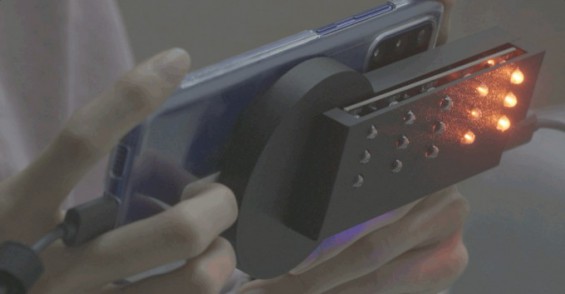
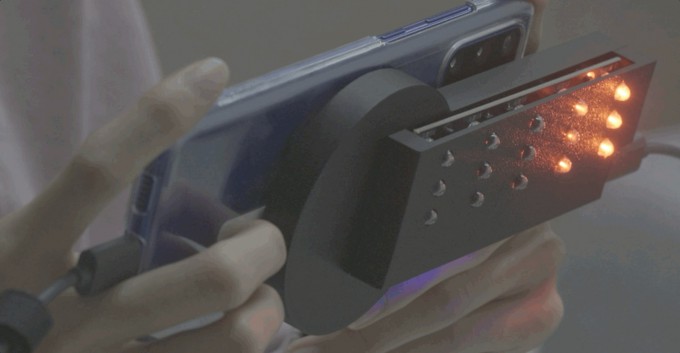
A prototype of SweepLED in operation. Courtesy of KAIST
A device costing under $10 has been developed that can turn a smartphone into a hidden camera detector. Using AI-based analysis, it detects camera lenses hidden in objects like clocks and remote controls with 94% accuracy in just 5 seconds.
KAIST announced on the 30th that a team led by Professor Jun Han of the School of Computing has developed ‘SweepLED,’ a technology that detects hidden cameras by attaching an LED case to a smartphone, in a joint study with the National University of Singapore and Singapore Management University. The research findings were presented on June 20th at ‘ACM MobiSys 2026,’ an international conference in mobile computing.
As cases of miniature illicit filming cameras being concealed in everyday objects like clocks, chargers, and smoke detectors in accommodations and public spaces increase, there is a growing demand for camera detection technology that can be easily used by the general public.
Most existing portable camera detectors work by shining a light from one direction and having the user visually check for bright reflected spots. This often leads to false positives, as it is difficult to distinguish between camera lenses and common reflective objects like metal or glass.
SweepLED analyzes the changing reflection patterns on an object’s surface by keeping the smartphone’s camera light fixed while only changing the LED’s direction. The key is to capture the characteristic distortion in the reflected shape caused by the camera lens’s aperture and image sensor structure.
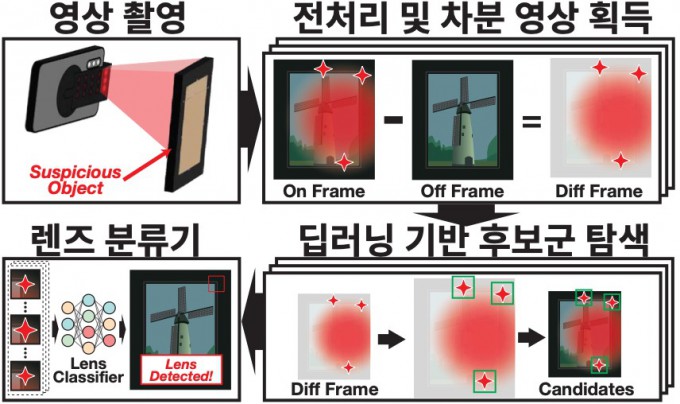
Overview of SweepLED’s hidden camera detection technology. Courtesy of KAIST
The research team trained a deep learning-based image analysis model to distinguish camera lenses using these reflection change patterns. Instead of relying on the user’s eye, an AI comprehensively analyzes the movement and shape changes of the reflection to identify hidden cameras.
When evaluated on 30 everyday objects for its ability to detect concealed cameras, it achieved an accuracy of about 94%. The time taken to inspect a single object is less than 5 seconds.
The core components for the LED case that attaches to a smartphone cost less than $7 (approximately 9,640 KRW), making it inexpensive. This suggests the potential for commercialization as an affordable detector in the form of a smartphone accessory or a general consumer product.
Professor Han stated, “Illicit filming cameras are a serious threat to personal safety and privacy in everyday spaces. By combining low-cost, smartphone-based hardware with AI analysis, we have demonstrated the possibility of a practical detection technology that even non-experts can easily use.”
<Reference>
– doi.org/10.1145/3812835.3814866

From left: Jong-hyeok Yoon, a Ph.D. student at KAIST; Sean Tan Rui Xiang, a researcher at the National University of Singapore; and Professor Jun Han of KAIST. Courtesy of KAIST
Copyright ⓒ DongA Science. All rights reserved.
