


Screenwriters Inc.,as author Mihir Chitre frankly contends in his introduction, is a collection of interviews conducted during the lockdown with Indian screenwriters for the Hindustan Times. What began as a passion project soon evolved into a series of 33 interviews – together, they read like a three-hour conversation with some of the finest directors and screenwriters of 20th- and 21st-century India.
As I read through the interviews, I gradually became aware of the extent of my own ignorance. While the book contains conversations with many legends of the film industry who are veritable household names, many were also unfamiliar to me. But here’s the rub: if some of the names looked unfamiliar, the films they had worked in (and, to a large extent, birthed) didn’t. What was going on here?
Simply this: all too often, we know the film, we know the “stars” in it, we preview the music before the film is released, and yet remain unaware – or even unconcerned – about the screenwriter(s) driving the film. We’re a culture that has grown up idolising film stars and their various exploits – even our experience of music is influenced by it (how many other countries revere “filmi music” the way we do?). And yet, as Chitre asks in his introduction, “How many screenwriters in India are known outside the film industry?”
I suspect that my experience may not be the most unique one, but it is symptomatic of the kind of popular ignorance that the book seeks to dispel. In an interview with the BBC, legendary actor and filmmaker Orson Welles once attributed his bold experiments with cinema to “sheer ignorance”. As he famously put it, “I thought you could do anything with a camera that the eye could do, or the imagination could do.”
In many ways, the interviews in the book reveal a similar, passion-driven modus operandi. And like Welles, many of the screenwriters here started working at a time when the Indian film industry was much less formally organised than today.
As veteran screenwriter Anjum Rajabali recalls in his interview in the book, “The idea that the writer is the first film-maker and could have a vision independent of the director never really existed in Hindi cinema unlike in the West.” Rajabali’s work with the Screenwriters Association, India, is well-known – what the interview really uncovers is how grounded in reality it was. For context, Rajabali mentions that the idea of a writing contract was unheard of in the 1980s and ’90s.
But that is just the beginning. More than one interviewee speaks about the pitfalls of working as a screenwriter in those days. These stories paint a troubling picture of how screenwriting was initially seen just as an add-on to the filmmaking process, and not as a separate profession with commensurate dignity.
Add to it the aspect of gender, and things become trickier. Even a doyenne of Indian cinema such as Sai Paranjpye opens up candidly about her early days of filmmaking: “I don’t know now if it was because I was a woman or because I didn’t understand money, but I never really made too much money (through screenwriting).”
Writer and director Ruchi Narain recalls how she got her first screenwriting stint only after working initially as a costume designer and assistant director. The challenges multiply when faced with queer and non-binary themes on screen. Renowned screenwriter Onir brings up the censorship challenges he faced while directing his movie Shab (2017). At the same time, he notes a visible shift in attitudes today: “The fact that today you have people thinking of the possibilities of Spider-Man being gay …is proof that people are opening up to these ideas. Today, a superhero could be a woman, gay, or trans.”
Screenwriter Ishita Moitra also provides a synoptic view of how the film industry has evolved to be more accepting of gender diversity: “When I first came in, gender used to matter a lot more because…there weren’t too many women screenwriters.” But today, “a woman is not a woman writer. She is just a writer.” Part of this is also because of the advent of OTT platforms, which have thrown open the doors of creativity to writers regardless of their background.
Another common thread running through the interviews is the writers’ experiences, which take us all over India, from small-town Bihar or 1970s’ FTII to Delhi and Hyderabad of the 1990s. Of course, their point of intersection is Mumbai, the city most associated with cinema in our country, which was also home to several writers in this book.
For most writers, the city became a laboratory for experimentation and exploration. It was here that Imtiaz Ali began writing for the stage as well as the screen. As he recalls in his interview, “I feel that anybody who came to Bombay around my time to become a director was, at first, a writer… We were all middle-class small-town boys. We had our own experiences, and gradually, we found a way in.”
A similar account is narrated by writer-director Avinash Das, who frankly states that “Bombay is the only city where if you tell someone that you want to make a film, they won’t discard you.” In a way, then, Mumbai emerges almost as a minor character in the book.
Talking shop
If questions of identity and origin feature so prominently in these conversations, there are equally bracing discussions on cinema as an art form. Screenwriters Inc. is especially notable for its appetite for what usually gets classed as “trivia”. We often fantasise about the kind of culture our favourite artists grew up consuming, such as the books or films that influenced them. Such fantasies find a vocal utterance in the book as Chitre teases out the inner lives of creatives. This also takes the readers back to an era when film discourse was centred as much around the director/screenwriter (who were often the same) as the actors.
It reminded me of the lively, insightful discussions I’d seen on The Dick Cavett Show on YouTube, which aired in the United States from 1968-1996, and developed a cult status of its own with guests like Alfred Hitchcock or Orson Welles. While there may be few well-known equivalents for it in India, Screenwriters Inc. comes close to offering the same proximity with artists to its readers: what does a great film-maker/scriptwriter look like up close? Where do they get inspiration from? Fortuitously, for us, Chitre eschews the usual celebrity-interview angle to focus more on the screenwriter’s work, their craftsmanship, and their take on the industry.
Inevitably, the discussion veers into the subject of arthouse versus mainstream cinema, and “high” art and “mass” culture. Because the book is structured as a collection of interviews without a narrative of its own, it allows ample space for a diversity of opinions to coexist. Thus, it includes Rajat Kapoor’s visionary idea of cinema as a medium that should “light things up, make you aware of things that you either weren’t before or if you were, you weren’t able to find an expression for”.
At the same time, there is the more populist approach of Nitesh Tiwari, the writer behind films like Dangal and Chhichhore. For Tiwari, “the primary function of cinema, especially in our society, is that it’s a stress-buster.” Entertainment, then, becomes the primary function of art, followed by instruction. Such a view of art has a long history to it; the combination goes back at least five centuries to when the English poet Sir Philip Sidney declared that poetry (or literature) should be a mix of “delight and instruction”.
Elsewhere, artists emphasise the role of the audience. Cinema, after all, is also a social art. Chandan Kumar, the writer behind the popular Amazon Prime web series Panchayat, speaks about staying true to the “Indian sensibility” by making films/shows that viewers can relate to. Others point to the pressures of the market, since screenwriting is a fundamentally commerce-driven art.
Perhaps the book’s merit lies in not imposing or siding with any particular stance. While this may seem incomplete to some, it certainly makes for a rich and multifaceted reading experience, as if the interviewees in the book were all assembled for a panel discussion, and Chitre were the moderator.
Ultimately, Screenwriters Inc. does not purport to make any grand, original claims about Indian screenwriting. Rather, it has the more primary purpose of bringing the screenwriter into the spotlight as far as the popular imagination is concerned. If, so far, Indian cinema has suffered from a lack of audience for screenwriters (and by all measures, this would seem to be the case), then this book goes some way in bridging this gap. That it does so with extraordinary elan and freshness makes it all the more accessible. Take it along as a travel companion, and you won’t regret it.
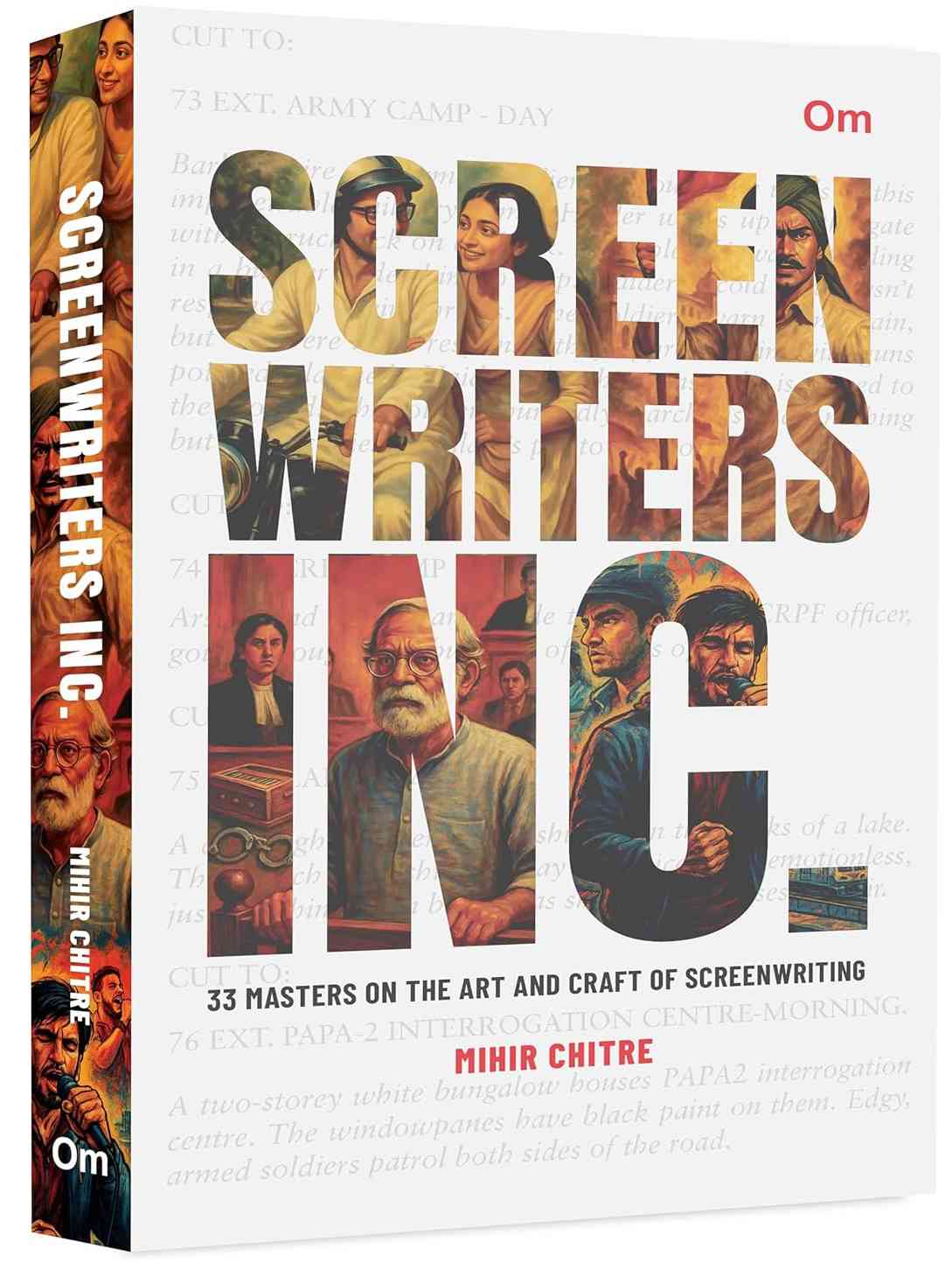
Screenwriters Inc.: 33 Masters on the Art and Craft of Screenwriting, Mihir Chitre, Om Books International.
We welcome your comments at
letters@scroll.in.Get the app
ANDROIDiOS
