


Even Martin Scorsese uses AI for storyboards. Can the art survive?
As Hollywood begins to adopt the technology, the professionals in most direct jeopardy are the illustrators mapping out directors’ first visions. They sketch out what could be lost
A film industry dominated by AI is a dystopian prospect: stories and dialogue generated by large language models, populated by reincarnated screen icons and uncanny humanoids. That is in the future, but the real-world impact of AI is already directly affecting jobs behind the scenes, as Hollywood’s biggest film-makers begin to adopt the technology. James Cameron – long an advocate for emerging technologies in film-making – is on the board of a gen AI firm, citing his interest in how AI will intersect with CGI; Steven Soderbergh used Meta-powered tech to create animations for his recent documentary about John Lennon; even Christopher Nolan, while dismissing the idea that AI will replace humans as “nonsense”, conceded that it will create some useful “imaging tools”.
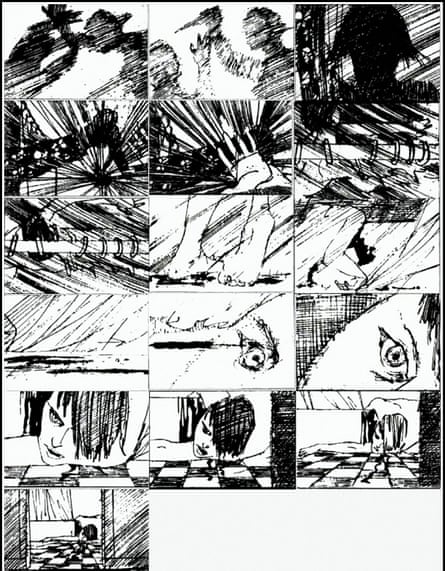
The current canary in the coalmine however is the storyboard artist, whose work gen AI appears to have directly in its sights. Storyboard artists are the illustrators who draw the panels of images with notes and diagrams that map out scenes before they are filmed. Storyboards are used to work out how a film will look, and as a blueprint to communicate a director’s vision to cast and crew,andare one of the first steps in bringing a script off the page. Now they appear on the verge of replacement by programmes that use text prompts to create illustrations instead. Even an old-school diehard like Martin Scorsese has got on board; in June he announced a partnership with an AI firm whose text-to-image model he used in the storyboarding process for his next movie.
Usually, storyboards are made together by a director, an artist and other crew members responsible for the film’s visual storytelling, such as cinematographers, editors, production designers, stunt co-ordinators and more. “I find it very fulfilling to make art in such a collaborative way,” says Alex Clark, a British storyboard artist whose recent films include Bong Joon Ho’s sci-fi comedy Mickey 17, adventure romance The Gorge and Louis Leterrier’s recent thriller The Last House. “It’s about people sitting down to discuss each other’s ideas. You might act things out, make sound effects, read dialogue. You develop a creative relationship with one another.”
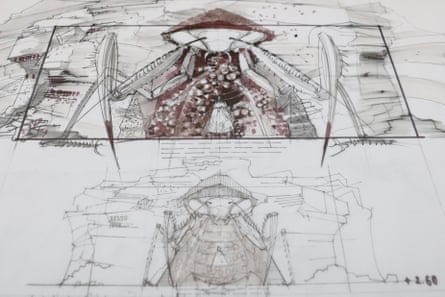
For Clark, the process of creating a storyboard is just as important as the finished product. “A common misconception is that storyboarding is about making nice drawings. But it’s more than that – it’s about relating to how the director is thinking, and conceiving the most appropriate ways to tell the story of a scene,” he says. Dune director Denis Villeneuve articulated this relationship when describing his frequent collaborator, artist Sam Hudecki, as “an extension of my brain”. For Villeneuve, storyboarding is “a new way of writing”: writing a screenplay might provide the words, but storyboarding is the first step in creating the “cinematic language of the movie”. He views it as “a way to dream” as the film begins to come to life on the page.
Clark says that there is a balance that must be struck between “capturing the essence” of a scene and figuring out how the shots are going to work once the cameras are rolling. “The act of how you mark the page – to convey forms, tones, compositions, blocking and so on – forces you to thoroughly think about how all these different details will affect the scene. It gives you a rigorous understanding of how the scene is going to work.” Clark’s work reflects the fact that storyboarding is one step in an ongoing collaboration that continues through pre-production, shooting on set and beyond. “Sometimes I try to scale the drawings back, when it feels appropriate to leave space for others to build on it – whether it’s an actor’s performance, the way the set is decorated, lighting setup or subtle movement of the camera. I like finding space for happy accidents.”
For researchers and film enthusiasts, storyboard art offers a glimpse into the journey that lies behind a film, including fascinating changes in direction like this. “Storyboard art shows us the evolution of the creative vision,” says Ferdinando Cocco, a lecturer in film at Abertay university in Dundee. He points to Disney’s 1991 film Beauty and the Beast as an example: when it was first being worked on in the late 1980s, the storyboards had a rococo-inspired aesthetic, contemporary to the fairytale’s origins, styling Gaston as a bewigged 18th-century French aristocrat rather than the swollen, strong-jawed hunter who exemplified more modern ideals of masculinity.
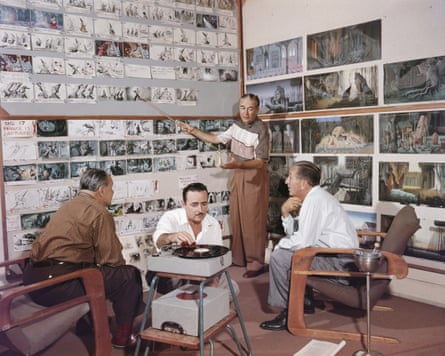
As a film-making technique, the storyboard was first used regularly by Disney animators in the 1930s and and it plays a key role in their production process (as evidenced bydisplays of concept and storyboard art, and the side-by-side videos Disney posts online. (Disney also announced a $1bn investment into OpenAI’s video tool Sora last year.)
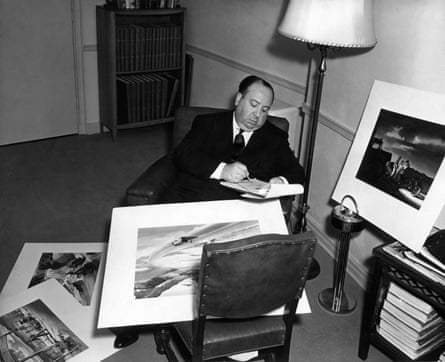
Storyboards were swiftly adopted by live-action productions, dating at least back to Gone With the Wind (1939). Since then, many film-makers have left behind storyboards that are beautiful and evocative images in themselves. Alfred Hitchcock created meticulously detailed storyboards, which spawned some of the genre’s most recognisable images: such as the shower scene in Psycho sketched beforehand by his frequent collaborator Saul Bass, the graphic designer behind many classic posters of the era. And before that, Hitchcock had worked with Salvador Dalí on surreal designs for the dream sequence in his 1945 film Spellbound.
Other directors, including Akira Kurosawa and Ridley Scott – whose storyboards are known as “Ridleygrams” – draw their own. Some of Bong’s self-drawn sketches are currently on display at the Academy Museum in Los Angeles, and his panels for Parasite have been published as a graphic novel. “Whenever I go to set without storyboards, I feel like I’m standing in the middle of Grand Central Terminal wearing only my underwear,” Bong writes in the book’s preface – however he does encourage the reader to see the differences between the storyboards and the film as “exciting moments of fear and spontaneity”.
Fan interest in behind-the-scenes material has created a market for storyboard books, while last year an exhibition devoted to storyboard art held in Milan displayed panels from films made by arthouse auteurs such as Ingmar Bergman and Federico Fellini, to artists Isaac Julien and Carrie Mae Weems, to Hollywood royalty – including Scorsese.
Creating engaging images is not without a practical function either, as storyboards are often pinned up on set to give the crew a sense of what will be shot that day. “I feel a responsibility to produce work that inspires and captivates everyone about what they’re making,” Clark says. “If the level of artistry and attention is evident at this stage, I believe it can set the tone on set, of valuing the craft involved.”
All hope is not yet lost. Cocco has observed a return to analogue practices and suggests that AI can be used in a way that fosters rather than dilutes the creative process. “Perhaps the difficulty that AI purportedly overcomes was the whole point from the start,” Cocco says. “Having to communicate with others forces an expansion of the artistic vision in ways that cannot be pre-empted.”
Clark meanwhile predicts that, as AI usage in the industry increases, people will come to have a greater appreciation for films with a human touch. “Ultimately, I think most successful films make you feel something as a human being. One advantage of hand-drawn storyboards is that you have a direct sense of that human authenticity right there on the page.”
Explore more on these topicsShare
Reuse this content
