


Season 3 of Netflix’s docuseries, which dropped this week, follows Jayden Daniels, Baker Mayfield, Cam Ward, Joe Flacco through the 2025 NFL season
Netflix’s popular docuseriesQuarterbackreturned for its third season this week with perhaps its most varied group of subjects yet: Washington Commanders star Jayden Daniels, navigating the heightened expectations that follow a historic rookie campaign; Baker Mayfield, continuing his career resurgence with the Tampa Bay Buccaneers; No. 1 overall pick Cam Ward, experiencing the NFL for the first time; and elder statesman Joe Flacco, adjusting to an in-season trade from Cleveland to Cincinnati.
Capturing those four journeys required much more than simply following the action on Sundays. Produced by NFL Films, Omaha Productions, and 2PM Productions, the series unfolds over roughly 10 months, with cameras documenting the physical demands, personal milestones, career uncertainty, and quieter personal moments that shape an NFL season.
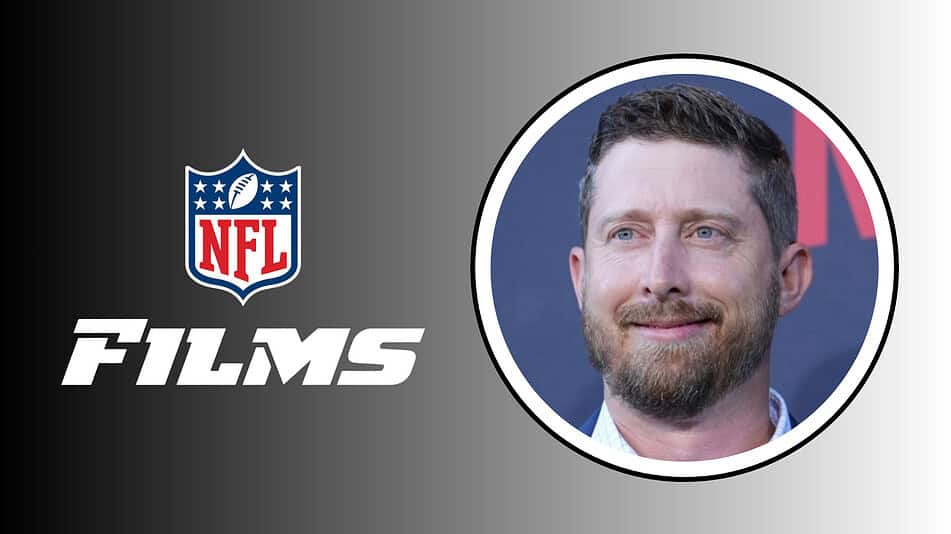
At the center of the production is NFL Films Supervising Producer Joe Zucco, who serves as showrunner on the series. Each quarterback is paired with a dedicated director(Courtland Bragg, Shannon Furman, Tim Rumpff, and Emily Winter), and compact microphone systems, cinema cameras, and a mix of modern and decades-old lenses help crews capture intimate moments without disrupting them.
SVG sat down with Zucco to discuss howQuarterbackdiffers from the lightning-fast production cycle of another series he has overseen,Hard Knocks; the technology and cinematography behind NFL Films’ signature look; and the trust required to document players at their most vulnerable.
Season 3 dropped on Tuesday. What feelings do you get after all this time when a series you ran is released for the public?
It’s exciting because so many people work on the show, put in countless hours, dedicate so much of their lives to it, and travel extensively. There’s a real sense of pride when it finally comes together.
A series like this follows someone throughout an entire season. For us at NFL Films, Omaha Productions, and all our partners, the show is a 10-month process. During the season, it can become a grind: you’re in the weeds trying to figure out the story, schedule all the logistics, manage the budget, and do all the work it takes to put everything together. When it finally comes out, you can step back and say, “Here’s something really cool that we all created, and now people get to see it.”
At this point in my career, social media also gives you a sense almost immediately of whether people are enjoying what you’ve made. I’m as guilty of checking it as anybody else. Yesterday, we were driving from our home in New Jersey to my in-laws’ house in Rhode Island, and my wife drove so I could be on social media saying, “Oh, they like Baker.” I loved Cam Ward this season, so I was also thinking, “Good, people are liking Cam.”
You still get excited, but you also get a little nervous. You hope people enjoy the show, that you did right by the participants and they enjoy it as well.
Anyone who has ever worked on an all-access type of series will tell you that building trust with your subject is crucial. Is establishing that trust easier when the project is established like Quarterback is, or do you start from scratch with each player?
It depends on the individual. Going back to Seasons 1 and 2, Kirk Cousins understood what the show could be, and I think that comes across onscreen. He was completely invested and opened his life to us. But every individual is different.
I would say we have three advantages when it comes to establishing trust.
The first is that the participants know the show is produced and edited by NFL Films. Ed and Steve Sabol started this company more than 60 years ago, and players are accustomed to having us around through Hard Knocks and everything else we do. There is some built-in trust. That trust is often established at the team level, though, and this show focuses much more closely on the individual, so there is still work to do.
The second advantage is that Peyton Manning is an executive producer. He is involved with the show and speaks with all the participants before they agree to take part. These quarterbacks have looked up to Peyton at some point in their lives — and many still do. They trust that he isn’t going to do them wrong, and that certainly helps.
The third advantage is that we assign a lead director to each participant. It isn’t one director bouncing from person to person. As showrunner, I’m running the overall production from NFL Films, but, this year, we have four quarterbacks and four directors, with one director assigned to each quarterback.
Those directors spend as much time with the quarterbacks as possible, even before the season begins, to build that relationship and establish trust. As you said, that is everything. If the participants aren’t willing to let you into their vulnerable moments — if all you capture is a team winning by 30 points and everybody celebrating — that doesn’t make for a particularly interesting television show.
Establishing trust is paramount. We have some advantages because of the factors I mentioned, but earning that trust still requires work every year.
You mentioned Hard Knocks. That’s another series that you have served as showrunner on. It’s the long-running gold standard of sports docuseries. That show and Quarterback feel like polar-opposite experiences to produce. Hard Knocks is built on its super-quick turnaround times. How would you describe the differences working on a show like Quarterback vs. a show like Hard Knocks?
I’ve worked on many seasons of Hard Knocks, and what you laid out is absolutely true. Hard Knocks moves incredibly fast.
There is a point in the Quarterback production process when things also become fast. Once we begin sharing episodes with Netflix, receiving notes, and turning around revisions, the pace accelerates. But there is nothing quite like Hard Knocks when it comes to turnaround time.
We bring in an enormous amount of [Quarterback] footage every day, and we have an army of people reviewing it and identifying the standout clips that ultimately make it to air. The process becomes more of an assembly line because you have to build a pyramid: you begin with everything that came in, then continually narrow it down and funnel the strongest material toward the final show. All of that has to happen very quickly.
One similarity between the shows is the importance of trust and familiarity. Many of the technical elements also are similar. On Hard Knocks, we want to capture the sounds and visuals without ever getting in the team’s way. When the players and coaches begin to forget we are there, that is when we capture the most honest moments.
Much of what we have learned technically over more than 20 seasons of Hard Knocks has been applied to Quarterback. During the first season, when Kirk Cousins was with the Vikings, he didn’t tell his teammates until Week 7 or 8 that he was participating in the show. At that point, nobody knew what the series was going to be. The fact that he could go that long without telling them demonstrates how unobtrusive our production is. We have incredible cinematographers and lenses that allow us to capture what appear to be very intimate moments from a significant distance.
The same is true on the audio side. Hard Knocks has been a major driver of the audio technology NFL Films uses, because access sound is one of the most important elements of a show like this.
There are similarities in the technical approach and the editing style, but the turnaround for Hard Knocks is entirely different. We begin storyboarding the five episodes while training camp is still underway, but then you have to react to events and move quickly.
With Quarterback, we storyboard the major developments taking place throughout the season, but we have the flexibility to adjust as the story evolves. A moment that seemed important in Week 3 may no longer feel important by Week 12.
With Hard Knocks, what is important in that moment is what has to get on the air.
What do you find to be the most important piece of gear in shooting and producing a show like Quarterback?
I would point to two areas: audio and visuals.
Scott Carter, who leads our audio-acquisition team is remarkable. We can arrive before a practice or game, place the microphone pack inside a player’s shoulder pads, and allow that player to go through his normal routine. The person speaking with him has no way of knowing he is miked unless the player tells him. We don’t have to spend half an hour getting the player set up. He arrives and puts on his equipment the same way he normally would.
Across all our shows, we never want players performing for the camera or the microphone. We need the technology to be small and unobtrusive enough that they can forget it is there. Over the years, we have been able to shrink the audio packs significantly. It is now a small, flexible pack that fits into the shoulder pads, and the player barely knows it is there beyond our telling him, “You’re wearing this today.”
That is incredible because the audio is so important. Giving fans the ability to hear crystal-clear conversations between players on the field is a huge part of what makes these shows special.
Then there is the visual aesthetic of NFL Films, which has continued to evolve. It all began with Steve and Ed Sabol and the way they wanted to tell stories. We continue building on that legacy.
Everything is digital now, but we use cinema cameras that would be found on major film sets. Unless you’re Christopher Nolan shooting an entire project in IMAX, these are the types of cameras being used in feature films.
Through our work with ARRI, we are always testing new cameras and technology. At the same time, some of the lenses we use are 40 years old. They simply don’t make glass like that anymore. Those lenses create such a cinematic look and have enough reach that we can be 30 yards away and make it appear as though we are right in front of a player during an intimate conversation.
Is there a particular shot from this season that you are really excited about?
There is a tremendous amount of great football cinematography in the series.
Our Director of Photography, Phil Gushue, and his team at NFL Films did an incredible job. Phil couldn’t shoot every game because he couldn’t be in multiple places at once, but we had a great rotation of cinematographers. Phil creates a detailed lookbook that he shares with the cinematographers to establish the type of imagery we want. Our goal is to frame the action differently from the way viewers have already seen it on the game broadcast and make the experience feel much more intimate.
There is one moment this season when I thought, “This is exactly what this show is.” If you’re familiar with how the Buccaneers’ season ended, they played on a Saturday in Week 18 and had to win their game, and the result of the Falcons–Saints game on Sunday would determine whether they made the playoffs.
Going back to our earlier discussion about building trust, Shannon Furman — who previously directed Hard Knocks and has directed on every season of Quarterback — was Baker Mayfield’s director. Immediately after the Bucs won Saturday, Shannon approached Baker and [his wife] Emily in the parking lot and said, “Can we come to your home and watch you watch the [Falcons–Saints] game?”
As a result, we were inside Baker and Emily’s home while Baker anxiously watched to see whether the Saints could pull out a victory. The team he would ordinarily root against suddenly became the team he was supporting more than anyone. He was incredibly nervous. At one point, he removed himself and sat on a counter in the kitchen to watch on another TV. Phil was able to use the distant TV in the living room to tell the story by rack focusing between Baker and the TV in the distance. The shots he captured, combined with the emotion visible on Baker’s face, allow the audience to feel exactly what Baker was experiencing.
There is one stretch of more than 90 seconds that plays as an unedited shot. Baker is watching the main television in the living room, which is across the open-concept space. He believes the Saints have scored a touchdown, but the play is called back because of a penalty. We see every emotion on Baker’s face. Then Phil racks focus to the television roughly 30 ft. away, where viewers can see the officials making the call.
For that type of vérité moment, it is an incredible piece of cinematography and an extraordinary example of access. To me, it represents exactly what we want this show to be.
What advice would you give to a young professional or someone in college who is inspired by the docuseries style of storytelling and wants to work on projects like this?
I can relate to that question closely because my oldest son just graduated from high school.
One important area is communication. Young people today are accustomed to sending a quick message on Snapchat or communicating in a very informal way. But when pursuing professional opportunities, you have to be intentional.
If you want to work at NFL Films or on Hard Knocks, find out — whether through your school or your own research — when the application process begins and make sure you apply early because companies begin looking for candidates well in advance.
A show like Hard Knocks relies on an army of young people working at the first level of the production, so opportunities do exist. Do everything you can to earn one. Apply, follow up, send personalized emails, and make phone calls.
Once you get your foot in the door, however, you have to stand out. That is what I tell my son all the time. Everyone wants to work in sports. Everyone wants to work in sports media or documentaries because it sounds exciting.
But it is also extremely hard work. You have to demonstrate that you are the person a producer whose hair is on fire can turn to and say, “I need help with this. Can you handle it?” Let people know, “If you need help with anything, I’m here.”
You have to put yourself out there, take risks, and place yourself in uncomfortable situations. One thing I always say is this: if you can make the job of the person you report to — or the person running the project — even a little easier, that person will remember you.
Many young professionals are understandably concerned about annoying someone. There is a fine line, and you don’t want to become a pest. But, if you simply sit back, there is a chance you will get lost in the shuffle. If you are working as a seasonal production assistant and primarily report to an associate producer, make the effort to find the person leading the show and introduce yourself.
Ultimately, that is the biggest thing: you have to find a way to stand out.
This interview has been edited for length and clarity.
