


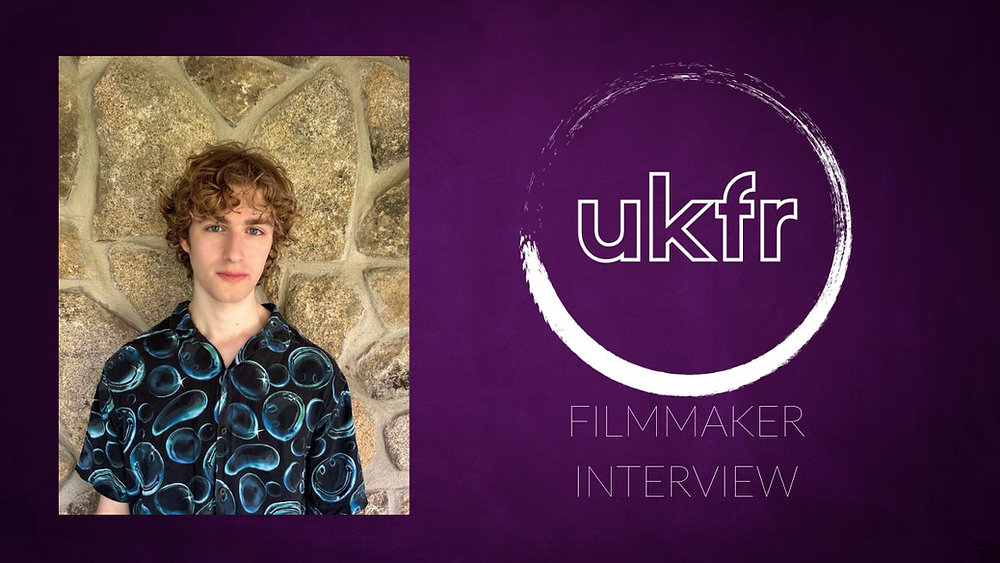
Filmmaker Interview byChris Olson
You are back with a new film,Noblestone. What’s it about, and what made you want to return to the quirky caretaker character of Karen, and how did you approach evolving her story this time around?
Noblestoneis about an eccentric housemaid who is hired to live with a self-absorbed artist.
The film features the return of ‘Karen’ the housemaid, who played a very similar role in my last feature, and had appeared before then in a few short films.
I suppose Karen is less deranged here. Previously, she was much closer to a traditional horror villain. Here, she remains as creepy and extraterrestrial as ever, but there is far greater ambiguity surrounding both characters.
Your sister, Lucia Goya-Betts, is back playing two characters. What were the technical and creative challenges of directing the same actor in both leading roles?
It’s certainly time-consuming, as every scene must be shot twice in order to capture each side of the conversation. This also makes the editing process, particularly in terms of audio, much less enjoyable.
Of course, the main frustrations come from rarely being able to have the two in the same shot, meaning that during certain moments I had to either stand in as Karen myself, or mask the two together in post.
The story also had to be developed with this limitation in mind – meaning I couldn’t go as far with the physical violence as I would have liked. At the same time, the one-actress thing works perfectly alongsideNoblestone’s themes. I also think she does an outstanding job in both roles, and the radical difference between the two characters adds to the absurdity of their interactions.
How do you balance the contrasting tones of absurdity and psychological suspense in the writing process? What is your writing process?
The humour won’t work for everyone, and some viewers may feel that it completely mismatches the tone of the rest of the picture. That wasn’t something I thought about too much while writing.
I wanted Noblestone to feel like a dream, and dreams are often absurd, terrifying, and beautiful at the same time. The jokes aren’t incidental either; they’re another language through which the film creates meaning.
As for the writing process, the first few months consisted of mapping out the structure and storyboarding each scene. Once I had a visual blueprint, I could begin writing.
I was particularly impressed with the cinematography in the film. What was your approach to this and how pleased areyouwith the final execution?
I am generally pleased with it. I wanted the film to linger in the mind after viewing, much like a dream, and I think there are enough memorable images for that to be the case.

However, the visual detail is richest during the first hour of the film, as shooting in my own home afforded me fewer constraints and more freedom. The material shot in Spain in my grandparents’ house relies more on the use of space and colour to tell the story.
While I like the cinematography overall, there is one conversation scene around the midpoint of the film that was shot horribly, and briefly detracts from the viewing experience.
Were there specific classic thriller or horror cinema influences you were referencing, both in terms of visual storytelling and your choice of score?
In terms of visual storytelling, Hitchcock and Kubrick are the gold standard, and their influence remains prevalent throughoutNoblestone. Outside of horror, certain slow-cinema directors such as Tsai Ming-liang or Apichatpong Weerasethakul – the latter being one of my greatest filmmaking inspirations – have taught me a great deal about how to capture dreams on screen.
My approach to music is largely inspired by the Golden Age of Hollywood, as well as twentieth-century European cinema, both of which utilise their scores in ways that seem almost non-existent these days.
Noblestone was filmed in Spain and London. How did the natural beauty and light of the Spanish landscape influence the mood of the film compared to the interior, warmer domestic settings?
Once again, I wantedNoblestoneto feel like a dream, and that’s done through atmosphere. The film is filled with pillow shots, used to develop a strange psychogeography that isolates the characters and gives the impression that the story exists in some alternate reality. It’s an approach I expect to continue in my future work.
What central themes or questions were you most passionate about exploring through the interactions between the two main characters?
Well, most of the thematic weight is carried by the visuals. The film is like a puzzle, and you attempt to solve it by paying attention to everything happening outside the immediate action and dialogue between the characters. The script is a fairly literal demonstration of the film’s main themes playing out.
The concept of determinism runs throughout the picture – the idea that every human choice is the result of internal and external factors beyond that person’s control. With that as its backbone,Noblestonebecomes an explosion of ideas, some more apparent than others, and those ideas are for the audience to experience.
As a teenage filmmaker producing feature-length, highly distinct indie films under zero-budget constraints, what has the journey of stepping from Lady Governess (and your work as Tito Wiley) to Noblestone taught you about your evolving identity as a director?
My old stage name was something I came up with when I was 11, so naturally I didn’t want to be using it for the rest of my life. But I think the name change is appropriate alongside the completion of the new film. I likeNoblestonebecause it’s more consistent and complete than anything I’ve made before, and it contains a number of scenes and ideas that hint at the kinds of pictures I’d like to make in the future.
What’s next for you?
Aside from some musical projects, I will be starting my next feature shortly. This time with a bigger cast, bigger crew, and bigger locations. It’s a project I’ve had planned since I was makingNoblestone,and I am looking forward to finally getting it made.
