


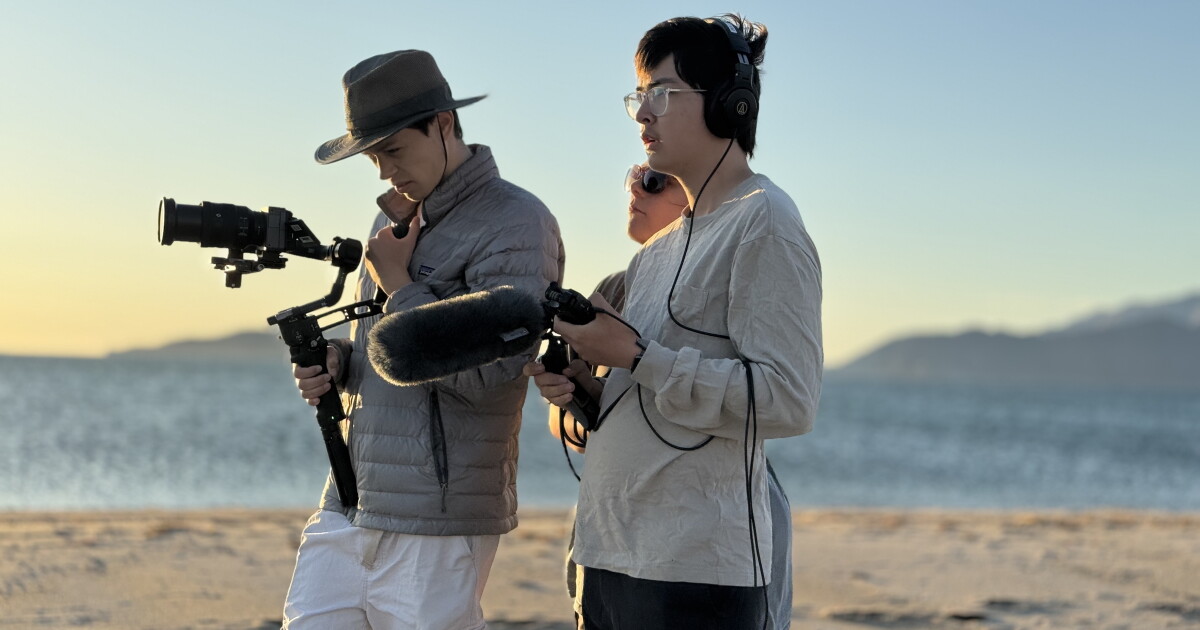

Glendale Community College students can now learn about documentary filmmaking in Baja California. A study abroad option in Japan is currently in the works.
(Jerry Henry
/
Courtesy Jerry Henry
)
This story is free to read because readers choose to support LAist. If you find value in independent local reporting, make a donation to power our newsroom today.
Joel Ruano was raised by his grandparents in Lamont, a community made up of about 14,000 people, a few miles from Bakersfield.
Growing up, college was not in Ruano’s plans. And though he loved watching movies, he never envisioned a career in filmmaking.
After earning his diploma, Ruano worked at carrot factories. Then, he operated heavy machinery at a distribution center before landing a job at an electric vehicle company. For years, he believed his future lay at the industrial warehouses that surround his old neighborhood.
But when the company went bankrupt in 2023, Ruano decided he wanted a change. Encouraged by his loved ones, he enrolled in Glendale Community College’s film, television and media arts department, which now offers coursework in documentary filmmaking and the chance to study abroad.
For students like Ruano, these opportunities have been transformative.
Los Angeles is home to renowned film schools like USC, UCLA and the American Film Institute. But their cost of attendance can be an obstacle for some students. Community colleges offer affordable alternatives.
“This is my career path now,” Ruano told LAist. “I just love holding the camera and seeing through the monitor and getting the first taste of what the audience is going to see. And I get to control that vision.”
Making up for lost time
At Glendale, department chair Geri Ulrey makes it a point to keep in touch with students after they graduate. She also hosts alumni mixers and pings former students when she has something to share that may be of interest.
That’s how Ben Do found his way back to Glendale. He earned his associate’s degree at the height of the COVID pandemic, so most of it was done on Zoom. As a result, Do graduated with no in-person film experience, something he always lamented.
Ulrey messaged him years later, inviting him to consider the school’s new documentary film production courses.
Soon, Do became part of Planet Story Lab, a course that provides mentorship from professionals and the chance to do fieldwork.
Do also appreciates the chance to hear directly from people in the field, who are often guest speakers. This includes documentary director Laura Nix.
“Just hearing how she approaches talking to people about the process of what a documentary is” has been helpful, Do said. “People think it’s a very educational thing and very straightforward, but there’s a lot more creative and emotional liberties that come with it as well.”

Glendale Community College students spend two weeks in Baja California. Their filmmaking work involves learning from and interviewing locals.
(Jerry Henry
/
Courtesy
)
Support local education coverage
Help LAist provide trustworthy local information on schools and learning in our community.
Finding the ‘freedom to be unsure’
Redd Davis came of age in Burbank, with the Warner Bros. Studios looming in the background. Celebrities were a common sight. Still, even though Davis knew a career in film was possible, they were scared to take the leap. Their uncle is a screenwriter, and Davis knew how hard it was for him to break into the field.
“My grandma came here from Mexico when she was 13,” they said. “She had to build a life for herself and be able to support my mom.”
The way Davis saw it, they’d been given a “really rare opportunity to make a stable life.”
“And I was really nervous to mess with that,” they said.
Davis was determined to earn a living, but they were not sure how. After high school, they enrolled at Glendale and, as a treat, signed up for a course called “Beyond Hollywood: Race, Gender and Sex in Movies,” taught by Ulrey. Davis figured there was no harm in exploring film just a little, just for fun.
But the course drew them in.
“It felt almost like an English literature class,” they recalled. “It was a lot of conversation and writing and just dissecting ideas. I became very interested in anything that [Ulrey] was teaching, so I just kept taking classes with her.”
Still, when Ulrey mentioned documentary filmmaking, Davis wasn’t very interested.
“I thought that I just wanted to do narrative work,” they said.
But David trusted Ulrey. So when she brought up the opportunity to learn documentary production in Mexico — including underwater filming techniques — Davis thought it best not to forgo the opportunity.
And so, last summer, Davis became part of a camera crew at Bahía de los Ángeles, a coastal region in Baja California, with a population of almost 800.
After prepping on campus for two weeks, a small group of Glendale students set out to the field station in Mexico, accompanied by Ulrey and cinematographer Jerry Henry. Students majoring in biology, geology and oceanology also joined them.

In Bahía de los Ángeles, students use specialized cameras for underwater filmmaking.
(Jerry Henry
/
Courtesy
)
As soon as Davis stepped off the bus, the heat in Bahía de los Ángeles was overwhelming.
“We didn’t sleep in rooms,” they said. “We pulled out cots and would lay down at the beach. We would literally sleep under the stars.”
Come morning, the film students would gather their gear, confer with Ulrey or Henry, plan out their day, then spend the bulk of the day filming.
On occasion, the students got to go on boat rides, hiking or swimming in the sea.
Davis had read about Mexico in their mom’s journals, but this was their first time in the country. “It was special,” they told LAist, a chance to create connections and memories of their own.
The trip also enabled Davis to cultivate a professional relationship with Henry, who’s provided opportunities for them to work on set as a production assistant. These experiences have helped Davis see that filmmaking involves a wide array of work, including — but not limited to — being an actor, writer or director. As an example, Davis noted that people who work in greenery departments devote themselves to providing plants for film sets.
Davis still doesn’t know what they want to do once they graduate, but they are navigating the uncertainty with joy and confidence. “I feel more freedom to be unsure,” they said.
The trip to Baja, Davis added, “really shattered any doubt or hesitance I had left” about a future in filmmaking.
In the past, a voice inside would always ask: “How are you going to be able to afford a car, and then an apartment? Your groceries and your utilities?”
After Baja, Davis determined to figure it out. “I’m completely in love with this,” they said.
How to get help with funding
Glendale’s study abroad program costs $950, in addition to traditional enrollment fees. However, students taking classes in the Film, Television and Media Arts department are eligible for the Golden Globe Foundation Documentary Scholarship, which typically provides $500 to help cover those expenses.
Recovering a lost passion
For 36-year-old David Shuck, the documentary filmmaking courses have enabled him to recoup and hone something he loves.
As an undergrad at Bowdoin College in Maine, he studied abroad at the Czech National Film Academy; but, at the time, “there was no practical film production offered at my college,” Shuck said. “I was pretty much all self-taught.”
Time passed. And life took Shuck in different directions. Still, the love of film remained.
To refresh his skills, learn new techniques and meet like-minded people, Shuck also enrolled at Glendale.
For one recent project, he created a documentary about his wife, who’s an immigration attorney.
“I wanted to be able to communicate the Kafka-esque nightmare of bureaucracy … that [undocumented] people have to navigate once they’ve been abducted,” Shuck said.
The shooting took Shuck about about six weeks. During this time, he followed his wife to and from the Adelanto Immigrant Detention Center in the Mojave Desert, repeatedly. Shuck filmed her working later hours and captured her frustration. After one particularly hard day, he documented her treating herself to an ice cream sandwich and a few episodes of Malcolm in the Middle.
In his documentary class, Shuck learned that it’s “more compelling to see what people are doing in the moment rather than rehashing what’s been done already.” Ultimately, he turned 13 hours of footage into a 15-minute video.
“It would be really nice to be able to earn a living doing this. But I am just excited at the prospect of being able to make the next project and being able to make it sustainably through the community college system,” he said.
He’s told Ulrey and his other professors: “I’m going to kick around until you kick me out of here.”

Last summer, a group of students made a film about a local woman named Alejandrina Díaz Oleta, a restaurant owner and chef.
(Jerry Henry
/
Courtesy
)
Nurturing the next generation of filmmakers
Currently, Ruano is part of a team of students working on a documentary about future firefighters in the L.A. area.
This work has enabled him to get hands-on training in every part of filmmaking, including pre-production, shooting and post-production, he said.
At Glendale, Ruano has learned that “being organized is very, very crucial.” He’s also learned that “having great communication” is key to creating something with a group of people.
Most importantly, he’s learned he’s capable of academic success.
“Coming back to school was very stressful for me,” he said, remembering the challenges he faced in high school. “This was sort of my moment to redeem myself.”
In June, Ruano became a first-generation college graduate. Come fall, he will continue to pursue filmmaking at Cal State Northridge — one of the many universities where he was admitted.
In the short term, Ruano is set on earning his bachelor’s degree and then maybe going into a master’s program.
In the long term, he wants to find a way to bring art and filmmaking to Lamont, where he grew up.
“I’m only one of thousands of people who have really great stories to tell,” he said.
You come to LAist because you want independent reporting and trustworthy local information. Our newsroom doesn’t answer to shareholders looking to turn a profit. Instead, we answer to you and our connected community. We are free to tell the full truth, to hold power to account without fear or favor, and to follow facts wherever they lead. Our only loyalty is to our audiences and our mission: to inform, engage, and strengthen our community.
Right now, LAist has lost $1.7M in annual funding due to Congress clawing back money already approved. The support we receive from readers like you will determine how fully our newsroom can continue informing, serving, and strengthening Southern California.
If this story helped you today, please become a monthly member today to help sustain this mission. It just takes 1 minute to donate below.
Your tax-deductible donationkeeps LAist independent and accessible to everyone.
