


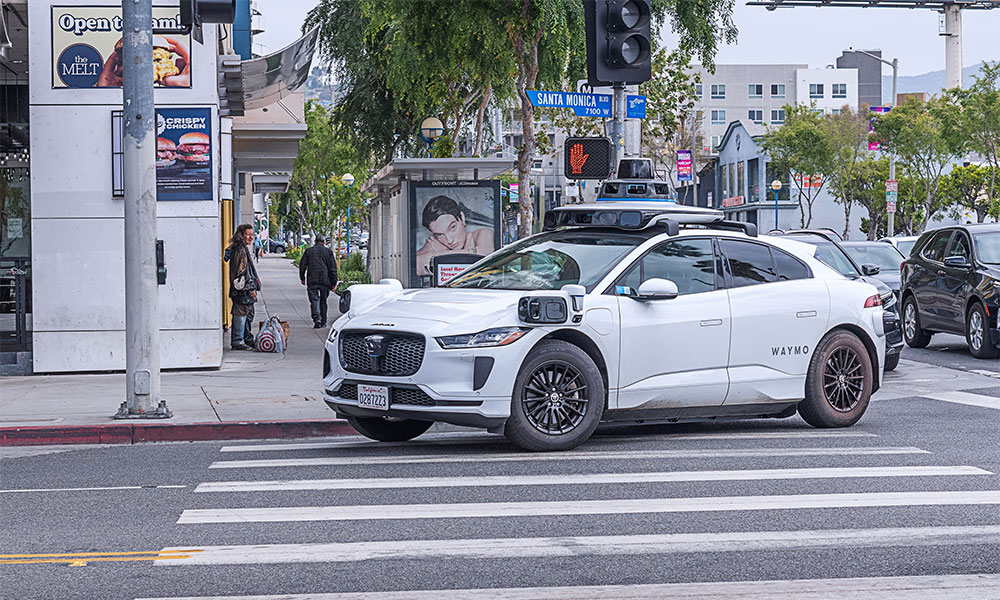
This year saw a remarkable rise in advanced artificial intelligence (AI) tools, now built into everything from transportation and education to healthcare and the workplace. As with every new technology, concerns have emerged over safety, regulation, and the possibility of economic disruption and job loss. Autonomous or driverless vehicles, most notably those operated by Waymo, have been deployed in over 10 major U.S. cities, including Los Angeles, raising questions about traffic safety and liability. Meanwhile, Angelenos continue to grapple with what the growing use of AI in television and film means for the future of an already struggling entertainment industry.
Against this backdrop, our LABarometer survey on Mobility & Sustainability – fielded from February 20 to May 10, 2026, among 1,280 residents – included a series of questions on AI in transportation and Hollywood. We find that only a small minority of L.A. County residents are using autonomous ride-hailing services like Waymo and many remain skeptical of their safety. Still, AI looms large over the entertainment industry, and those working in the industry report financial strain and heightened anxiety about losing their jobs to AI.
Here are the key takeaways from our survey:
1. Waymo use among Angelenos still trails far behind other ride-hailing services like Uber or Lyft and is concentrated among younger, more educated residents.
When asked which types of transportation they had used in the past year to get around Los Angeles, only 5% of Angelenos reported using an autonomous ride-hailing service like Waymo. By contrast, about 28% had used a traditional ride-hailing service with a driver, like Uber or Lyft. Despite the attention Waymo has received in the last year, autonomous vehicles remain a niche mode of travel in L.A. (Waymo is the only autonomous ride-hailing service operating in the county.)

The demographic profile of autonomous ride-hailing users closely resembles that of Uber and Lyft users. Controlling for other key demographic factors, younger Angelenos (ages 18–39) were significantly more likely than other age groups to report using an autonomous ride-hailing service in the last year. Those with a bachelor’s degree or higher were also more likely to do so, even after accounting for household income. Notably, both non-Hispanic White and non-Hispanic Black Angelenos were more likely than other racial or ethnic groups to use an autonomous service.

2. Angelenos feel safer from harassment in Waymos than in driver-operated services like Uber or Lyft – but not safer from accidents.
When asked how safe they feel from harassment or crime while using various forms of transportation, Angelenos rank autonomous vehicles among the safest – second only to a private vehicle. About 23% said autonomous vehicles were “safe” or “very safe” from harassment or crime, compared with about 17% when rating ride-hailing services with a driver (Uber/Lyft). Figures were even lower for public transportation, including the bus (12%) and Metro (6%).
Yet, when it comes to safety from accidents or injuries, Angelenos rated autonomous vehicles such as Waymo the least safe form of transportation, with only 9% considering them “safe” or “very safe.” This trails the share who rate private vehicles (27%), the bus (19%), Metro (23%), and even traditional ride-hailing services like Uber or Lyft (12%) as safe, although the gap with traditional ride-hailing services is not statistically significant. When it comes to traffic safety, Angelenos still feel more comfortable with a person behind the wheel, although it is unclear if that’s because they distrust Waymo’s technology or how other L.A. County drivers will react to autonomous vehicles on the road.


3. The gender gap in perceived safety from harassment or crime is smaller for Waymo than it is for driver-operated services like Uber or Lyft.
Gender differences account for almost the entire gap in perceived safety between autonomous (Waymo) and traditional (Ubert/Lyft) ride-hailing services when it comes to harassment or crime. Women are less likely than men to view any form of transportation as safe, but that gap narrows sharply in ratings of autonomous ride-hailing services. Among men in L.A. County, 23% consider a ride-hailing service with a driver (Uber/Lyft) “safe” or “very safe,” compared with 25% for autonomous a ride-hailing services – little difference. Among women, however, 13% consider driver-operated services “safe” or “very safe,” compared with 21% for driverless services. In other words, women see autonomous ride-hailing services as substantially safer than traditional ride-hailing services, while men do not.

4. In the past year, Angelenos working in entertainment experienced fewer economic gains than non-entertainment workers.
Our latest LABarometer survey asked participants whether they worked in an entertainment-related industry (film, television, radio, gaming, etc.). When we merge this data with our most recent Financial Health Network (FHN) survey from the Understanding America Study (UAS), we find that residents who identify as entertainment workers report fewer economic gains than other workers in L.A. County. For instance, just 31% of entertainment workers in L.A. saw their incomes rise in the past year, compared with 39% of workers in other industries. Entertainment workers were also more likely to be dissatisfied with their finances (52%) than non-entertainment workers (30%).


5. Almost three-fifths of L.A.’s entertainment workers expect AI to replace jobs like theirs in the coming years, compared with 36% of non-entertainment workers.
Compounding this financial dissatisfaction, entertainment workers in L.A. County are more likely than non-entertainment workers to believe that AI will eliminate more jobs like theirs than it creates. Last year, many of these survey respondents were asked by the UAS about their attitudes towards AI. After merging those survey responses with responses to our LABarometer survey, we find that 36% of workers in other industries expect AI to eliminate more jobs like theirs, compared with 59% of entertainment workers. Entertainment workers also assign a higher risk of losing their own job to AI within the next five years (30%) than workers in other industries do (21%).


6. Entertainment workers’ AI anxieties rank near the top among L.A. County industries.
Comparing entertainment workers with other industries shows just how elevated their anxieties are. When we merge our LABarometer results with responses to the UAS employment survey – in which participants were asked to report the industry they work in – we find that self-identified entertainment workers in L.A. expect AI to reduce jobs at a much higher rate than L.A. workers in nearly every other industry. The only industry comparable to entertainment in its fear of AI-related job loss is administrative/waste management services.

To learn more about these and other mobility and sustainability issues in L.A., check out our tracking report, topline, or visit our website. You can also join our mailing list to receive LABarometer newsletters and survey updates.
The LABarometer Mobility & Sustainability survey tracks neighborhood transportation and environmental attitudes and behaviors in Los Angeles County, inspired by county-wide efforts to reduce automobile congestion, minimize environmental impacts, and increase resilience to climate change in the region. Wave 6 of the Mobility & Sustainability survey was fielded from February 20, 2026 – May 10, 2026. A total of 1,280 Los Angeles County residents participated. Participants were recruited from the LABarometer Panel, and the survey completion rate was 71%.
LABarometer is managed by the Center for Economic and Social Research at the USC Schaeffer Institute for Public Policy & Government Service.
