


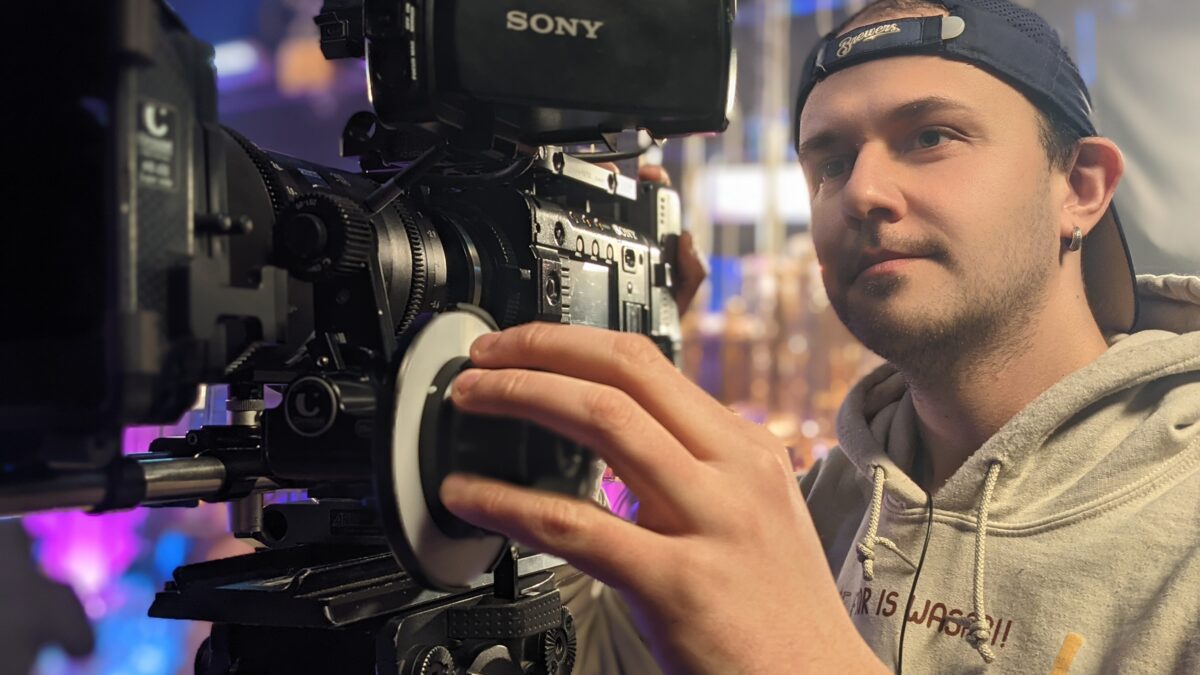

Ukrainian camera operator and director of photography Serhii Koshelenko is building a new approach to the visual language of reality television, merging real, unscripted stories with a cinematic aesthetic in the frame. What allows him to deliver meaning to viewers and hold their attention,is a deep understanding of how people behave in front of a camera, combined with a command of light.
His career spans more than fifteen years in television production, encompassing popular Ukrainian shows as well as the American PBS documentary series Start Up, a multiple Daytime Emmy Award nominee. He has also worked with The Vessel studio and shot video content for Gunna and Coco Jones. Koshelenko is a member of the Society of Camera Operators and the Television Academy. We talked to him about developing his own methodology for camera work in reality television.
MovieMaker: Why is a reality TV camera operator today more than just a technical specialist?
Serhii Koshelenko: A modern camera operator is a co-author of the story. The job isn’t only to set exposure correctly or record an event — it’s to shape how the viewer feels about the subject, how they come to understand that person’s character and emotions. The storytelling itself depends on the operator’s craft.
In reality TV, there’s no possibility of repeating a moment. You get one chance, and one chance only, to catch the shot. If a subject starts crying, you need to move to a close up in time to convey the emotion happening in that moment. These aren’t professional actors who can do another take on request — they’re ordinary people. If a cast member gets into a conflict or runs out of the room, the operator has to anticipate it and be ready to adapt so that nothing is missed.
A good reality camera operator stays fully focused on the present shot while at the same time, preparing for plan B.
The right tone of light helps convey the story better and underscore the emotion. If a subject has a difficult personality, it’s often better to bring a cooler light into the frame; if they radiate warmth and positivity, warmer tones complete the picture.

MovieMaker:Tell us about your own experience working on popular shows in Ukraine.
Serhii Koshelenko: I’ve worked on major projects, including The Bachelor,MasterChef, X Factor, The Biggest Loser,and many others. I was a director of photography on Single Dad Seeking and also took part in creating the visual style of Supermom. It’s a pleasant feeling — turning on an episode I’m no longer involved in shooting and still recognizing the familiar construction of the frame.
Theses experiences helped me develop a quick reaction to change within the frame. Over those years there were large-scale concert productions, observational documentary work, psychological interviews, conflicts, powerful human emotions — and a great deal of movement in the frame. My focus on what matters has become automatic. That experience gave me the ability to see not only what the lens is capturing, but what’s happening off to the side or overhead, as if I have a third eye that is constantly adjusting to change.
Working on popular shows also taught me about clear communication within a team: when everyone knows their position on set, and can signal a partner with a glance or a gesture about what to do if something goes off plan, everything runs like clockwork.
I’ve also had to serve as lead operator on large shows myself. On one project, I coordinated the work of twelve camera operators and five lighting technicians. That’s an enormous responsibility — not just for my own work, but for everyone else’s results. Planning, discussing ideas with the team, and motivating everyone before the start all demand a considerable reserve of energy. But I truly love what I do.

MovieMaker:You’ve now been working in the United States for almost five years. What have you found interesting about how work is organized here?
Serhii Koshelenko: In the U.S., I joined the production of the PBS documentary series Start Up, which I worked on for the last three seasons. The show has been nominated for a Daytime Emmy Award multiple times.
In my work, I like combining documentarian honesty with a cinematic image. I aim to make the camera help tell the story — without relying on dozens of pieces of equipment to do it.
What I found here was a clear division of responsibility, mutual respect among every member of the team, and an open creative dialogue. Each specialist is responsible for their own part of the work, but everyone still operates as a single team. If your idea makes sense, you can discuss it with the director or the producer without difficulty, and you will be heard.

MovieMaker:You created your own lighting methodology for lighting reality shows. Why do you consider it important for the industry?
Serhii Koshelenko: Over the years, I noticed a real gap in camera-operator education. There is a great deal of material on narrative filmmaking and classical camera craft, but the specifics of an operator’s work in reality TV aren’t described anywhere in a systematic way.
My methodology is a body of practical experience: how to prepare for a shoot, how to analyze a location, which small details deserve attention, and how to build a lighting scheme suited to each story. My guidance helps an operator make the right decisions before a shoot even begins. Clear planning makes it possible to reduce the amount of equipment, cut the budget, and still achieve a more cinematic result. In reality TV, it’s essential not to clutter a location with anything unnecessary, and to maintain a barrier between the camera and the subject. When a subject forgets the camera is there, that’s when we get a genuine emotion. The more fixtures, cables, and stands on set, the harder it becomes to adapt to changing conditions.
MovieMaker: How exactly does your methodology change the visual language of reality TV?
Serhii Koshelenko: I apply principles that are traditionally associated with film. I work with depth of field, background, color, contrast, and natural light
The background should tell part of the subject’s story. If someone runs their own business, their space, the objects around them, the details of their work can say a great deal without a single word. You light the subject — say, a farmer. In the background, a soft beam falls on a crate of apples, and further back, almost out of focus, the fruit trees that feed our subject and his family.
Light is also part of the dramaturgy. It helps the viewer feel the emotion. The operator’s task is to convey reality by placing emphasis through angle and light.

MovieMaker: Your reality TV lighting methodology is publicly available. Why did you decide to share your work with others?
Serhii Koshelenko: Because I accumulated this experience over years, and I see real value in it. Younger operators need to know how to prepare for a shoot, how to make a frame stronger — how a white wall and a small LED light, even under imperfect shooting conditions, can add beauty and deeper meaning. The lighting methodology is useful for experienced operators as well, since it helps with planning and structuring the work.
My methodology is free. I encourage artists to read it, think it through, and apply it in practice. A number of colleagues, both in Ukraine and in the U.S., have used my methods in their own work. I’ve seen positive feedback from the team at Suspilne, Ukraine’s public broadcaster, who used it while working on Bastion of the Exclusion Zone, a documentary about Chornobyl, as well as from colleagues at Sys Production. It would be wonderful if the methodology became known at the schools that train camera operators, so that there could be even more high-quality reality television.
