


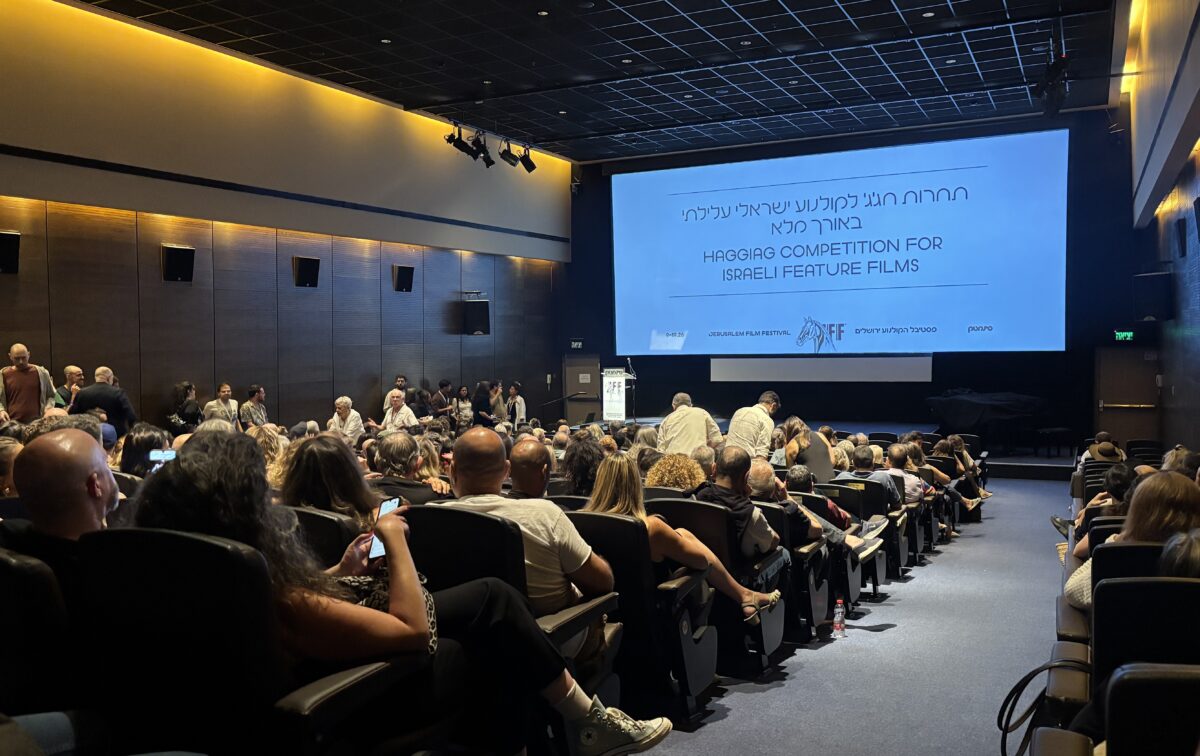
I recently returned to New York from a week at the Jerusalem Film Festival, where I had the honor of serving on the jury for the Spirit of Freedom Award. Beyond seeing an extraordinary lineup of films, I spent the week meeting with filmmakers, producers and industry leaders, gaining an even deeper understanding of the challenges facing Israeli cinema today.
The Jerusalem Film Festival, founded by Lia van Leer and centered at the beautiful Jerusalem Cinematheque, has long been one of Israel’s most important cultural institutions. It is a place where filmmakers from all walks of life present their work, and where audiences come together to engage with ideas through great and sometimes challenging movies. In a country that often feels deeply divided, it remains one of the few spaces where art breaks through the politics and culture brings the community together to engage with timely questions, all while being entertained.
At the 2026 Jerusalem Film Festival.
Yet this year, one message emerged repeatedly in conversations with filmmakers: Israeli cinema is under pressure from every direction, and it needs help to survive.
Before the backlash against Israel that followed the horrors committed on Oct. 7, 2023, Israeli productions benefited from strong international partnerships and co-production support from around the world, particularly from European film funds and producers. Since then, most of those collaborations have been suspended and collaborations with Europe have been significantly reduced, forcing filmmakers to seek new sources of financing. (The Israeli cultural ministry has also been putting major limitations on the Israeli film industry, from opposing its Academy Award selections to creating a smear campaign against filmmakers.)
In response, the Israel Film Center at the Marlene Meyerson JCC Manhattan, the leading refoundations and individual donors, has been working to help fill that gap. Through a variety of initiatives, we have helped secure significant funding to support Israeli film productions during this challenging period, allowing Israeli stories to continue to be told
The results were evident in Jerusalem. Four films supported through our efforts premiered at the festival, including “Tell Me Everything,” the acclaimed Sundance selection that opened the festival for an applauding audience of 30,000. But during the course of the week, I also realized something important: funding production is only half the battle. These films must also be seen. Showing the complexity (and even the normal drama) of Israel is more important now than ever.
Today, many Israeli films face growing obstacles in reaching audiences. Some international festivals have become reluctant to program Israeli films, while distributors often weigh political sensitivities alongside commercial considerations. The result is that remarkable works of cinema, films that deserve to be evaluated on their artistic merit, too often struggle to find distribution and rarely have international releases.
Before Oct. 7, Israeli films were adored in Europe and released widely. Even in the United States, where audiences do not take as easily to foreign films, Israeli films could find a mainstream release. Now, distributors hardly consider them out of fear of a backlash or simply a limited coverage, which will lead to smaller audience numbers.
Despite Israel’s presence in the headlines, most Israeli films are not about war or religion. They are stories about families, friendships, aspirations, humor, grief and the complexities of everyday life. Many are beautifully crafted, deeply human works that reveal the diversity and nuance of Israeli society, qualities often missing from news coverage. By bringing these films to audiences, we encourage empathy, foster dialogue and offer a richer understanding of Israel through the power of cinema.
That is why the next chapter of support for Israeli cinema must also include helping these films get seen. We need to invest in supporting film releases and bringing these films to the public. By supporting distribution, expanding theatrical partnerships, strengthening educational outreach and creating new opportunities for exhibition across North America, we can ensure that these stories continue to spark conversation, challenge assumptions and connect people through shared humanity.
But most importantly, go see Israeli films wherever you can, at your local Jewish film festival, or at a brave independent arthouse. Israeli narratives need to be heard, and your viewership matters.
Isaac Zablocki is the senior director of the Carole Zabar Center for Film at the Marlene Meyerson JCC Manhattan and the director of the Israeli Film Center, the leading presenter and reer of the ReelAbilities Film Festival
