


Production Is Up, Spending Is Down: What the Numbers Say About Film and TV in 2026
Production
News
Production Statistics
Film Production
Television Production
Production Spending
Film Crews
Los Angeles Production
California Film Incentive
UK Production
Canada Production
Australia Production
Georgia Film
Production Locations
Film Incentives
By Marc Alexander
August 25, 2026
13 minute read
Last Updated:August 28, 2026 9:31am
Add M&E as a preferred
The latest production data shows an industry making more films with less money, fewer scripted series, and shifting billions of dollars between competing production hubs, leaving crews and vendors with a recovery that still feels uneven.
Film and television production is no longer in the free fall that followed the strikes, streaming retrenchment and studio cost cutting of the past several years. But the numbers also do not show a return to the production boom that preceded them.
Instead, a new pattern is taking shape: more projects in some parts of the business, less money overall, fewer scripted series, heavier concentration in premium productions and increasingly aggressive competition between production hubs.
Multipleductions beginning principal photography in 2025, up 8% from 1,213 in 2024. Yet estimated committed production spending on those projects fell 5%, from $43.3 billion to $41.4 billion
That apparent contradiction is more productions, but fewer production dollars. This may be one of the most important statistics for crews and production suppliers trying to understand the current market.
Feature films accounted for almost all of the increase. 829 features starting production in 2025, a 19% jump from 695 the year before. Feature spending rose only 3%, however, from $13.3 billion to $13.7 billion.
Series moved in the opposite direction. Scripted television starts fell 7%, from 518 to 481, while estimated series spending dropped 8% to $27.7 billion. It is estimated that scripted series spending is now 23% below its 2022 level. I find this surprising, as I thought streaming services and networks were trying to create more binge-worthy series. Apparently not.
The result is an industry generating work differently than it did during Peak TV.
More films, but much of the growth is at lower budgets
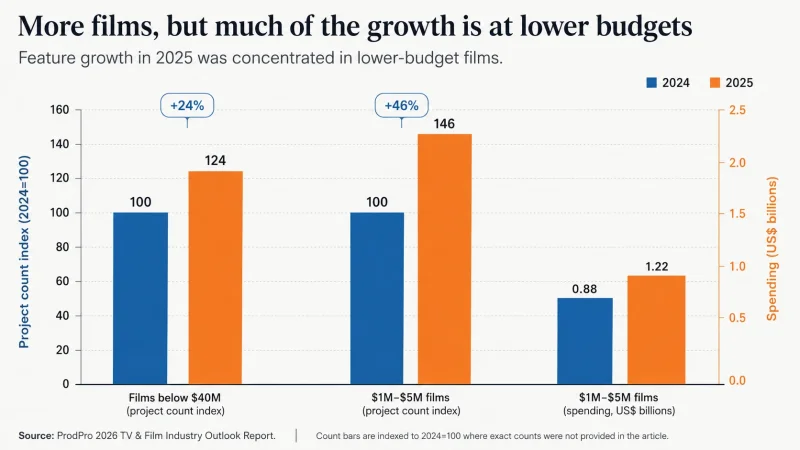
The feature film recovery has being driven disproportionately by smaller films.
Statistics have shown that the number of films budgeted below $40 million increased 24% in 2025, with independent projects returning after financing problems held back many productions in 2024. In the $1 million to $5 million budget tier alone, estimated spending increased from roughly $880 million to $1.22 billion as the number of projects rose 46%.
The $40 million to $100 million range continued to contract.
That leaves production increasingly polarized between relatively inexpensive films and a smaller group of very expensive studio projects.
A $4 million independent feature and a $100 million studio production may each count as one production start, but they generate dramatically different amounts of stage rental, equipment demand, construction, transportation, payroll, visual effects, post-production work and crew employment.
A rising project count therefore does not automatically mean a comparable recovery in industry employment.
The production map is being redrawn
Where that money is spent is changing almost as significantly as how much is being spent.
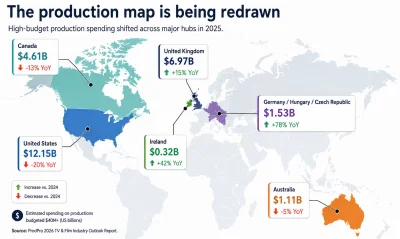
For productions budgeted at $40 million or more, it is estimated that U.S. production spending at $12.15 billion in 2025, down 20% from the previous year. Canada was down 13% to $4.61 billion.
The United Kingdom moved in the other direction, increasing 15% to $6.97 billion.
The combined Germany, Hungary and Czech Republic market increased 78% to $1.53 billion, while Ireland rose 42% to approximately $320 million. Australia was down 5% at $1.11 billion.
Those figures reinforce how much location decisions have become financial decisions.
In a survey of studio executives, it was found that 65% identified tax incentives as one of their three most important tools for controlling production costs. Executives estimated that about 70% of their slates were being produced in the lowest cost
New York ranked first among locations executives were budgeting for in 2026 and 2027, followed by the United Kingdom, California, Georgia and Ireland.
For local crews and vendors, the industry’s contraction is therefore being compounded by redistribution. A production does not have to disappear for one production market to lose the work; it only has to move.
Los Angeles remains well below its former production levels
Few markets illustrate that pressure as clearly as Los Angeles.
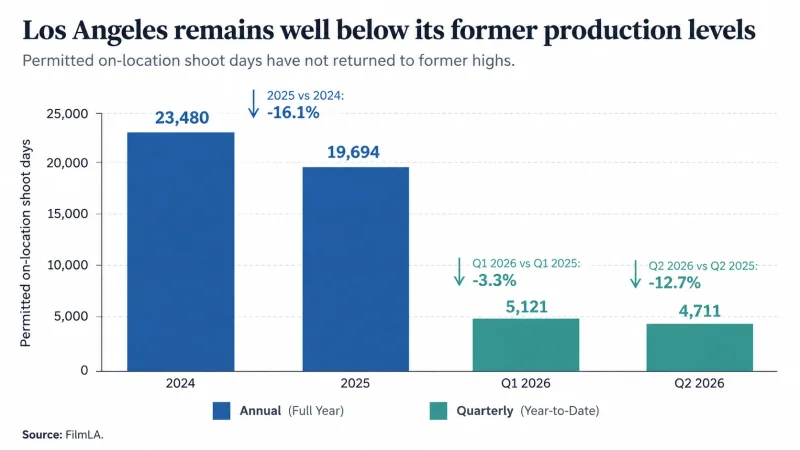
FilmLA recorded 19,694 permitted on-location shoot days in Greater Los Angeles during 2025, a 16.1% decline from 23,480 in 2024.
There were signs of improvement at the beginning of 2026. First quarter production reached 5,121 shoot days, up 10.7% from the preceding quarter, although still 3.3% below Q1 2025. Feature activity was particularly strong during the period, reaching 687 shoot days (52.3% above the same quarter a year earlier).
The second quarter offered a more complicated picture.
Overall activity fell to 4,711 shoot days, down 12.7% year over year. Television improved sharply from the first quarter to 1,607 shoot days, but remained 27.7% below Q2 2025. TV drama recorded 732 days, down a comparatively modest 6.4% year over year, while reality television continued its multi-year decline.
Feature films produced 443 on-location shoot days in Q2, down 19.9% year over year, and commercials fell 21.5% to 543 days.
California’s expanded film incentive is beginning to account for a larger portion of the work that remains. Incentive backed productions represented 38.3% of Q2 TV drama shoot days and 33% of feature film shoot days recorded by FilmLA.
The California Film Commission says the 170 productions awarded credits during the first fiscal year of the expanded Program 4.0 collectively project $6.6 billion in direct California production spending, $2.58 billion in qualified wages and nearly 35,000 cast and crew jobs. Those are projected figures attached to approved productions rather than completed-spend totals, so their full effect will take time to appear in regional activity data.
The UK remains a production powerhouse, but television spending is cooling
The UK’s numbers demonstrate why looking only at total production spending can also be misleading.
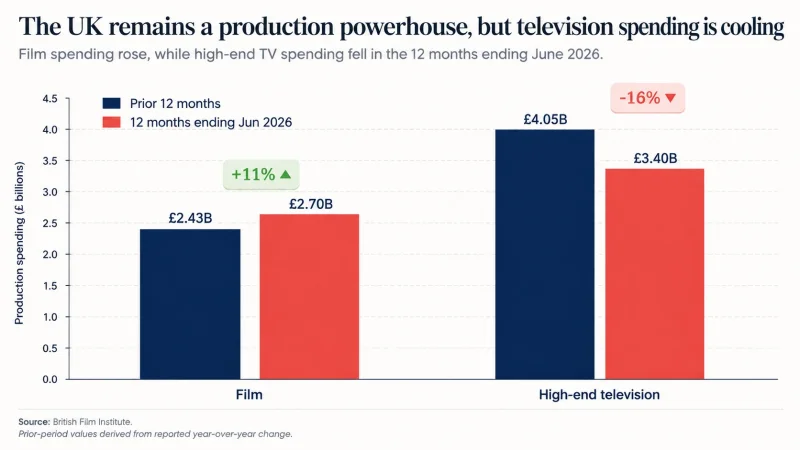
British Film Institute data shows £6.1 billion in combined film and high end television spending during the 12 months ending June 2026.
Film was strengthening. UK feature production spending reached £2.7 billion during the rolling year, up 11% from the revised previous year figure, with inward investment productions accounting for £2.4 billion, or 89%, of the total.
High end television went the other way. HETV spending fell 16% to £3.4 billion.
The divergence became especially visible during the first half of 2026.
Seventy three films began production in the UK during H1, seven more than had initially been recorded during the same period in 2025. Film spending nevertheless declined 6% to just over £1 billion.
HETV starts remained unchanged at 82 productions, while spending dropped from £2.13 billion to £1.69 billion (a decline of roughly 21%).
The UK is therefore still attracting extraordinary amounts of production capital, particularly from overseas studios and streamers, but the latest data points to the same broader trend visible elsewhere: (saying it again) project counts and spending are no longer moving together.
Australia is spending record amounts on fewer local projects
Australia provides an even more striking example.
Screen Australia reported a record A$2.7 billion in drama production expenditure during 2024 and 2025, up 43% from the prior year.
But only 71 Australian titles entered production, down from 89.
Spending on those Australian productions increased 14% to A$1.1 billion despite the decline in project count. Australian theatrical feature spending rose 76% to A$379 million, driven by a limited number of high budget productions.
Australian subscription television and SVOD showed the same concentration.
Spending increased 5% from A$471 million to A$492 million, even as the number of productions dropped from 28 to 18 and hours fell from 135 to 105. Average production cost per hour jumped 44%, from A$3.6 million to A$5.1 million.
International production was the major growth engine. Twenty two international projects spent A$1.3 billion in Australia, a 163% increase from the preceding year. Post, digital and visual effects expenditure also climbed 33% to A$762 million.
Those figures are encouraging for Australian stages, crews, equipment vendors and VFX houses, but once again they show an industry where higher spending does not necessarily mean more productions.
Canada rebounds, while employment stays nearly flat
Canada recorded C$10.17 billion in total film and television production volume during the 2024 and 2025 fiscal year, up 4.6%.
Foreign location and service production was responsible for much of that recovery, increasing 9.5% to C$5.3 billion. The industry contributed nearly C$12 billion to Canadian GDP.
Employment was much less dynamic.
Canada’s screen production sector supported an estimated 181,360 jobs, down 0.3% year over year. Employment associated with Canadian television production declined 6.6%, while foreign location and service production jobs increased 4.6%.
Georgia holds onto production, but at lower spending levels
Georgia’s Film Office reported approximately $2 billion in direct production spending during fiscal 2026, generated by 280 productions.
That compares with $2.3 billion in direct production spending during fiscal 2025.
The state continues to maintain a large episodic production base and substantial studio infrastructure, but the lower spending total reflects the cost pressure affecting U.S. production even in markets with mature incentive programs.
Georgia’s experience is important because the production slowdown is no longer simply a Los Angeles versus everywhere else story. The broader U.S. industry is operating with fewer dollars, and even established alternative hubs are competing harder for the work that remains.

DDA Talent and WPA Merge, Building a Larger Global Agency for Below the Line Talent
Film and TV production starts are rising, but spending and scripted series volume remain under pressure. The latest data reveals where production is moving in 2026.
