


Contact: Erin Flynn
September 22, 2026
KALAMAZOO, Mich.—Most people experience the theatre from the velvety plush seats in the audience. Amber Kolp’s summerinWestern Michigan University’s Gilmore Theatre Complex was different.
“One day I spent almost the entire day digging around in a theatre ceiling,” she says.
Kolp, a theatre design and technical production major from Lowell, Michigan, is among a group of more than 40 students helping carry out major theatre upgrades—and amping up their résumés in the process.
Through a grant from the Irving S. Gilmore Foundation, Western’s Shaw, Williams and York Arena theatres, housed in theGilmore Theatre Complex, are getting an audio and visual technology overhaul.
“Our aim here is to bring to Kalamazoo a theatre-going experience that is on par with major markets—to give our audience all the benefits of state-of-the-art technology. It is also a tremendous opportunity for our students to engage with this equipment and an exceptional example of experiential learning,” saysDr.Joan Herrington, director of the School of Theatre and Dance. “The community will be elevated, the arts will be elevated, and our audiences will have a really unique experience right here in Kalamazoo.”
Over the summer, faculty membersEvan Carlson, B.F.A.’17, assistant professor of lighting design, andJoshua Reid, B.F.A.’10, adjunct professor of sound design, hosted a two-week summerof sound and lighting equipment, from new fixtures and cables to immersive sound systems.
“For the audience, that means enhanced visual quality through crisper and more flexible lighting and the ability to deliver audio from a number of angles through full surround-sound technology,” says Reid. “It will help break through theatre’s infamous fourth wall—the invisible boundary between characters and the audience. They willactually feelpart of the space where the performances are taking place.”
The effort culminated in the installation of a massive LED wall, which will be housed in Shaw Theatre but will be transportable between theatres as well as outside events in various configurations.
“The grant really started with an idea of bringing modern theatrical experiences and modern technology to audiences,” says Reid.
“We’re bringing in the versatility of what theatre is becoming,” adds Carlson. “With a lot of this infrastructure upgrade and the gear, we can take it out of these spaces and bring theatre where it hasn’t been before and reach more audiences.”
In addition to enhancing production quality, upgrades will also include a previsualization suite where lighting, stage management and sound design students can pre-produce their shows in a virtual setting.
“There are elements that we’ve kept from the old system, but how we think about new systems has completely changed, and I think that’s going to open up a lot of doors for the students,” says Reid. “We’ve really raised the bar for them.”
Immersive learning experience
Overhauling an entire theatre system is a massive undertaking, and not something many college students have the opportunity to be part of. More than 40 theatre Broncos jumped at the challenge.
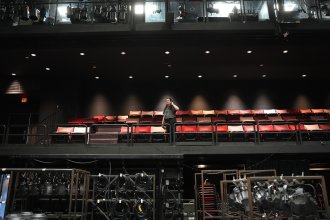
“For me, it was about getting as much experience as I can,” saysAbby Levin, a theatre design major from upstate New York. “[Our professors] have done a really good job making sure we get our hands on everything. I’ve been doing a lot of cable management—running cables, labeling cables—and helping build new audioracksin all three theatres.”
Keith Roelfsema, B.A.’10, works as director of engineering atVizidefLLC, a visual technology service company. He says he was “honored” to return to his alma mater to lead the LED wall installation and teach students how to use it.
“For our scenic design students to have the experience of working with an LED wall, for our sound and lighting students to work with the most up-to-date technology and be able to build these skills and habits that took me 10 years in the professional world to put together—to be able to start that this much earlier is going to give them a huge leg up when it comes time to find a job,” he says.
Reid agrees: “By gaining these skills earlier in their careers, they’re not only going to have a head start when they leave our program,” he says. “They’re going to be ready for more complex and more advanced skills when they start looking for jobs in the industry.”
Kolp is still thinking about potential career options.
“Whether I keep going with theater into sound design or whether I pivot to something else, I think everything I learn here will be incredibly useful.”
Beyond the professional experience, students benefit from working with expert faculty—such as Reid, a Tony Award-nominated sound designer who has worked on multiple Broadway and regional theatre productions—who have excelled in their fields outside of academics.
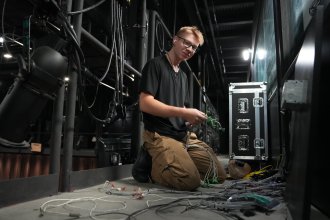
“It’s so important to have faculty who have been or are currently in the industry,” says Levin. “The connections we’ve made through our professors and through our classesmakessuch a huge difference. That’s one of the reasons I chose Western, coming from New York, because this campus has such a strong program, and I think faculty like Josh are a huge part of that.”
Above all, students feel a sense of pride knowing the impact their work will have on WMU Theatre for years to come.
“It’s an amazing opportunity that I’m so grateful to have,” says Ben Franz, a theatre design and technical production major from Brighton, Michigan. “It’s an honor knowing what I’m helping to put together right now is going to be used for generations of students and productions.”
Check out the new technology in action as WMU Theatre kicks off its2026-27 seasonFriday, Sept. 25, with the opening show of Noah Haidle’s “Birthday Candles”inYork Arena Theatre.
For more WMU news, arts and events, visitWMU Newsonline.
