


In an exclusive conversation with ETV Bharat’s Akhil Vinayak, cinematographer NK Ekambaram reveals the technical challenges, train-set innovations and performances behind Yezhu Kadal Yezhu Malai.
Yezhu Kadal Yezhu Malai cinematographer NK Ekambaram interview (Photo: Special Arrangement/ Film Poster)
ByETV Bharat Entertainment Team

Director Ram’s Yezhu Kadal Yezhu Malai is a film built around an unusual world. Starring Nivin Pauly, Anjali and Soori, the Tamil romantic psychological thriller unfolds largely on a moving train, where an encounter between a 32-year-old ordinary man and an 8,000-year-old immortal sets off a chain of events.
For cinematographer N K Ekambaram, creating this world became one of the biggest challenges of his career. The film demanded a very different visual approach, especially because a major portion of the story takes place inside a train. Speaking exclusively to ETV Bharat from Chennai, Ekambaram opened up about his unexpected first meeting with Ram, the making of the train set, the film’s elaborate lighting design and his experience working with Nivin Pauly and Soori.
A friendship that began at a football match
Ekambaram’s association with Yezhu Kadal Yezhu Malai began almost by chance. His son is a football player and studies at MG College, Thiruvananthapuram. During a football match in Coimbatore, Ekambaram discovered that one of the players on the opposing team was director Ram’s son. Ram had also come to watch the match. “I went to see him in person and got to know him. As soon as he saw me, he said, ‘Theriyum sir.’ That was our first meeting,” Ekambaram recalled.
Ram later invited him to his house for coffee. What began as a brief meeting quickly turned into a warm conversation. “In the 10 minutes we spent together, I felt like we had been friends for 10 years,” he said. Before they left, Ram mentioned that he was planning a new film and had not yet decided on a cinematographer. He asked Ekambaram if he would consider working with him and promised to narrate the story in detail in Chennai.
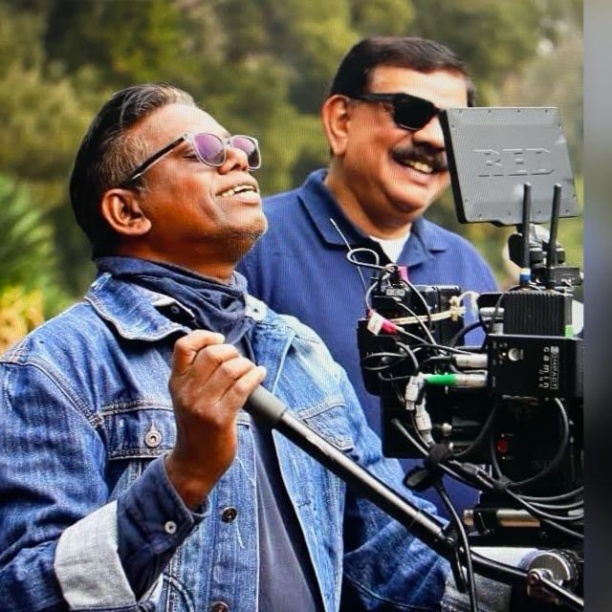
Yezhu Kadal Yezhu Malai cinematographer NK Ekambaram with Priyadarshan (Photo: Special Arrangement)
For Ekambaram, the opportunity was special. He had worked with director SP Jananathan on several films and had long admired filmmakers such as Vetrimaaran, Ram, Bala and Mysskin. “It was a natural desire of mine to work with these directors. I’m so glad I did,” he said.
‘I was literally shocked when I read the script’
The moment Ekambaram read Ram’s script, he realised that Yezhu Kadal Yezhu Malai would be unlike anything he had worked on before. “When I read the script of the film, I was literally shocked. It is a story of a journey,” he said. A large part of the film takes place inside a moving train, with those sequences running for around one-and-a-half hours. The challenge was to make the audience feel that the train journey was constantly changing even though much of the action was restricted to two compartments. “I recognised the challenge of telling the story in a way that takes place only within two compartments,” Ekambaram said.
The train moves through darkness, city lights, rain, lightning and different weather conditions. Each atmosphere had to look different. “Everything should feel like a dream world,” he explained. Ram had already included several visual ideas in the script. That gave Ekambaram a clear understanding of what the director wanted, but also made him realise how demanding the execution would be. “Once the idea is clear, we only need to pay attention to the technical parts. But I was sleepless after realising that this script was such a big challenge in front of me,” he recalled.
Why the train was recreated on a set
Before shooting began, Ekambaram travelled extensively by train along with Ram and other technicians. The purpose was not simply to find locations, but to study how the world outside a moving train changes. “The landscape and culture that change every 300 kilometres were views when we were just travelling, but when we travelled for a film, they became studies,” he said. He observed how light changed during the journey, how the interiors looked while passing through tunnels and how rain, villages and different landscapes altered the atmosphere.
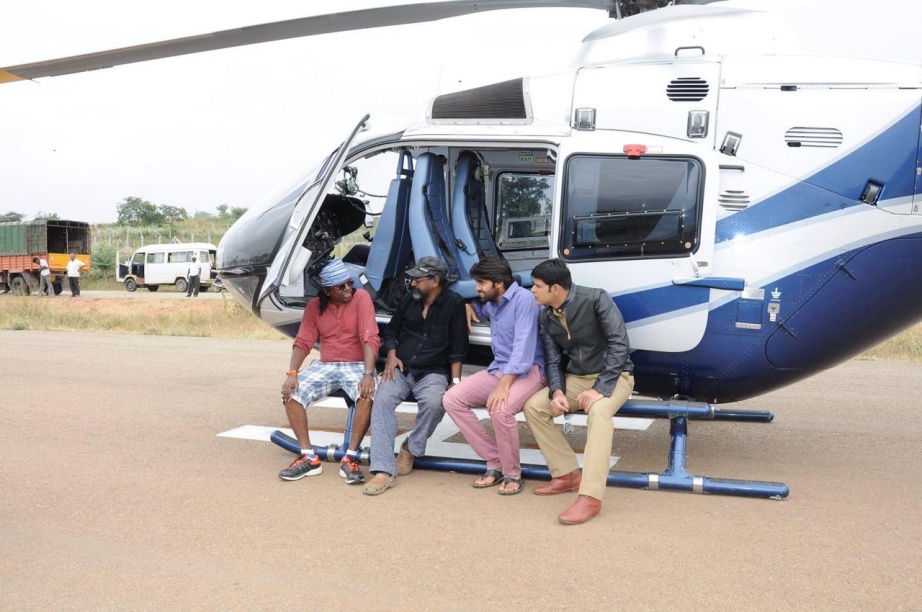
From the sets of Yezhu Kadal Yezhu Malai (Photo: Special Arrangement)
But shooting the entire sequence inside an actual moving train would have created several practical problems. “If you were shooting in a real train, it would take about half an hour to retake a shot. The running train had to be stopped and taken back, so there were many difficulties,” Ekambaram explained. The team also had an elaborate lighting plan that could not easily be executed inside a real train. The solution was to recreate the train at an AR Rahman-owned film studio in Chennai.
Lights that made the train appear to move
The train set became an important part of the film’s visual design. Rather than repeatedly changing lights manually, the team programmed them digitally. The lighting was designed to create the illusion of movement outside the train. As the train appeared to gather speed, the lights moved at the same pace. “When the train was moving fast, the lights also moved at the same speed. The fast movement of the lights made it seem like the train was moving fast,” he said.
Even the signal lights were specially designed. They were positioned and changed according to the timing of each scene. One of the more striking sequences features the train travelling in moonlight. For this, the team created artificial moonlight while the outside world was produced using chroma key and visual effects. “We added the places it passes through with the support of graphics. The original places were shot later according to the speed of the train,” Ekambaram said. The result was a carefully controlled combination of cinematography and visual effects.
The single-shot sequence that took an entire day
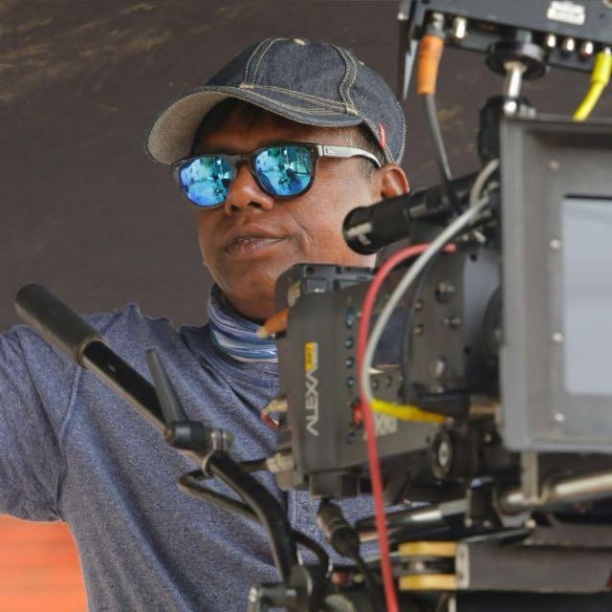
One of the film’s most technically demanding moments is a single continuous shot inside the train. The space was so limited that only the camera operator could enter the compartment with the camera mounted on a gimbal. Ekambaram controlled the frame from outside through a console. Even the focus puller could not travel with the camera. Instead, he worked from outside by estimating the positions of the actors. “It took almost a whole day to shoot that scene. Sometimes the artists would not be in the right position because of the movement of the camera. Sometimes the focus would be lost. Sometimes the camera would lose its rhythm,” Ekambaram said.
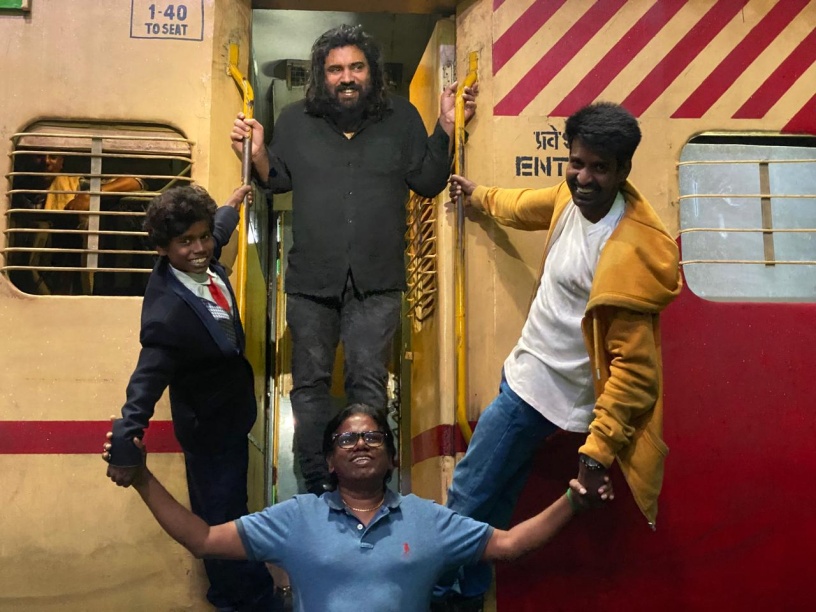
From the sets of Yezhu Kadal Yezhu Malai (Photo: Special Arrangement)
After several attempts, the team finally got the shot they wanted. The cinematographer deliberately avoided revealing more about the scene because he believes it should retain its impact when audiences watch the film. With such a large portion of the story taking place inside the train, the team also had to constantly change lighting patterns and camera angles. “There are only Nivin Pauly and Soori in the train scenes. So we needed different lighting and different camera angles to keep the audience from getting bored,” he explained.
Making Nivin Pauly look like an immortal
Nivin Pauly plays the immortal at the heart of the story. The character has existed for around 8,000 years and has witnessed different eras. Ekambaram said the visual treatment had to reflect that unusual existence. “He is not a god, as you might think. He is someone who was born before the present human race existed. Someone who has seen many eras,” he explained. The character therefore needed a presence that felt almost divine. “When I first saw Nivin Pauly, the director and I thought he looked like Jesus Christ because he came to the set with his hair long and in that shape,” Ekambaram recalled.
Costume also played an important role in creating the character. Ekambaram said the costume design helped establish the character’s appearance and also worked with Nivin’s physical look at the time. But according to him, the biggest transformation happened once Nivin stood in front of the camera. “When I see Nivin on the set, he is just an ordinary guy. A very calm person. But when he comes in front of the camera, I often feel a divine look on his face,” he said.
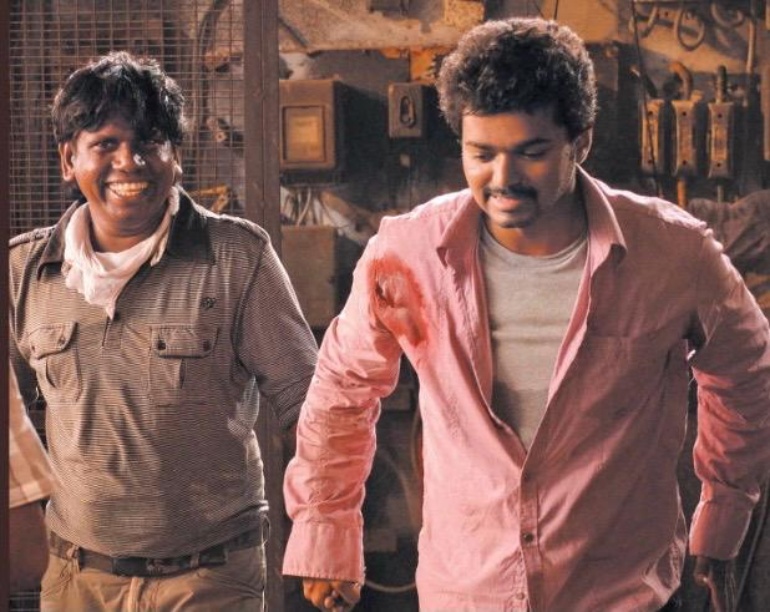
Yezhu Kadal Yezhu Malai cinematographer NK Ekambaram with Thalapathy Vijay (Photo: Special Arrangement)
Ekambaram was particularly impressed by Nivin’s ability to move between emotions without exaggeration. He recalled a scene where Nivin’s character watches Anjali’s character in strong winds and another where he asks her if he can see her the next day. “Nivin’s expression, which looked sad as she walked forward without answering, still remains in my memory,” he said. For Ekambaram, Nivin’s natural acting became one of the film’s major strengths.
A love story that crosses eras
The relationship between Nivin’s immortal character and Anjali’s character unfolds across different eras. He repeatedly searches for her and falls in love with her, while she does not respond to his feelings in the same way. The cinematography had to reflect the changing nature of their relationship. The team chose locations such as Rameshwaram, Vandiperiyar and Vagamon for their romantic portions. Costumes and backgrounds were also designed differently to give each phase its own identity. Ekambaram said around half an hour of the film involves the love story between the two characters.
Why Soori was equally important
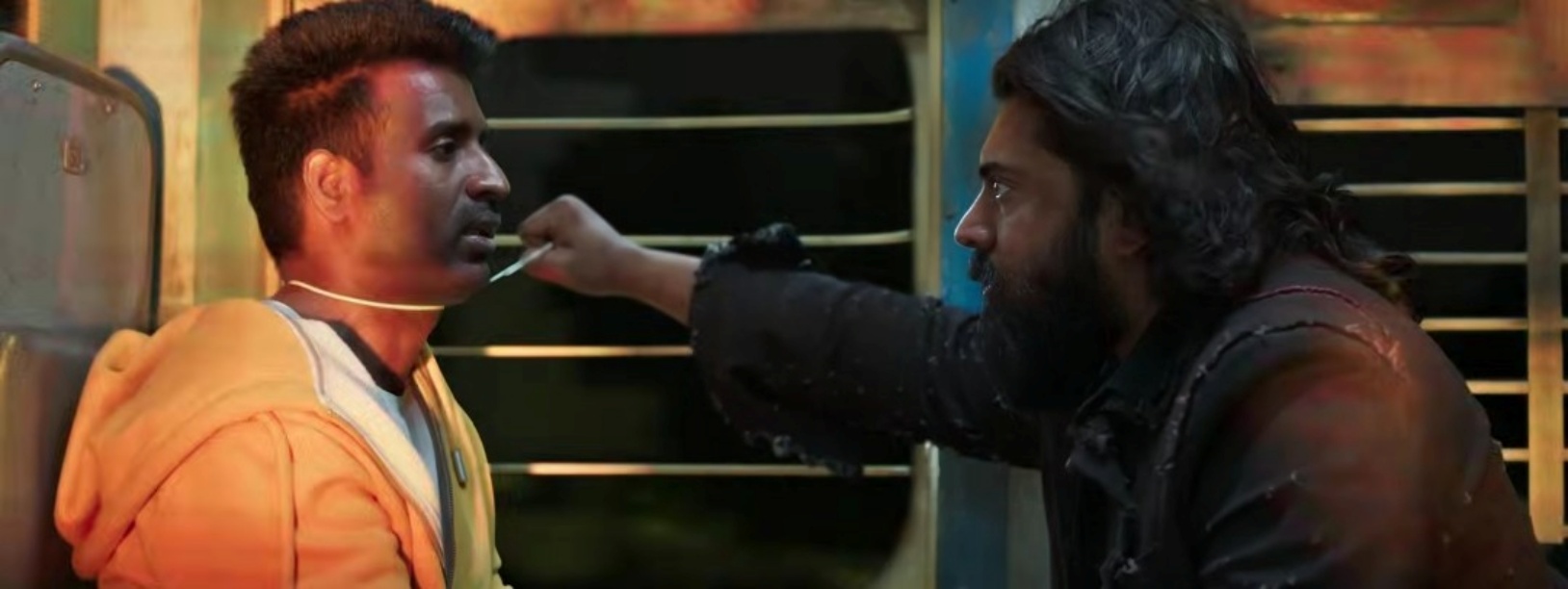
Ekambaram shares a close bond with Soori and said the actor seemed perfectly suited to his character. “While shooting the film, I often felt that his character was written for him. Soori was so fit in that character,” he said. Soori plays an ordinary 32-year-old man who unexpectedly finds himself facing an immortal being. His character goes through fear, confusion, desperation and survival instincts. Sometimes his reactions are comic. At other moments, he becomes aggressive.
Yezhu Kadal Yezhu Malai (Photo: Special Arrangement)
“He is ready to fall at the feet of Nivin’s character and cry, asking him to find a way for him to escape. And if necessary, he can also attack him,” Ekambaram said. The contrast between Nivin and Soori was important because much of the film’s central journey depends on their interaction. “Nivin is someone who acts with great ease. Soori has worked hard to elevate the character by standing opposite him and bringing it together with him,” he added.
‘Do you want to finish or make it better?’
Ekambaram also had plenty to say about Ram’s working style. The director, he said, does not compromise easily. He often asks for retakes even when a shot appears perfectly good to the rest of the team. “Sometimes I wondered why he suggested retaking even shots that seemed good,” Ekambaram recalled. It took about a week for him to understand Ram’s approach. Every retake, he realised, was an attempt to introduce another improvement.
“When he goes to shoot a scene, he has a specific idea in his mind. He keeps trying to shoot that scene until he gets it,” the cinematographer quips. Eventually, Ekambaram also started looking for additional possibilities with every retake, particularly in lighting. He summed up Ram’s attitude with a question that became an important part of his own approach to the film: “Do you want to finish or do you want to make it better?”
Yezhu Kadal Yezhu Malai cinematographer NK Ekambaram (Photo: Special Arrangement)
A big canvas with very few characters
Despite the scale of the story, Yezhu Kadal Yezhu Malai relies on a small group of characters with Nivin Pauly, Soori and Anjali at the centre of the film. The train portions primarily feature Nivin and Soori, with no large group of junior artists. An important forest sequence also features only two characters, while a desert sequence has four smaller characters. “The special thing about this film is that the audience will feel it as a big canvas,” Ekambaram said. That meant the visual treatment had to keep expanding the world even when the number of characters remained limited.
‘Vettam is medicine for stress’
After spending so much time on one of the most experimental projects of his career, Ekambaram has a simple way of dealing with the pressure. He watches Vettam, his first Malayalam film, repeatedly. “I watched my first Malayalam film, Vettam, over and over again. Vettam is a medicine to overcome any stress,” he said.
Yezhu Kadal Yezhu Malai, which premiered at the 53rd International <a href="https://cinemamix360.com/2026/10/03/the-first-ever-muslim-film-festival-is-coming-to-new-york-city-on-oct-11/" title="The first-ever Muslim film festival is coming to New York City on Oct 11″>Film Festival Rotterdam and competed for the VPRO Big Screen award, is scheduled to release in theatres on October 1, 2026. For Ekambaram, the film represents an unusual combination of visual experimentation, technical precision and an ambitious story that moves between an ordinary man, an immortal being and a world shaped by love across eras.
