


- Arts & Entertainment
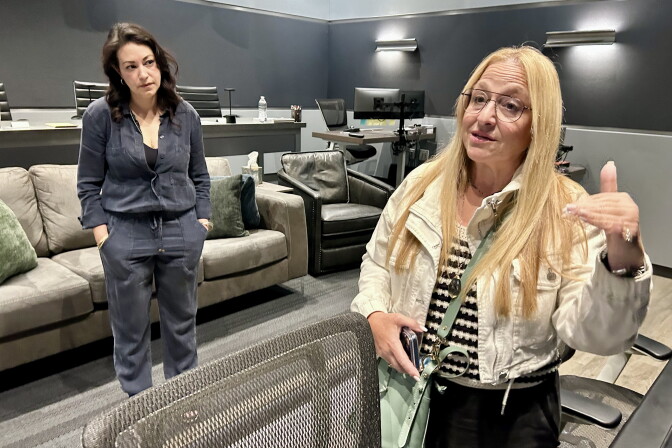
Marielle Abaunza, left, executive vice president of business development at Signature Post in Burbank and Monica Levinson, a longtime Hollywood producer, in one of the facility’s mix stages.
(Adolfo Guzman-Lopez
/
LAist
)
Topline:Advocates say the recently passed post-production tax credit will make California more competitive, but a federal production tax credit may be the blockbuster.
Why it matters:TV and film productions and their post-production work, such as editing, color correction and sound mixing, are being pulled to other states and countries because of attractive tax incentives. It’s hoped this new tax credit will begin drawing work back to California.
Why now:The bill was recently signed into law by Gov. Newsom, although it currently offers $10 million a year, much lower than the $100 million originally asked for. It’s likely to make California more competitive — but a federal production tax credit bill now going through Congress may be the blockbuster. The Motion Picture, Television and Entertainment Revitalization Act is co-authored by Sens. Adam Schiff, a Democrat, and Tim Scott, a Republican. President Donald Trump supports it.
The backstory:California started a tax incentive in 2009 to try to stop runaway productions. The current version of the incentive was extended three years ago.
Read on…To hear about the limitations of the new California post-production tax credit law.
At Signature Post in Burbank, Mariella Abaunza, the post-production company’s executive vice president for business development, shows off a photo of her talking to Gov. Gavin Newsom at the recent signing of AB 2319 at the Television Academy in North Hollywood.

Marielle Abaunza holds a photo of her and Gov. Gavin Newsom at the signing ceremony for California’s new stand-alone post-production tax credit.
(Adolfo Guzman-Lopez
/
LAist
)
She was there with the coalition that lobbied for the creation of a new stand-alone tax credit for post-production work done in California.
“It definitely restored my faith in government. … Advocacy works,” she said.
It was a sizable coalition. Abaunza is president of the California Post Alliance, the post-production industry’s trade group. Leaders of the Motion Picture Association and the Editors Guild were there too.
It definitely restored my faith in government… advocacy works.
— Marielle Abaunza, Signature Post in Burbank
The post-production tax credit is aimed at stopping the flight of TV and film work to other states and countries, attracted by generous tax incentives.
While there are existing tax credits for filming in California, under the new law, productions qualify for a 35% to 50% tax credit if post-production work such as editing, color correction, scoring and sound mixing is done in California, even if the filming was done outside the state.
But industry advocates acknowledge there’s a weakness in the law: Proponents initially asked lawmakers to set aside $100 million for the post-production tax breaks. By the time Newsom signed the bill into law, that amount had been drastically reduced to $10 million.
“That’s going to get used up in a couple days. … It’s not hard to allocate $10 million in post-production in California,” said Stephen Weizenecker, an entertainment lawyer based in Atlanta who advises TV and film productions on how to take advantage of tax credits in U.S. states and overseas.
But he said that regardless of the much lower cap, the credits will make California more competitive.
It’s not hard to allocate $10 million in post-production in California.
— Stephen Weizenecker, Atlanta-based entertainment lawyer
Abaunza hopes it will be a boost for Signature Post. The 6-year-old post-production company, which mixed sound for films and shows like ”Everything Everywhere All at Once,” “American Fiction,” and “Lessons in Chemistry,” has been experiencing a slowdown, like many others.
“We’re still ahead of the game, and we still have the largest concentration of post-production talent of anywhere in the world,” Abaunza said of Southern California.
But she said that post-production advantage has been eroded by new facilities and worker talent in the U.K. and Canada, among other countries.
Monica Levinson, executive producer of FX’s “Love Story,” “Say Nothing,” and many other TV and film projects, points out that those countries have another advantage: a lot more government social services.
She compared that to the U.S. “The one thing that this country has are unions, and it has health insurance, and it has pension plans, and the things that need to be put into the budgets of productions,” she said.
Weizenecker also noted that as much as producers might want to keep production in California or the U.S., they may not be the ones making the decisions about where work is done.
“ If Netflix only gives you so much to spend on the production, including post,” he said, “you’re gonna go where it’s the most cost-effective.”
Federal game changer
While the California tax credit is a step in the direction of keeping productions in the state, a much bigger tax credit is now making its way through the federal legislative process that may be even more transformative.
It’s called the Motion Picture, Television and Entertainment Revitalization Act and was co-authored by U.S. Sens. Adam Schiff, a Democrat from California, and Tim Scott, a Republican from South Carolina. President Donald Trump has also said he supports it.
If the bipartisan birth and early life of the bill isn’t enough to raise eyebrows, what it promises may be: a 20% federal, labor-based tax credit to U.S. TV and film productions where 75% of the days spent on principal photography happen in this country.
The bill would also favor post-production work and extend benefits to productions in some rural areas and places affected by disasters.

Marielle Abaunza is executive vice president of business development for Signature Post in Burbank.
(Adolfo Guzman-Lopez
/
LAist
)
“These things could be real game changers to bring back the work here,” Levinson said. She’s the co-chair of the legislative committee for Producers United, a 3-year-old group that advocates for established TV and film producers. That position led her to join the coalition of groups working to get the federal bill passed.
TV and film production and post-production used to be dominated by California, and L.A. County in particular. But Hollywood, as it refers to what you see on the big and small screen, is a national business now.
“Everybody in this country is behind this federal incentive. And therefore, that’s why it’s become such a bipartisan effort because there’s production in every state right now,” Levinson said.
Supporters have not said how much less money would go to public coffers if this federal tax credit passes.
- News

For more than 20 years, California has levied taxes on health insurers to help fund Medi-Cal, the state’s insurance program for low-income people.
(Jose Carlos Cerdeno Martinez
/
Getty Images
)
Topline:Doctors and health insurers filed a lawsuit Friday alleging Gov. Gavin Newsom and the Legislature violated the law when they approved a healthcare tax that could substantially increase insurance premiums for Californians.
The lawusit: The California Medical Association and California Association of Health Plans say in a new lawsuit that the tax violates Proposition 35, passed by voters in 2024. It claims the recently passed tax on health plans, known as the managed care organization tax or MCO tax, circumvents the 2024 initiative that limits healthcare taxes and directs revenue toward specific purposes. The California Medical Association and California Association of Health Plans filed the complaint with the California Supreme Court.
The backstory: For more than 20 years, California has levied taxes on health insurers to help fund Medi-Cal, the state’s insurance program for low-income people. The state historically taxed private health plans at a lower rate than Medi-Cal insurers, but in June, the Legislature passed a bill substantially raising the tax on private plans. Health insurers said they will pass the cost directly on to consumers, spiking premiums by about $100 per person each year. That means a family of four could pay a $400 annual increase. That would come on top of the rate increases people typically see year to year.
Doctors and health insurers filed a lawsuit Friday alleging Gov. Gavin Newsom and the Legislature violated the law when they approved a healthcare tax that could substantially increase insurance premiums for Californians.
The lawsuit claims the recently passed tax on health plans, known as the managed care organization tax or MCO tax, circumvents a 2024 initiative that limits healthcare taxes and directs revenue toward specific purposes. The California Medical Association and California Association of Health Plans filed the complaint with the California Supreme Court.
“California voters passed Proposition 35 and made it law. The state does not get to ignore that law simply because following the law is inconvenient,” medical association CEO Dustin Corcoran said in a statement.
Newsom’s office did not immediately respond to a request for comment. H.D. Palmer, a spokesperson for the Department of Finance, said in a previous statement to CalMatters that the state wanted to balance the affordability concerns of privately insured patients against large-scale federal Medi-Cal cuts.
Newsom stopped short of opposing the 2024 initiative when it was on the ballot, but he warned at the time it would “hamstring” the state budget.
For more than 20 years, California has levied taxes on health insurers to help fund Medi-Cal, the state’s insurance program for low-income people. The state historically taxed private health plans at a lower rate than Medi-Cal insurers, but in June, the Legislature passed a bill substantially raising the tax on private plans.
Health insurers said they will pass the cost directly on to consumers, spiking premiums by about $100 per person each year. That means a family of four could pay a $400 annual increase. That would come on top of the rate increases people typically see year to year.
“California is breaking the law by blowing through a tax limit voters put in place to protect Californians and businesses from higher health care costs,” said Charles Bacchi, CEO of the health plans association.
Doctors, hospitals, clinics and Medi-Cal insurers have argued for many years that the revenue from the tax should go toward improving Medi-Cal. They said that the state was inappropriately using the money to replace general fund spending, and that many providers were being paid far less than their services cost. In 2024, they asked voters to approve a limited tax that would be reserved for Medi-Cal improvements.
But Congress last year changed the rules on taxes used to generate revenue for healthcare, including the ones imposed on health plans. Rather than lose the money generated by the tax, Newsom proposed and the Legislature agreed to submit two taxes to the federal government for approval: one that complied with the 2024 initiative but would be rejected by the feds, and one that complied with federal regulations and largely disregarded the initiative.
Supported by the California Health Care Foundation (CHCF), which works to ensure that people have access to the care they need, when they need it, at a price they can afford. Visit www.chcf.org to learn more.
This article wasoriginally published on CalMattersand was republished under theCreative Commons Attribution-NonCommercial-NoDerivativeslicense.
- Sponsored message
- Education

A student makes their way to Wheeler Hall at the University of California, Berkeley, on Feb.19, 2026.
(Christina House
/
Los Angeles Times via Getty Images
)California could create its own multi-billion-dollar science and health research agency under a bill signed by Gov. Gavin Newsom Wednesday, helping to fill a gap left by the politicization of science under the second Trump administration.
Why it matters:The bill places a $7.5 billion bond measure on the March 2028 ballot to pay for the creation of the California Foundation for Science and Health Research. The new state agency would provide grants and loans for projects in public health, climate science, agriculture and other areas. Panels of scientists would review proposals, and the agency would develop rules allowing the state to share in some of the profits from inventions made with its support.
The backstory:The Trump administration canceled nearly $2 billion in research grants to the University of California beginning in early 2025, later acknowledging in court that officials searched for keywords such as “health equity” and “sexual orientation” in order to decide what to cut. While a court order restored much of the money, the National Science Foundation has since slowed grantmaking nationwide, and President Trump has proposed giving political appointees more power to veto National Institutes of Health grants that don’t align with his agenda.
What’s next:Voters will decide in a year and a half whether to fund the idea, which the University of California has championed.
California could create its own multi-billion-dollar science and health research agency under a bill signed by Gov. Gavin Newsom Wednesday, helping to fill a gap left by the politicization of science under the second Trump administration. Voters will decide in a year and a half whether to fund the idea, which the University of California has championed.
Approved by state lawmakers at a time when federal science funding has become increasingly unpredictable, the bill places a $7.5 billion bond measure on the March 2028 ballot to pay for the creation of the California Foundation for Science and Health Research. The new state agency would provide grants and loans for projects in public health, climate science, agriculture and other areas. Panels of scientists would review proposals, and the agency would develop rules allowing the state to share in some of the profits from inventions made with its support.
“Scientific advancements are curing and preventing diseases, improving the lives of people living with chronic conditions, protecting our communities from wildfires, lowering the cost of food, and powering our economy,” the bill’s author, state Sen. Scott Wiener, said in a statement. “We cannot allow the federal government to throw away that hope for a better future.”
Newsom joined Wiener to sign the bill Wednesday atop the Golden Gate Bridge, a landmark built with voter-approved bond money in the 1930s that his press office described as a symbol of California ingenuity. He said the proposed science agency “does the opposite of what Donald Trump is doing (and) will allow us to double down on what makes this state great.”
It was a dramatic comeback for a measure that almost died in the Legislature earlier this year, when a more ambitious $23 billion version of the plan failed to make it onto the November ballot despite bipartisan support.
Researchers from UC Berkeley and elsewhere had joined with UC leadership to lobby for the bond, hosting rallies and inviting lawmakers to a science fair highlighting projects that had seen their funding stalled or canceled by the federal government.
There were plenty to choose from: The Trump administration canceled nearly $2 billion in research grants to the University of California beginning in early 2025, later acknowledging in court that officials searched for keywords such as “health equity” and “sexual orientation” in order to decide what to cut. While a court order restored much of the money, the National Science Foundation has since slowed grantmaking nationwide, and President Trump has proposed giving political appointees more power to veto National Institutes of Health grants that don’t align with his agenda.
This spring, the National Science Foundation canceled an additional $21 million in grants to UC Berkeley, accusing the projects’ lead researchers of accepting foreign funding without disclosing it, a charge some of those scientists denied. UC President James Milliken has called the disruption of federal research funding “one of the gravest threats to the University of California in our 157-year history.”
Lawmakers nevertheless declined to move the science bond forward this spring amid worries about competing demands on state funds – including a housing bond on the November ballot and the possible need to backfill other federal cuts. But negotiations among bill supporters, legislative leaders and the governor over the summer led to the scaled-down version that Newsom signed Wednesday.
Along with the University of California, California State University, private universities, and independent labs would all be potentially eligible for grants from the new state fund. A $7.5 billion state fund would not by itself make up for the instability in federal grants – the UC alone received nearly $5 billion in federal research funding in fiscal year 2024-25. But supporters say it could be especially helpful to researchers in fields such as climate science that are critical to the state’s future but have run afoul of Trump administration priorities.
Berkeleyside partners with the nonprofit newsroomOpen Campuson higher education coverage.
This story was originally published byBerkeleysideand distributed through a partnership with The Associated Press.
- Education

Planada Elementary School, built in 1955 below flood level, damaged by heavy rains and a levee break on Jan. 6, 2023.
(Planada Elementary School District
)A winter of potentially devastating weather driven by what scientists predict to be a massive El Niño event could strain many of California’s TK-12 public schools, experts say.
The backstory:The southern and central parts of the state are expected to be hit hard along with coastal areas, as they were in 2023 when mid-March storms forced the closure of at least 178 schools. Only this time, weather scientists predict El Niño could stress levees to the max, and even bring potential for tornadoes, along with torrential rains, mudslides, storm-driven tides and heavy winds.
Why it matters:Many schools have leaky roofs heading into El Niño, bond records show. Older school buildings are expected to be damaged by El Niño-driven storms. Coastal flooding could be severe as one small oceanfront school braces for El Niño.
Why now:One of the things that makes El Niños so dangerous in coastal areas is that they are known in California for also causing rising tides known as Kelvin waves. They are slow-moving and can raise sea levels for weeks. Some could reach shore as early as October. At the same time, an astronomical phenomenon known as super king tides is expected from November to January, Danial Swain, a climate scientist with University of California Agriculture and Natural Resources, said in an online presentation. “That would probably bring record-breaking coastal flooding this year.”
A winter of potentially devastating weather driven by what scientists predict to be a massive El Niño event could strain many of California’s TK-12 public schools, experts say, likely damaging aging structures and forcing school closures.
The southern and central parts of the state are expected to be hit hard along with coastal areas, as they were in 2023 when mid-March storms forced the closure of at least 178 schools. Only this time, weather scientists predict El Niño could stress levees to the max, and even bring potential for tornadoes, along with torrential rains, mudslides, storm-driven tides and heavy winds.
While district superintendents in especially vulnerable areas are already planning ahead, some schools may be ill-equipped to handle punishing weather. At least 59 California school districts are seeking voter approval for bonds in the November election, and have identified the need to repair or replace “leaky,” “dilapidated” and “decaying” roofs, an Ed
Gov. Gavin Newsom declared a state of emergency on Sept. 21, ordering pumps and sandbags to be stockpiled near vulnerable areas, among other precautions. Federal flood data show roughly 20% of the state’s schools are located within flood plains. In 2023, heavy storms flooded schools in Alameda and Merced counties as well as one near Watsonville, where a levee ruptured.
“Climate-driven El Niño conditions could mean months of dangerous weather, heavy rain, strong winds, deep mountain snow and flooding,” Caroline Thomas Jacobs, director of the California Office of Emergency Services, said at a news conference, adding that the public shouldn’t underestimate “the power of water.”
Preparing for a severe El Niño
As predictions of severe weather spread, there isn’t a school superintendent in an area that the El Niño is predicted to impact “that hasn’t been thinking about this for weeks already,” said Scott Borba, executive director of the California Small School Districts Association. Many small districts have aging buildings — some as many as 75 years old, Borba said.
“You’ve got leaks and dry rot and all the things that a super wet winter is going to just exacerbate,” he said.
While district leaders work with other local agencies during weather emergencies, they are largely on their own when making major decisions, such as whether to cancel school, Borba said.
“Sometimes you have some county office of emergency services’ support. But when it comes to making that decision, that decision lies with the superintendent alone,” he said.
One small school district leader who may soon be making such decisions is Raven Coit, the superintendent and principal of the 61-student TK-8 Peninsula Union School District on the south end of the Northern Humboldt Peninsula in Humboldt County. It’s perhaps the most isolated coastal school in California, roughly 600 yards from the ocean. Dunes often serve as a play area for students.
Coit took steps this year to try to limit storm damage. She had trees cut back and used money saved by deferring other projects to complete much-needed roof repairs. “There was a big storm that caused leaking. I’m proud to say that it won’t rain inside this year,” she said.
But the likelihood of impacts from El Niño remains. The school’s “in a vulnerable spot,” she said. Flooding could cut off access to the only road leading to the school. There’s a backup generator that she’s “trying to figure out if I can make it work.”
While nearly all the school’s students live nearby, many teachers do not, and may not be able to get to work. Local high school students are bussed to Arcata on the mainland — if buses can get through.
She said the school could also turn to remote learning in a crisis.
How El Niño may impact schools in coastal areas
One of the things that makes El Niños so dangerous in coastal areas like Coit’s is that they are known in California for also causing rising tides known as Kelvin waves.
They are slow moving, and can raise sea levels for weeks. Some could reach shore as early as October. At the same time, an astronomical phenomenon known as super king tides is expected from November to January, Danial Swain, a climate scientist with the University of California Agriculture and Natural Re
“That would probably bring record-breaking coastal flooding this year.”
A worst-case scenario “would be an El Niño Kelvin, plus a peak king tide, plus a significant storm,” he said.
A Southern California school leader of one of those districts said it’s bracing for storms.
Don Austin, superintendent of Laguna Beach Unified School District in Orange County, said that living on the coast, “I have seen our beaches get washed away with recent storms and homes destroyed.”
His schools have “roof leaks and other issues that will be heavily impacted by an El Niño,” he said.
The most impactful weather-driven damage to a California school in recent years was in March 2023 when a broken river levee caused the Pajaro Middle school near Watsonville to flood, along with the heavily Mexican immigrant and farmworker community it serves.
The school reopened in 2024. A complete replacement of the entire levee by the U.S. Army Corps of Engineers could take a decade, officials said.
Mark Strudley, executive director of the Pajaro Regional Flood Management Agency, said the agency is spending roughly $1 million to strengthen the levee, and that the breach that led to the school flooding has been permanently repaired. El Niño, he said, is the obvious concern, and the work is aimed at protecting the town of Pajaro and the middle school.
Leaders of the Pajaro Valley Unified School District remain concerned about El Niño, but haven’t identified a temporary site to move students to if the school floods again the district’s executive director of teaching and learning
Asked what the district officials are doing based on their experience with the 2023 floods and the threat of El Niño, Pughe said they are “canvassing local neighborhoods, encouraging families and residents to sign up for emergency alert services.”
Data journalist Daniel J. Willis and staff writer Emma Gallegos contributed to this story.
Edsis on key education issues facing California and the nation. LAist republishes articles from Ed
- Early Childhood Education

Head Start providers say the changes could hurt the quality of of the program, which currently provides wraparound services to low-income children and their families.
(Elly Yu
/
LAist
)
Topline:Early childhood providers in L.A. are concerned about what could happen next to Head Start amid the Trump administration’s proposal to overhaul the program. The public comment period of the proposed rules ends Oct. 6.
The backstory: In August, the administration announced a significant overhaul of the program, stripping it of many of its regulations and imposing new requirements, like teaching in English only. Federal officials said the deregulation would provide for more local flexibility, but providers say it could gut the program.
Why it matters:The Head Start program provides early education and other wraparound services for about 70,000 children across the state. “ It’s a holistic program really designed to lift kids out of poverty and to set them up for future success, so what’s at risk when the standards are changed are a lot of those elements and guidelines that support the program quality,” said Melanee Cottrill, executive director of Head Start California.
What’s next:The public comment period ends on Oct. 6 — after which the administration could finalize the new regulation. It’s unclear when that will be, and experts say the plan could be caught up in litigation.
In August, the Trump administration announced a significant overhaul of the Head Start program, leaving early childhood providers in Los Angeles concerned about their ability to serve low-income children.
The proposed rules strip Head Start of many of its regulations and impose new requirements, like teaching in English only.
The public comment period ends Oct. 6 — after which the administration could finalize the new rule. It’s unclear when that will happen, and experts say it could be caught up in litigation.
Why does the administration want to change the rules?
Federal officials said the deregulation would provide for more local flexibility.
An administration statement said the moves reduce both regulatory burden and administrative costs, allowing for more available slots — as many as 236,000 Head Start slots nationwide — and save $2.2 billion.
“We are removing unnecessary bureaucracy, strengthening nutrition and physical health, trusting parents and local communities, and opening Head Start to hundreds of thousands more children,” said Robert F. Kennedy Jr., the secretary of health and human services. “That’s how we renew the promise of Head Start for the next generation.”
Earlier in the administration, the White House proposed to cut Head Start entirely from the budget but reversed course.
The case against the proposed rules
Head Start providers worry the new rules, if implemented, could be the start of whittling down a program that provides early education and other wraparound services for about 70,000 children across the state.
“It’s a holistic program really designed to lift kids out of poverty and to set them up for future success, so what’s at risk when the standards are changed are a lot of those elements and guidelines that support the program quality,” said Melanee Cottrill, executive director of Head Start California.
For example, Head Start provides support services beyond education, like developmental screenings and dental care, which would no longer be required under the Trump administration’s plan. The new rules would also require documentation beyond self-attestation for families experiencing homelessness.
“Putting a lot of documentation requirements in place would be very onerous for people who are in really difficult circumstances,” said Donna Sneeringer, president of the Child Care Rerams in northern L.A. County. The programopened up a Head Start center at a family homeless shelter last year
The administration’s proposal also sets a 5% cap on administrative costs, down from the current 15%, which Sneeringer said will be hard for nonprofits to implement.
“I think many Head Start operators are really going to struggle to even keep their programs open,” she said.
How you can submit public comment on the proposed Head Start changes
Members of the public have until Oct. 6 to submit comments on the proposed rule change. You can do so by:
- Submitting a comment online:
- Emailing a comment to Deregulation@acf.hhs.govand including the docket number ACF-2026-0595 and/or RIN number 0970-AD30 in the subject line of the message.
Subscribe to Updates
Get the latest creative news from FooBar about art, design and business.

Related Posts
Add A Comment