


Distributed workflows are fast becoming the norm for radio. What does it mean for you? This is one in a series of articles.
The author is VP Sales, Americas, forTieline.
Tieline has delivered wired and wireless IP solutions for over two decades, so it’s not a new concept for us. However, it took quite a long time for many engineers to shift to using IP, as they felt it was safer to use a wired solution like ISDN. It had always “just worked.”
Supercharged acceptance
When the pandemic hit in 2020, it showed everyone that we have the tools to broadcast remotely from anywhere. Since then, centralization has accelerated and new studios have become physically smaller and more flexible to stream live shows, perform audio production, create podcasts and social media videos.
Downsizing was made possible because it is common for radio show hosts, sports commentators, news readers, traffic reporters and syndicated talent and guests to broadcast partially, or entirely, from home.
As an example, Tieline users Don McDonald and Tom Cock are hosts often out on the road away from their flagship studio producing the “Talking Real Money” show. They use a ViA when on the road together, or Tom will use a Tieline codec at his home studio, and Don will use another Tieline codec at his home/mobile studio.
Both hosts can simply dial into the studio (or each other’s codec) for low-latency bidirectional links. Listeners dial into the flagship studio with questions and their audio from phone hybrids is routed to Don and Tom in real-time as a mix-minus.
Nowadays, broadcasting over IP is an accepted practice for radio and television networks around the world. Reliability is enhanced through multiple layers of redundancy with fully automated backup. Tieline employs SmartStream Plus hitless packet switching over multiple wired or wireless IP network interfaces; this technology has set a high standard for resilient IP streaming over the public internet over many years. Technology such as this, along with FEC, RIST and bonded IP, is the gold standard for broadcasting in 2026.
Remotes from anywhere
The ViA audio codec has become an industry standard remote codec preferred by major broadcasters on every continent.
Flexibility is paramount and that’s why Tieline’s newest product, the ViA Duo, provides even greater adaptability for a range of new use cases and workflows.
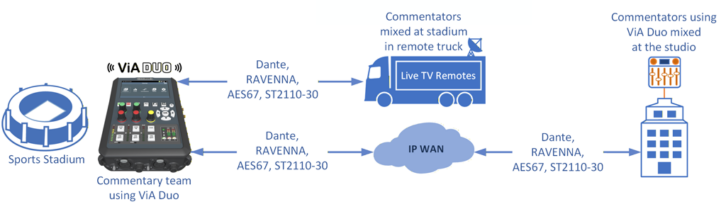
It’s driven by increasing demand for flexible platforms with professional, broadcast-quality connections for critical broadcasts. We see demand for a traditional IP codec, as well as opportunities for more flexible equipment supporting AoIP protocols including AES67, ST 2110-30, Ravenna, Dante, Livewire and NMOS. This allows the same unit to be an audio codec and provide commentary solutions by acting as an AoIP node on a network at a sports venue, or over a managed or dark fiber WAN connection back to a station in a remote integration (REMI) workflow.
Multiple IP remotes
More stations are expanding remote production, given how easy it is to route multiple production signals in and out of the studio. A single Tieline codec at a station can support 32 mono (or 16 stereo) signals in/out of their studio.
As an example, I was recently at the Indianapolis Motor Speedway with the group from Radio One Indianapolis. For the month of May, they weren’t just going live from the track but also producing prerecorded shows remotely for later use. I had the pleasure of seeing them deploy remote gear all over the 2.5-mile track at multiple different locations.
Radio One could handle so many live broadcasts and remote productions simultaneously because they have a large fleet of IP audio codecs back at their home studio. Each remote codec could simply dial back to the studio and be routed straight on-air, or be sent to a production room for recording and editing purposes.
Without their codec network, Radio One wouldn’t have been able to broadcast live from the track and their remote production would not have delivered a real-time solution. Felix Rosenqvist wasn’t the only Indy 500 winner, it was also Radio One’s engineering team and codec network running full speed during the entire month of May!
Merging audio and video
Audio codecs have been used for remote off-tube commentary of major events for several years. By integrating video into an audio codec like the ViA Duo, it means broadcasters can send a live gameday video feed to remote talent directly and commentators can call any event remotely from anywhere in the world.
Software codecs
We have all heard about new technologies merging from software-based services that allow for broadcasting anywhere using nothing more than a laptop and microphone.
However, I believe this isn’t always the most reliable or consistent experience for remote broadcast production. Laptops are truly 100% customizable by the operator and engineer, which isn’t a bad thing, but can lead to issues if not checked.
If installed software is out of place or not updated, services may become unreliable and not connect. In addition, if you are a PC user, regular updates have been known to “accidentally” disturb network and audio drivers, so a simple software update could impact your entire remote.
Of course, one can bypass this issue by either declining to update, changing registry or even opting for a “Long Term Service” edition of Windows.
Ideally, you shouldn’t have to monitor critical software updates to maintain your remote production capabilities. It makes more sense to use purpose-built hardware for which the manufacturer maintains functionality and security updates for you.
With this said, I do believe there is a time and place for software-based solutions, and Tieline itself has the Report-IT Enterprise app for reporting and similar applications. However, for reliability, nothing beats a dedicated hardware solution with multiple layers of built-in redundancy, compared to a cobbled-together PC/software solution requiring more effort to maintain.
Quality through remote control
With teams of announcers and commentators working remotely, it is critical that engineers can remote control their equipment. This helps maintain quality control and provides confidence that if issues occur at a remote site, they can be managed effectively.
For example, tools like Tieline’s built-in Toolbox Web-GUI or the optional Cloud Codec Controller are designed for comprehensive network management, configuration and control of all IP codecs, as well as Report-IT Enterprise app users. This provides confidence that people without technical knowledge can use IP codec technology and stay connected.
Read more on this topic in the Radio World ebook“Audio Production (From Anywhere).”
