


Translated by AIVersione italiana
The Philosophical Research Society is closed when I arrive on a rainy morning. The only sign of movement is that of a few cleaners moving between the low, geometric buildings; otherwise, the place is almost eerily quiet. Everything is painted in shades of cream and terracotta, giving it the appearance of a Mediterranean cloister transported to Los Angeles. A recent article about this society was headlined: ‘We’re not a religion!’ This is where Alia Shawkat wants to meet me. She arrives, apologising for being late; she’d tried to send me a message. We’ve barely had time to introduce ourselves before we’re already talking about New York, art, Los Angeles and that strange way of hers of giving the impression that time has stood still.
The 37-year-old actress is wearing a light white shirt, loose-fitting shorts and brown ballet flats, and is carrying a woven straw basket on her arm. She has just returned from New York, where she spent several months performing in Clare Barron’s play You Got Older. She says she feels a bit out of sorts: ‘As I look at my wardrobe, I hardly recognise the person who used to wear these clothes. I’ll probably do something crazy, like cutting my hair in the middle of the night.”
Loading…
Shawkat has been acting since she was nine. She is best remembered for her role as the precocious Maeby Fünke in the series Arrested Development. Over the past twenty years, however, she has built a career spanning independent films, television, theatre and the visual arts. Her most significant role since Arrested Developmentwas in another TV series, Search Party, in which she played Dory Sief, a drifting Brooklyn Millennial whose obsessive search for a missing woman became one of the sharpest satires of her generation. Her other projects include Green Room, Duck Butter and Atropia, which won the Grand Jury Prize at the 2025 Sundance <a href="https://cinemamix360.com/2026/10/26/tokyo-film-festival-opens-with-pledge-to-boost-japanese-cinema-as-rain-fails-to-dampen-spirits/" title="Tokyo film festival opens with pledge to boost Japanese cinema as rain fails to dampen spirits”>Film Festival.
‘Los Angeles gives you enormous freedom to lose yourself in your own mental universe. For better or for worse,’ she says, as we sit in the bookshop next to shelves full of books on dreams, alchemy and comparative religion. She grew up in Palm Springs, a couple of hours from the city. She chose to meet me at the Philosophical Research Society because it seems like a place steeped in history, in a context and an era where the main obsession is solely with the new. Founded in the 1930s by the mystic Manly P. Hall, it houses a campus filled with his books, his essays and yellowed newspaper clippings framed behind glass. ‘Los Angeles is the city of dreams; it’s as if they’ve actually settled into the ground,’ she observes. Hall wanted this place to be ‘more than just a symbol of Hollywood ambition: a place where that creative energy, made up of desires and encounters, could be felt within its walls’.
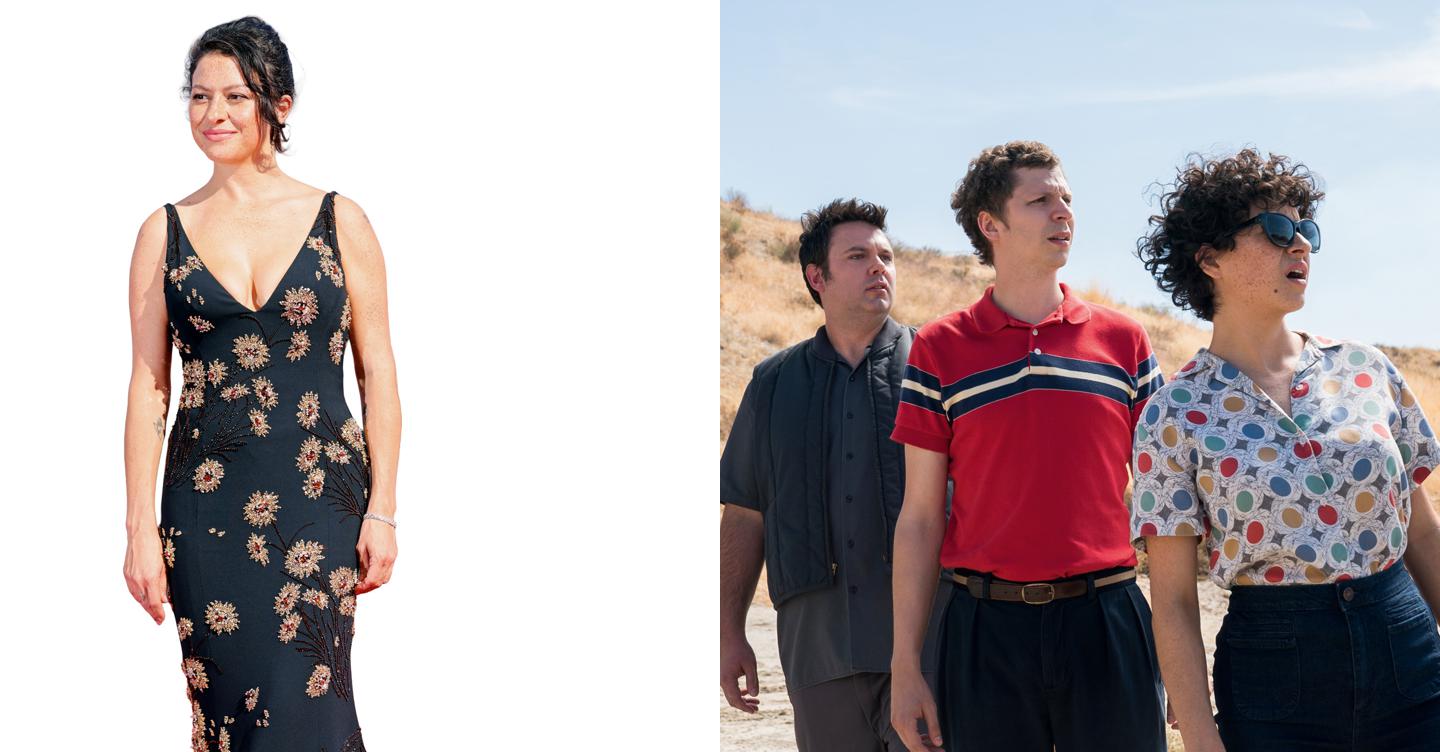
Da sinistra, Shawkat sul red carpet nel 2024; l’attrice in “Arrested Development” con Justin Grant Wade e Michael Cera. ©Saeed Adyani/Netflix. ©
The actress is here to talk about The Wrong Girls, a sci-fi comedy starring Kristen Stewart. The actresses play two vagabond friends under the influence of an experimental substance that sends them on a surreal adventure around Los Angeles. “It feels like a film that came out in 1998,” says Shawkat. “And yet it’s timeless. After all, we’ve never really seen a stoner film (a film genre centred on characters who smoke cannabis, ed.) with female leads. Unfortunately, anything centred on a woman is automatically interpreted through a political lens, and I can already hear the criticism: ‘Just imagine, a girl smoking marijuana!’” The film – written by Kristen Stewart and Dylan Meyer, her wife, and produced by their company, Nevermind Pictures – is ‘a dream come true’, adds the actress. ‘It was liberating to be able to be over-the-top, clumsy, even silly. It’s not often you get roles like this, without the pressure of having to conform to an ideal of composed, flawless female beauty.”
“She’s an incredibly versatile actress,” says Meyer of her. “Her perfectly honed ear for comic timing has given my lines nuances I didn’t even know existed.”
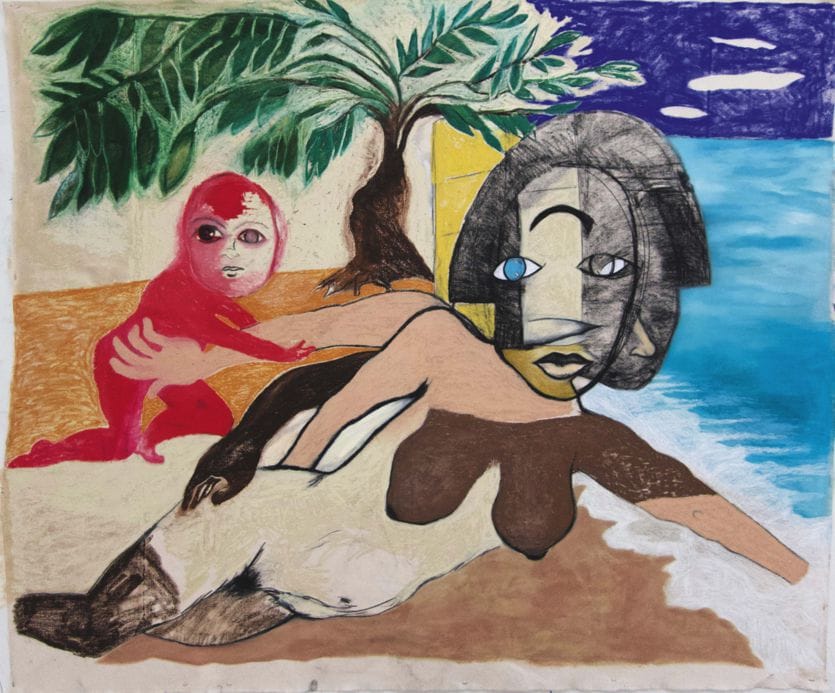
“Mom” (2025), di Alia Shawkat.
Shawkat met Kristen Stewart in 2010, whilst working on The Runaways, a biopic about Joan Jett and her 1970s rock band. ‘We were very young; I was sleeping with a married man and she was still straight. Now, playing two best friends, we really got into character. We were laughing all the time.’
Today, Alia has a young son, and motherhood has made her view her work differently. She no longer says yes just because a project sounds like an adventure: ‘I used to say, “Sure, off to Morocco for a week – why not?”. Now that’s enough – I wouldn’t even go to Santa Clarita if there’s no need to. Things change roughly every seven years.” It’s been almost seven years since Covid now. That pivotal moment sharpened her thinking. ‘I won’t make choices based on the fear of not working enough anymore, but only those that, even if they seem crazy, I know I have to make. The Wrong Girls was, for example, a wholehearted “yes”.’ The plot, after all, echoes her formative years. The actress’s father is an immigrant from Iraq who set up a strip club that became the family business; her mother, an American, initially helped him, but later chose to devote herself to Alia and her brothers. The actress describes herself as a strong-willed and rebellious child, a trait that still sets her apart. “Like when I started smoking weed, going to unauthorised gigs and sneaking out of the house,” she recalls.
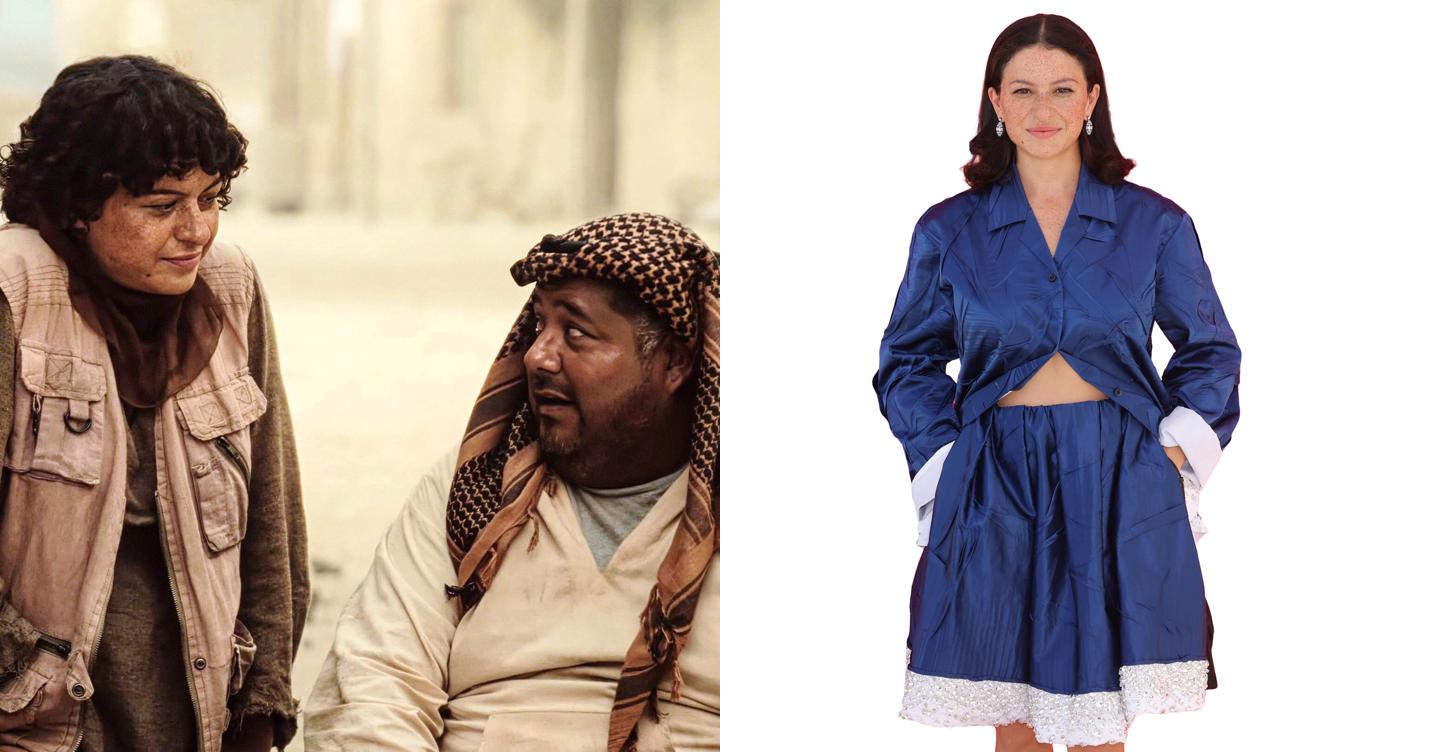
Da sinistra, Alia Shawkat in “Atropia”, 2025; al Festival Internazionale del Cinema di Venezia, nel 2024. ©Everett Collection Inc / Alamy Stock Photo. ©
As soon as she realised that television could be a career, she decided to give it a go. “Child actors were usually dragged to auditions by their parents,” says Shawkat. “In our case, it was me dragging my mum along.” Her parents would drive her from Palm Springs to Los Angeles – a two-hour journey – thinking that acting would remain a side activity. She was just 13 when she filmed the pilot episode of Arrested Development; she played the scheming Maeby alongside teenager Michael Cera. Those were different times: they were still too young to understand some of the jokes, she says, and spent their free time at Fox’s beach parties, playing pranks on the cast of another teen series, The O.C.
Alia is now writing her first film, which she hopes to direct as well, again with Nevermind Pictures – a comedy based on her own family experiences. The screenplay had been stuck in its early stages for years, but she now insists she’ll manage to finish it, ‘come what may’. The actress plays a failed performer who is fascinated by one of the dancers at her father’s strip club. ‘The production team kept asking me why the father didn’t kill the stripper. And I couldn’t help but insist that it would have been impossible, because my father is a good person – he’d never do that.’ The film’s story isn’t so much centred on the family strip club as on the moral ambiguity of growing up in that environment. She recalls entering it for the first time at the age of 21; she watched her father as he arranged the work shifts for the dancers her own age, before turning to her to ask about her plans. The contrast unsettled her. ‘Does my worth depend on my physical appearance?’ she wondered. ‘Why does this quality command such a high financial price? In my case, it was precisely that quality that paid all the household bills. So it’s worth a great deal. Yet I saw girls leading lives completely different from mine, and it was inevitable that I would feel a sense of guilt.’
Loading…
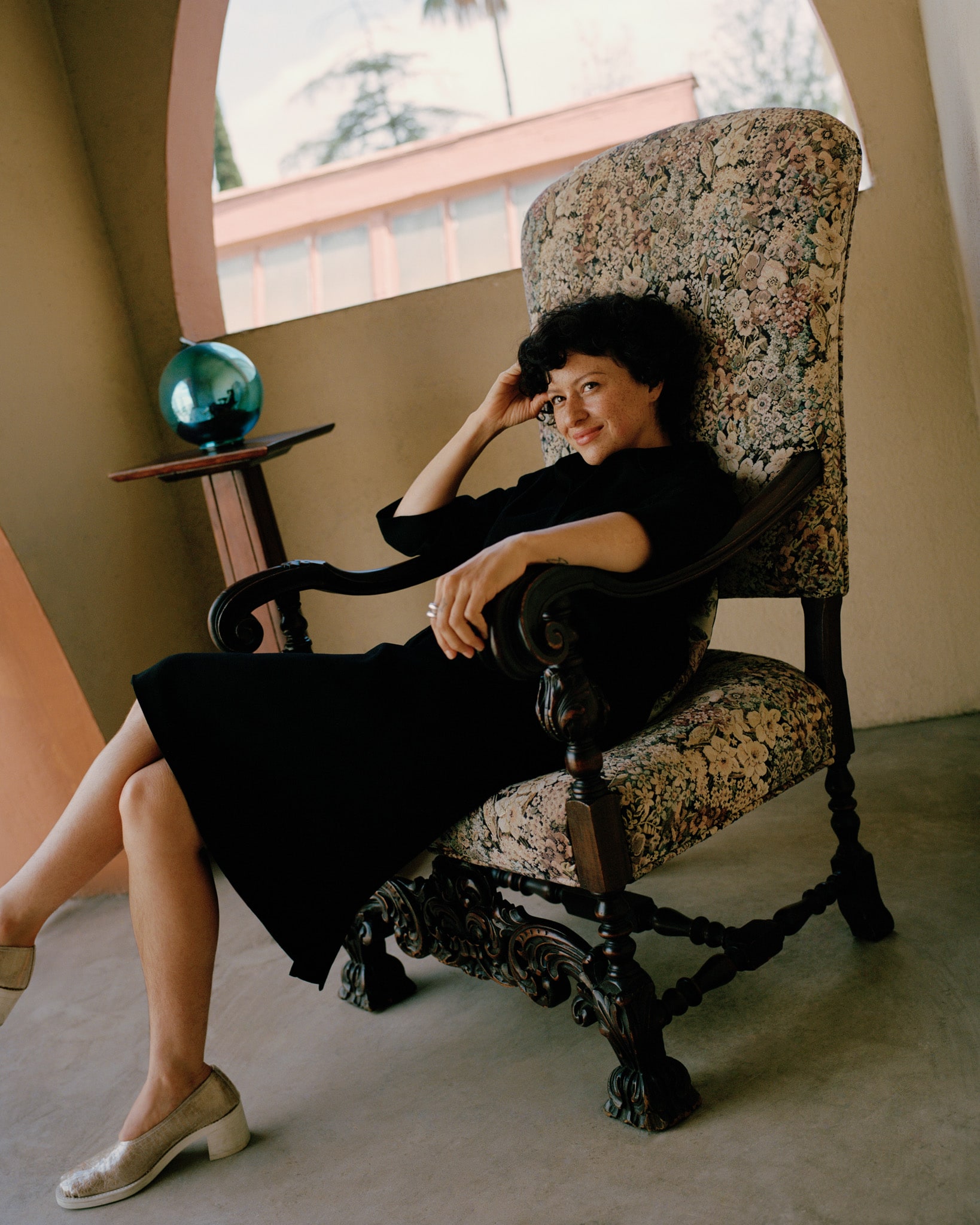
Blazer di lana e gonna coordinata, scarpe con tacco in gomma e pvc, COMME DES GARÇONS. Anelli d’argento, JIL SANDER. Tutto vintage, tramite Scout LA.
Her mother, too, she says, is a true artist – someone who analyses the emotional rhythm of every performance (Shawkat’s maternal grandfather, Paul Burke, was a film and television actor nominated for an Emmy Award). Her father is more down-to-earth. After seeing her perform in New York, her mother spent an evening discussing the themes of pain and healing, which are central to the play. ‘My father, on the other hand, asked me just one question: “So… do you cry every night?”’, she says, affectionately imitating his impassive Iraqi accent. When I tell her that, strangely enough, he sounds just like my Cypriot father, she laughs and agrees with me. “Sometimes it’s like getting blood from a stone,” she admits. He still hopes she’ll make a film with Marvel. “‘Art’s all well and good,’” she says again, imitating him. “‘But it doesn’t put food on the table!’”
Alia Shawkat, like many other actors, realises that a void has emerged within the industry. She has noticed that the best independent scripts – films made on a budget of between 6 and 10 million dollars – are snapped up by big stars such as Zendaya or Emma Stone, because financiers are less inclined to take risks.
‘Everyone complains that it’s tough out there, and I know that all too well.’ What worries her most is that fewer and fewer films are being made by young women. “Perhaps a hypothetical 36-year-old female director might even have a budget at her disposal and pull it off. But it’s very different from a story she’d make at 20. I want to make sure we keep taking risks and making films that are a bit odd. Because in the end, those are the ones people like.”
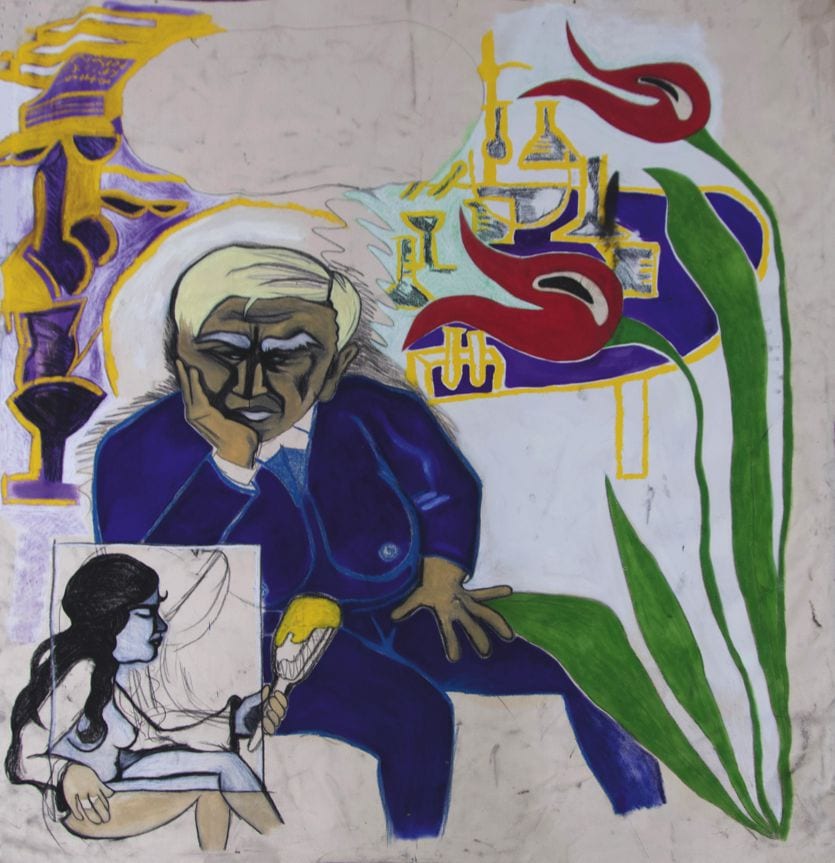
If acting is a public act, Shawkat’s private side finds expression in painting. Last November, she presented an exhibition at Aicon Contemporary in New York entitled puer prima, featuring paintings created over the last five years. These are works on canvas in charcoal and oil, dotted with dreamlike figures, strange creatures and fragments of memories. She explains that exhibiting them has made her feel more vulnerable than when she acts: ‘They’re like Rorschach tests. I’d like people to recognise all their own problems in these paintings.’ She’d expected the opening to be like a film premiere, but instead visitors trickled into the NoHo gallery in small groups throughout the evening. “I felt like an actress just starting out. I thought: ‘It’s a total flop – where’s my red carpet?’”, she recalls with a laugh.
“Alia’s paintings are powerful, poetic and deeply intimate,” says Camila Jahchan, manager of Aicon, which is also the gallery that represents her. “There is a chaos that is only seemingly instinctive: yet it feels deeply authentic and is therefore captivating. Painting becomes a space of comfort, a place where one can let down all defences. And that sincerity is immediately apparent.”
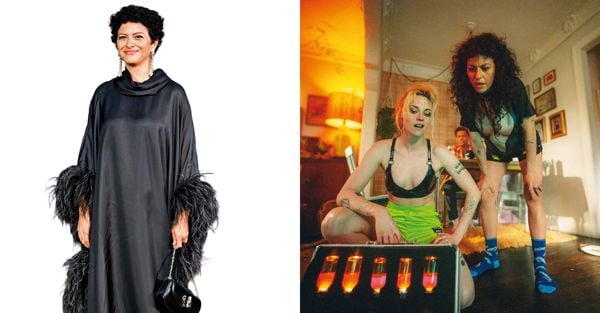
Da sinistra, l’attrice alla sfilata di Gucci P/E 26; Kristen Stewart e Alia Shawkat in “The Wrong Girls”. ©Everett Collection Inc / Alamy Stock Photo. ©
‘Professionally speaking, after a hectic spell in New York, I’m in a phase of reflection. I’m relaxing, and when I draw, I’m able to do so completely, with my whole body,’ the actress continues. She pauses mid-sentence and points over my shoulder: ‘I love these beautiful surrealist images.’ Leaning against a bookcase are esoteric illustrations – an Egyptian goddess draped in pink and a winged lion crowned by a shining star. They remind her of something she misses about painting: slowness. Even film sets move at a fast pace: “We rehearse, we shoot, we move straight on to the next thing. These painters, on the other hand, worked on their pieces for years, and with perseverance, perhaps, after a long time something mad emerges. But if you don’t do it, it can’t emerge.”
We wander around the bookshop of the Philosophical Society. Shawkat picks out a few books on the writer Clarice Lispector and on Maya Deren, an avant-garde film director from the 1940s whom he’d like to portray in a film. ‘She made some truly alternative films, then something terrifying happened to her whilst she was on an island – perhaps linked to voodoo rituals – and she died mysteriously.’
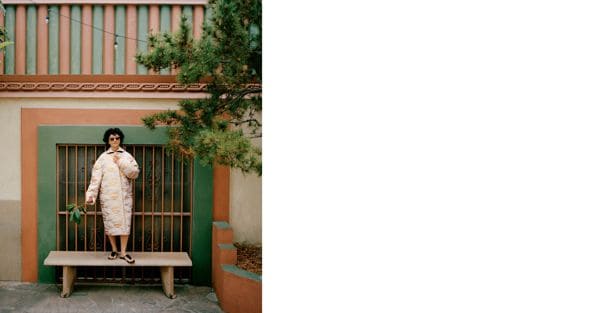
Cappotto jacquard in cotone, lino e lurex, TORY BURCH. Sandali in cuoio e pietre, HERMÈS. Occhiali da sole vintage in metallo e acetato.
Shawkat is getting ready for the photoshoot in a back office, where an old wooden desk has been moved beneath some faded blinds. Whilst she is sitting in the make-up chair, a man carrying a suitcase walks in; his name is James. He explains that he is organising an exhibition featuring 1,400 tarot cards. ‘I absolutely must have you read them for me,’ says Shawkat, thrilled. For James, the tarot has become a second career following his first in the film industry, where he worked as a press officer for films including The Conjuring. Due to some strange occurrences during filming, the production team decided to hire a bishop to bless the set. James insisted that a proper professional be called in (“some can rid buildings of evil, but not people”), so an exorcist arrived, who then read his tarot cards. So, when the film industry let him down, he decided to devote himself to tarot and has never looked back. Shawkat listens, fascinated.
Whilst the make-up artist massages her face with a cold roller, the conversation turns to the trend for full-body MRI scans that’s sweeping through Hollywood. They cost thousands of dollars, and everyone’s having them done to check for tumours, the hair stylist confides. ‘I’ll book one straight away,’ replies Shawkat, searching for one on her phone. All this whilst we’re surrounded by suitcases full of tarot cards.
“What a typical Los Angeles moment we’ve just experienced,” comments the actress. After the photo shoot, she’ll drive back out into the desert – where she grew up and where her parents still live – to celebrate 4 July. She’s ready to take some time out: to paint, write and finish the screenplay she’s been working on for years. “I’m trying to make choices that feel authentic to me,” she reminds me. “And perhaps a little scary.”
Copyright reserved ©
Loading…
Loading…
Newsletter
Notizie e approfondimenti sugli avvenimenti politici, economici e finanziari.
