


Esquire First Look: Pedro Pascal and Tony Gilroy Duet in the Musical Drama Behemoth! – Esquire Singapore
Esquire First Look: Pedro Pascal and Tony Gilroy Duet in the Musical Drama Behemoth!
Pedro Pascal shares how he became a cello prodigy in Tony Gilroy’s drama about sex, orchestras, and being the ultimate player
BY
Anthony Breznican
Published: 28 October 2026
You can’t hide in this room,” Tony Gilroy says.
The Andor creator and Michael Clayton filmmaker is standing amid rows of orchestra musicians in the center of the historic Newman Scoring Stage on the 20th Century Fox lot in Los Angeles, California. It’s where the music for Jaws, The Sound of Music, and countless other classic films was recorded. But on this day, the recording session is part of the actual movie. Pedro Pascal straddles a cello among the dozens of co-stars—who are actual violinists, cellists, French horn players—as they all shoot the opening scene of the musical drama Behemoth!
Gilroy points at the ornate web of microphones dangling from above, and then to the glassed-in control room where a team of engineers are attuned to every whisper. “When that red light goes on, there’s 23 people listening in that room,” he says. “You can hide in a philharmonic. If you’re off. If you’re sick. A concert keeps going and doesn’t stop.”
But here, in this historic space, the precision equipment doesn’t just expose every false note—it records each one for posterity. This is where Alex Serian, Pascal’s virtuoso cellist, discovers he can’t hide anymore. His past, going way back to childhood, is littered with broken promises and false hopes. His love life is a freeway pile-up. His family has disintegrated. All he has is the cello, and now it’s literally time to face more than the music.
“The music is pulling him right from the very beginning of it, pulling him forward to this destiny, pulling him to do everything,” Gilroy tells Esquire during our exclusive set visit. By focusing on the one thing he is good at, the only thing he can execute flawlessly, Alex finds a way to revisit all these broken memories and figure out a new way forward. He’s already a world-class musician, but he’s trying hard to become a better man.
Pascal says Gilroy explained it like Alex was being swept along in a flood. The actor gets choked up as he describes this lost person, grasping for something to hold onto and pull himself out. “He’s on a river,” Pascal says. “I think that the musical notes on the page can be the rope.”
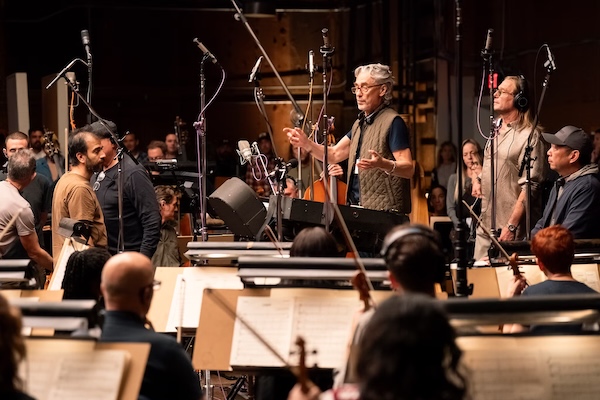
The Newman Scoring Stage is usually off-limits to the public. It’s not an exquisitely styled concert hall. It’s an open space big enough to be a basketball court, but not big enough for spectators. The wood panels affixed to the walls look like they’re in someone’s unfinished basement, ready for plaster and a paint job. It’s named after nine-time Oscar-winning composer Alfred Newman, who won awards for 1939’s Wuthering Heights, 1950’s All About Eve, and 1970’s Airport, released the year he died. It was renamed for him in 1997, but this is the first time the Hollywood workspace has been one of the stars of a movie itself.
In the film—scheduled for a 4 December release—Pascal’s character has abandoned the world of symphonies and concerts and has returned to his hometown of Los Angeles, where he finds work as a session musician working on movie scores.
Behemoth! doesn’t have one single composer—it has nine. Each of them contributed themes for the various fictional films that hire Alex as a performer. Henry Jackman, best known for Kick-Ass and Captain America: Civil War, penned the tense tones of the made-up Spies Don’t Run, which you can hear a sample of below.
Among the other contributors are Back to the Future composer Alan Silvestri, Marvel Studios and Pixar mainstay Michael Giacchino, Moana 2 co-writer and Beyoncé pianist Emily Bear, Get Out and Nope maestro Michael Abels, and The Hunger Games and Batman Begins composer James Newton Howard. The film also features composers Lukas Frank (singer-songwriter with the band Storefront Church), Nami Melumad (Star Trek: Strange New Worlds) and Brandon Roberts (an Emmy-winner for Free Solo). Each contributes a different flavour to the story, underscoring the fact that Behemoth! is sometimes a romance, sometimes a family drama, sometimes a farce, and occasionally even a cartoon.
As Alex plays the music for these various movies, he unlocks more memories from harrowing times: His late composer father (Hank Azaria) pushed him to extremes before exiting the stage and leaving it all unresolved. Now Alex must face the gradual decline of his harp-playing mother (JoBeth Williams), who is battling Alzheimer’s disease. He has a loving but fraught relationship with his brother (Will Arnett), a rockstar turned podcaster, who—if it’s not already clear from that description—has fallen on hard times.
Then, there are the women in his life, which he has helped make into a symphony of disorder. Olia major symphony benefactor—and can’t abide her favourite player moving on. Margarita Levieva is an old friend and sometimes lover who reopens old wounds, and Eva Victor is a fellow musician he once cared for deeply, who abandoned him with a head full of unanswered questions
“The one language he understood best was music. So that’s just something that he simply had to cling to,” Pascal says. “Now, the second language that he is probably better at is lovemaking—and not in any kind of Casanova way, but simply as a pure form of existing and expressing himself and being connected. The rest makes less sense to him. It’s so hard for him to navigate using words to express how he’s feeling. It’s all in his playing.”
Gilroy says it was vital to cast someone like Pascal, who could bring a sense of wounded innocence to Alex. “He’s obviously damaged by this toxic family that he came from,” Gilroy says. “He’s not a predator in any way, but he’s a very sensual person and a lot of women have been attracted to him.” He adds with a laugh: “And he’s really easy.”
But none of this has given Alex the comfort and stability he seeks. “I get a little emotional because it’s such a subtle thing that Tony’s done,” Pascal says. “It’s healing in a way that Alex isn’t completely conscious of, but he’s led by the language of music and starts to apply that language to his life.”
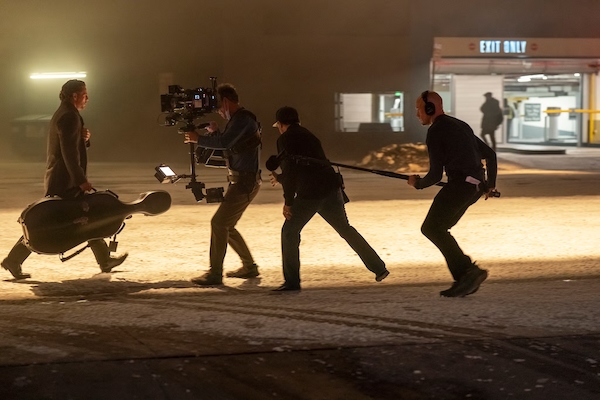
On the day Esquire visited the set last January, it was also the first time Alex has this awakening. They were using the Newman Scoring Stage as the setting for the film’s very first sequence, in which Alex plays cello as part of a pulse-pounding session for Spies Don’t Run. This is an in-joke for Gilroy, who wrote all the Jason Bourne films and directed The Bourne Legacy. Consider it self-referential, but far from reverential.
Behemoth! pokes fun at Hollywood tropes while paying tribute to the unseen men and women whose music often make films stronger than they might be otherwise. “I’ve been obsessed with studio musicians since I was 19,” Gilroy says. “I came out to LA to try to be a studio musician, and I realised how deficient I was within three days of playing guitar.”
Around the recording stage, there are posters for the made-up Spies movie, but the face of the dark-haired, suave secret agent—billed as Dominic Diaz above the title—is obscured. During a break between set-ups, Pascal asks Gilroy: “Who is the equivalent of Dominic Diaz?” He flashes his eyebrows up and down. “Is it Pedro Pascal?”
Those eyebrows are furrowed a few minutes later as he consults with Timothy Loo, who trained the actor on how to believably play the cello. Pascal doesn’t claim to be on the same level, but now he can believably fake it. “I can do a terrible, terrible ‘Twinkle, Twinkle Little Star,’” he says.
After watching playback of a previous sequence, Loo says: “Your left hand looked great.”
Pascal shakes his head. “The bow got away from me. I don’t know what happened. But it won’t happen again.”
The two had a history even before they began intensive training for Behemoth!, since among Loo’s hundreds of credits is the contemplative cello from Pascal’s own corner of the Star Wars universe. “He’s a kind of king amongst musicians for film in Los Angeles,” the actor explains later. “I had met so many of them and had been in the same room years earlier when Ludwig Göransson was scoring the first season of The Mandalorian.”
That happened to be right here, in the Newman Scoring Stage. This is another place where Behemoth! crosses over from real life to fiction and back again. Alex has his own personal history with this room, dating back decades. It’s where his trumpet-playing bandleader grandfather dropped dead after recording a jazzy, silly single (co-written by Bear and Gilroy.) It’s also where he first heard music in the womb. “His mother cut sessions here when she was pregnant with him. He’s been on that stage prenatally,” Gilroy says. “There’s no moment in his life where music isn’t his fuel, or his oxygen. There’s no part of his life where it isn’t just a fundamental presence. But then what?”
That’s the harder question that the movie expects Alex to answer. “He happens to be a prodigy,” says Gilroy. “He happens to be brilliant at it, but you see a lot of things that have fallen away in his life, that have gone nowhere,” the filmmaker adds. “That’s been the way of his life the whole way through.”
Finally, he’s figured out a way to make music not just a refuge, but a way to guide himself out of this messy life he’s made. It’s a backwards way of living, but that’s fitting too.
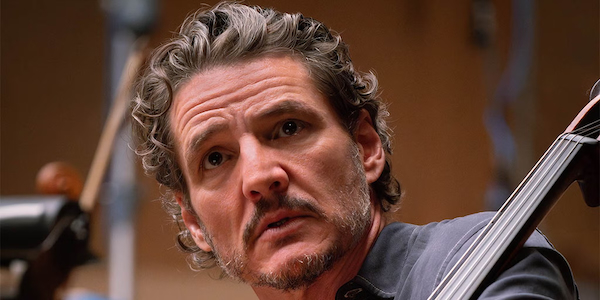
Behemoth! was put together in a backwards way. The usual method is to shoot it and edit it first. Composers might be working on various themes in advance, but after they have a working print, they study its cuts while penning the final score to make sure the music cues hit at just the right moments. Gilroy and his team turned that approach around.
The finished film is a sort of remake. Gilroy filmed rough versions of some sequences with his cellphone camera and stitched those together so the composers could write their scores with precision before principal photography began.
Once cameras were rolling for real, he had to capture the footage in an unusually merciless way. Camera movements were timed to the exact second so they would match the length and crescendos of the pre-written music. For instance, as Pascal played along with the orchestra on the Spies Don’t Run theme, a camera rolled through the row of performers to end in a close-up of him, right before a cut to his memory of an intense, wintertime confrontation with Wilde’s obsessed lover.
That meant cinematographer Damián García, a veteran of Andor, had to get his camera crew to mimic the surrounding musicians, making sure every movement happened in perfect sync. After several tries in which they were just a hairsbreadth off of the Spies roll-up, Damian tells the camera operator: “Start six seconds later and move 10 per cent slower.” That turns out to be the right tempo.
This precision is a hallmark of Gilroy’s storytelling. “I’ve been accused—and justifiably so—of being obsessed with people who are really good at things,” he says. “You can go back and look through the credits. Other than Dolores Claiborne, I’m trying to think if there’s a movie where everybody isn’t the best at something. There’s some aspect of that that must personally appeal to me, that makes me satisfied.”
IMDb backs him up. From Andor and Jason Bourne, to his Oscar-nominated writing and directing of Michael Clayton and even popcorn-fests like The Devil’s Advocate and the 1992 ice-skating romcom The Cutting Edge, Gilroy has a fascination with expertise. With Behemoth!, Gilroy explores what happens when being brilliant at one thing makes everything else fall short.
Expertise can help you see the world more clearly, but it can also help you hide from it. That’s what Pascal’s character in the film comes to see in his return to the movie music scene. Behemoth! isn’t necessarily autobiographical, but Gilroy says he feels a connection to that. “If you took everything away, I have the feeling I would still be able to go into a room and write my way out of it, and I think there is some satisfaction in that. But I don’t think it protects you from everybody else.”
It’s the “everybody else” that Pascal’s Alex finally has to confront. The rest of his life may be out of tune, but this is the story of a man seeking balance. You might even call it harmony.
