


One hundred years of Jewish films — between the Shtetl and Hollywood
Posted On: September 14th, 2026
Posted In: Sponsored Projects, Ukraina Moderna, Culture, Other Programs, Cinema
With the advent of smartphones and Netflix, we have been gradually losing the canon of popular culture — the films and books that everyone knows, with recognizable characters and catchy quotes. Our tastes are highly individualized, and even members of the same family often watch different TV series or movies in their own rooms. Over the years of teaching Jewish history, I have often mentioned movies I consider “well-known,” only to find that neither “canonical” status nor numerous Oscars guarantees recognition. Therefore, this semester I decided to teach a course at the Ukrainian Catholic University on Eastern European Jews through cinema, uniting in this way at least one group of 17 people through a common cultural experience. I called the course “From the Shtetl to Hollywood: How Cinema Shaped the Image of Eastern European Jews.” Now that the semester is over, I am ready to share my impressions.
This was my first course in which films, rather than literature, were the main object of discussion, requiring additional analytical tools. By the end, I realized that we had watched films produced over the past hundred years, from Jewish Happiness (1925) to the most modern ones, so they represent an entire century of Jewish films that also reflect history. I divided them into four groups and added a corresponding methodological reading to each. “Ethnographic” films attempted to record and recreate Jewish life in the 1920s and 1930s, when rapprochement with others and secularization were viewed as the main threats to Jewish culture. The Soviet Jewish Happiness and the Polish Dybbuk (1937) address these issues in very different ways: the former by showing the harsh reality of precarious labor and social divisions, and the latter by depicting every conceivable Jewish religious tradition, from weddings to funerals and excommunication. Films in the second group were about the shtetl. They shaped its visual image, which, as one would expect, became much more influential worldwide than the historical shtetls. The third group focused on the Holocaust, which I tried to link with the theme of language choice and gradual replacement of sensitive crime scenes with films like The Zone of Interest (2023), where violence remains off the screen. The last topic was post-memory, namely how travel films such as Everything Is Illuminated (2005) served to reinterpret Jewish life in Eastern Europe.
It was a special feeling to teach this course in Ukraine, because all the films I chose were set either in Eastern Europe or in Ukraine itself. They both reflected existing stereotypes and shaped ideas about these lands. Jewish Happiness was filmed in real Ukrainian shtetls, specifically in Kremenchuk, involving authentic local residents but carefully eliminating everything non-Jewish or modern. Fiddler on the Roof (1971) created an imaginary, almost exclusively Jewish town (filmed in what is now Croatia) and showed the local Christians as militant young men, dancing the “Russian dance” and barely restraining — and later not restraining — themselves from violence. Filmed twenty years ago, EverythingIs Illuminated (2005) mercilessly exoticized Ukraine, showing the destroyed post-Soviet landscapes (“What happened? Independence!”) interspersed with picturesque sunflowers. Shttl (2023) created an image of an ideologically divided town where Ukrainians lived more amicably with Jews than Jews themselves with each other. Watching such films often takes effort, or even causes discomfort, which I personally can only overcome by contextualizing them within their era. That the Ukrainian-French Shttlfinally has Ukrainian-speaking characters who are not pogromists or murderers seems to be a good indicator of the cinematographic evolution in understanding Ukraine’s place.
Linguistically, the films also show transformation. Yiddish is the only language spoken in TheDybbuk (1937), a film made by people for whom it was still the language of everyday life, even if not their own. Fiddler on the Roof was produced in English, with no attempt to recreate linguistic diversity. Recent films — Shttl and The Lemberg Machine (2024) — use a combination of Yiddish, Polish, Ukrainian, German, and Russian as an obvious choice not only to tell the story but also to recreate a complex cultural situation in which each language adds a layer of understanding. True, Yiddish speakers are now quite hard to find, and overly literary language will grate on the ears of the few viewers who can understand it.
When the course started, it turned out that most of the films on Jewish topics that the students had seen were about the Holocaust. My course tried to show a slightly more diverse picture through the films mentioned above (The Dybbuk, Jewish Happiness, and Fiddler on the Roof). Students noted they wanted to watch films not only about the Holocaust, but also about other topics. Nevertheless, all of them chose to write essays on films in the Holocaust category. Even films shot before the Holocaust, such as The Dybbuk, cannot be perceived without understanding what happened later, thus becoming a kind of way of commemoration.
I asked students to write why, in their opinion, films about the Holocaust avoided showing violence on the screen. Schindler’s List, with its long scene of frightened women in the gas chamber, gave way to The Zone of Interest and Ida. Some students wrote that society had distanced itself from war and did not want to hear about it. Others, on the contrary, believed that there is too much violence now and that the producers did not want to overload viewers. Still others perceived it as a way to attract attention through an unusual form. Psychotherapeutic language firmly entered the student lexicon, so a frequent explanation was that the change was intended to avoid triggers and make films less stressful for viewers.
I used this course to develop a service-learning project that students have been working on in collaboration with experts from the Center for Urban History (Lviv). The project addresses post-memory and involves identifying amateur films shot by tourists from the United States or Israel in Ukrainian towns over the past decades. Such films, which began appearing in the 1930s (the oldest collection is held at the YIVO Institute in New York), show that travel remains a key way of engaging with one’s past, especially for the post-memory generation. But these films are valuable not only for families. Just a few years after being shot, they became historical sources, showing lost Jewish heritage or making heard the voices of deceased eyewitnesses. My students found over fifty such films and videos, in which we often see tiny Ukrainian towns and villages.
I don’t know how to make movies, but my students do. In the first class, we watched a 1938 documentary about Jewish Lviv, one of five such films with a Yiddish audio track filmed for an American audience and discovered after the war. In it, we see Jewish monuments, residents, vendors in the bazaar, and religious Jews by the synagogue. I suggested that some of the students shoot a similar film in the same locations now, in 2025, to understand how we see “Jewish Lviv” today. Their film is also turning into a historical source, capturing flags with black ribbons, tourists, a destroyed Jewish cemetery, and garbage on the site of the Golden Rose synagogue. Jewish life in the old quarters became a monument, while what remains is impossible to see on the streets. Recalling the remarks about the martyrology of most Jewish films about Eastern Europe, I think about the difficulty of avoiding it. After all, even a simple depiction of Jewish everyday life will carry the idea of the coming tragedy embedded in it.
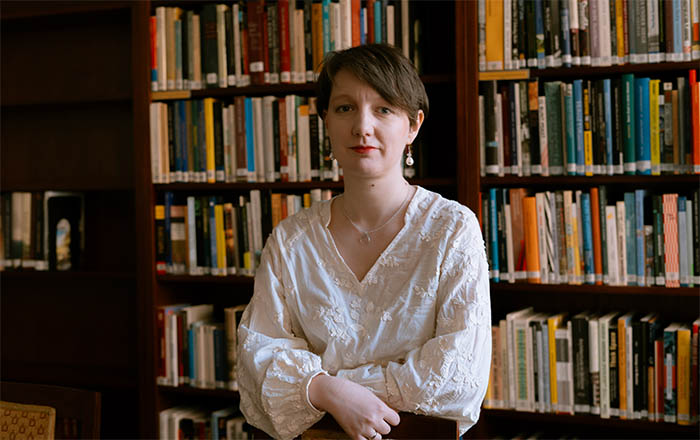
Vladyslava Moskalets is a researcher at the Lviv Center for Urban History, a lecturer in the Department of History at the Ukrainian Catholic University, and the coordinator of the Jewish Studies program there. She studies the social history of Galician Jews and the history of urban spaces. She is a guest lecturer at the University of Illinois Chicago.
Originally appeared in Ukrainian @Ukraina Moderna
This article was published as part of a project supported by the Canadian non-profit charitable organization Ukrainian Jewish Encounter.
Translated from the Ukrainian by Vasyl Starko
