
Audible brings Dracula to Venice: a full-cast audio series in seven languages
Robin Morgan-Bentley describe what happens in casting, microphone technique and editing when a story has no image
Audible presented Dracula at the 83rd Venice International Film Festival on 5 September, four weeks before the production reaches listeners. The panel, titled Dracula: A New Chapter in Cinematic Audio, was held in the Spazio Incontri of the Hotel Excelsior as part of the Venice Production Bridge.
The production is an Audible Original: a scripted ensemble adaptation of the 1897 novel by Bram Stoker, with an original score, sound design and a mix finished in Dolby Atmos, the spatial format that gives each sound its own position around and above the listener, in place of a fixed left or right channel. Robyn Ahern wrote the adaptation, her first project as lead writer after winning the Bisha K. Ali Screenwriters Fellowship. Mary Lambert, who directed Pet Sematary, is working in audio for the first time. The score is by Ilan Eshkeri, who has also written for the Audible productions of 1984 and House of Guinness.
Five versions — English, French, Italian, Castilian Spanish and Latin American Spanish — are released on 1 October 2026. German follows on 9 February 2027, Brazilian Portuguese later that year. Jonathan Bailey plays Dracula and Ella Purnell plays Mina Murray in the English version. Riccardo Scamarcio and Benedetta Porcaroli take the two roles in Italian.
What an Audible Original is: a filmed drama with the image removed
What is an Audible Original? Audible was acquired by Amazon in 2008 and operates eleven localised services — Australia, Brazil, Canada, France, Germany, India, Italy, Japan, Spain, the UK and the US — with customers downloading almost four billion hours of audio each year. Its catalogue covers audiobooks and podcasts, and the Originals occupy a separate category.
An audiobook delivers an existing text through one voice. A podcast is generally serial, often unscripted, built around hosts or reporting. An Audible Original of this kind is closer to a filmed drama with the image removed: a screenplay adapted from a a sound department, and a spatial mix. The company has already applied the model to canonical material with 1984 and Pride and Prejudice. Dracula extends it into horror
These are seven productions, and not one master recording with substituted dialogue. Sentence length changes between languages, consonants and vowels alter rhythm, and accents carry different social and geographical associations. A pause or a breath that lands after a five-word English line behaves differently after a longer Italian sentence. Local casting therefore affects timing, editing and sound design as much as it affects linguistic accuracy.
Robin Morgan-Bentley: how Audible commissions a scripted Original
Robin Morgan-Bentley, director of scripted drama and original fiction for Audible in the UK, describes the first decision on any Original as editorial. «We think a lot about storytelling. We know there are certain classic stories for which there is an insatiable appetite, stories that will be told again and again. I wanted to do something scary. There is a real opportunity in audio to create fear, because the intimacy of the medium means things can be really scary. The question was: how do we go back to Dracula and make a version that is faithful to the original but also feels modern?»
Audible met several writers and considered five or six treatments before selecting Ahern, on a brief that asked for something faithful, modern and made for audio. The adaptation follows Mina as Harker disappears in Transylvania and she reconstructs events through letters, diary pages and testimony.
«We have a team devoted to looking for stories. We commission projects and then we are very hands-on with the scripts. There can sometimes be an expectation that we simply take something, make it and ship it out, but we are involved in the creative process from the very beginning. My team will go through a script line by line. Sound design starts before we record anything, so the world of the production is already beginning to take shape. If you go back to Dracula, there is this cat-and-mouse game between Dracula and Mina. We wanted Mina to feel almost like a true detective, someone who is ultimately going to catch this monster.»
Audio removes the scheduling load of a screen production — camera department, lighting, wardrobe, built environments, a full cast available at once — and the studio network of Audible is centred on London, with hubs in Berlin and Paris working to shared technical and creative standards.
«Audio production can be much quicker and much more flexible than television or film. We do not need all the actors to be available in the same place at the same time. That can surprise directors who come from screen. If we were making the same project for the screen, we might need an actor for months. In audio, we may only need that actor for a short period of time. One of the advantages of audio is that we can record people wherever they are. Some actors might record in our London studios, while another performer may record in New York or somewhere else entirely.»
Dialect coaching sits alongside scripting, casting, sound design and editing in his description of the team. «Dracula is Transylvanian, but what does that actually mean for his voice? We did not want to create something that felt like pastiche or became silly, so we worked with the coach to determine the direction we should give the actor. One of the wonderful things about the English language, and about Britain in particular, is the enormous range of accents. Actors are often most comfortable performing in their native accent, and that is frequently when you get the best performances. A lot of the actors we work with already have considerable experience behind the microphone, and many of the skills they acquire elsewhere are transferable to audio.»
Discrete booths, body mics, ambisonics: what happens in the recording room
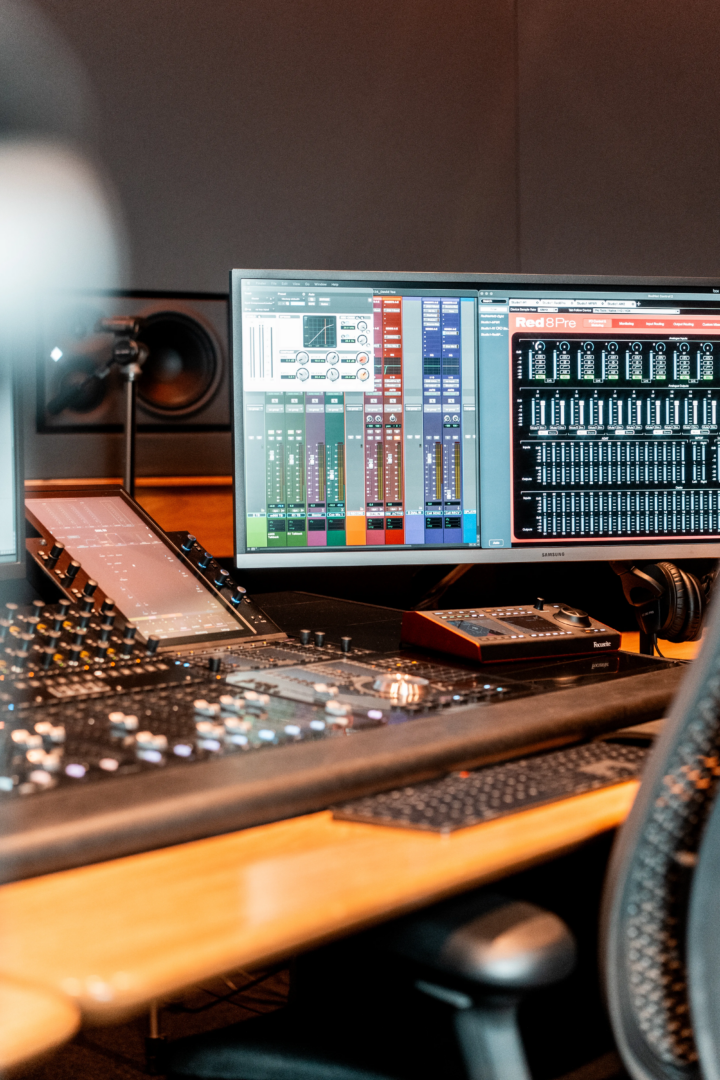
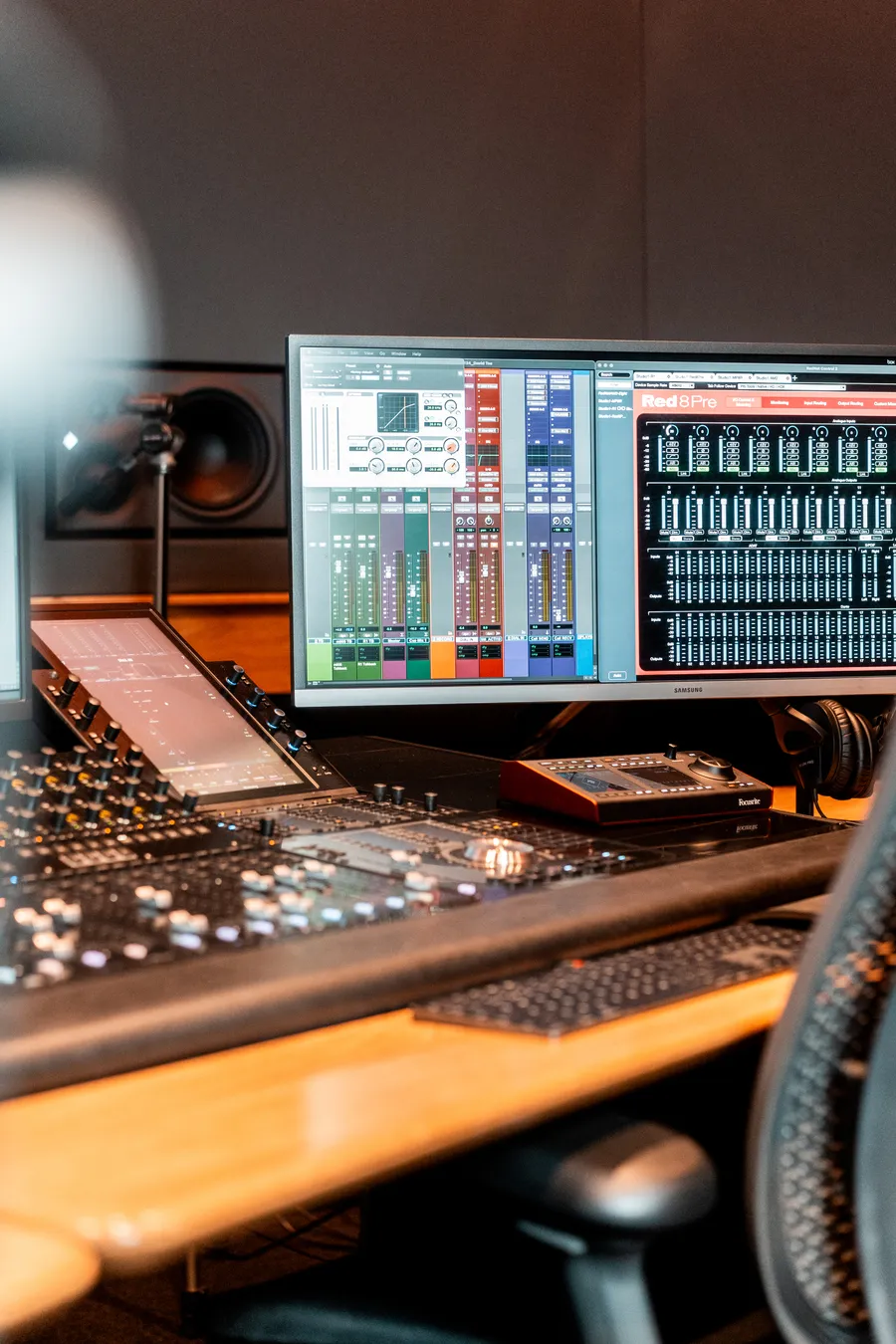
The London facility is the practical centre of the model, operating with Berlin and Paris to shared standards. For full-cast dialogue, discrete booths isolate each performer and produce clean tracks that can be edited and spatially positioned afterwards. Lavalier and body microphones allow an actor to move, turn, stand, sit or cross a room instead of remaining fixed in front of a single microphone; binaural and ambisonic techniques capture sound in three dimensions and place the listener inside the acoustic perspective of a character.
«Sometimes we want an actor to be completely still. In another scene, we may want them to move around because we want the sound to feel natural. If somebody is getting up, walking around or eating, there is a different quality to the sound when those actions are actually happening. The equipment and recording technique can change depending on the production, the location or even the individual scene.»
The same logic sends the microphones out of the building. For Harry Potter, the team recorded footsteps on century-old floorboards to capture the exact creak of the surface. For Pride and Prejudice, production spent a week in a country house in Devon recording the sounds of nineteenth-century domestic life: fabric, tableware, food preparation, a body moving through a room. An ordinary action can be harder to fake convincingly than a spectacular one, because the ear registers timing, pressure, texture and the irregularity of real movement.
«You might record somebody buttering bread, for example, because you want the sound of that action to feel completely natural.»
The productions are finished in Dolby Atmos. Proximity, height, direction and movement become narrative variables: a voice can arrive beside the listener, footsteps can cross behind them, reverberation can establish the scale of a room before a character names it. Dracula can whisper in the ear of the listener while his footsteps are heard in the dark, with no reflection to confirm where he is.
The ensemble is assembled last. «The amount of material recorded compared with the final running time varies enormously. It depends on the director and on the actor. There is certainly a long process in the editing suite, much as there would be in film. You are finding the best take for a particular line, but you are also constantly thinking about the flow of the scene.»
Mary Lambert: from the videos of Madonna to a production with no picture
Mary Lambert, speaking to the Audible audience in Venice, went further into the production process. Her career had been built on putting pictures to music: she directed the videos that made the image of Madonna in the 1980s — Borderline, Like a Virgin, Material Girl, Like a Prayer — before moving into features and, in 1989, Pet Sematary, the Stephen King adaptation that took 84 million dollars worldwide. Dracula is the first thing she has directed with no picture at all.
«We prepared the production in a very structured way, almost like storyboarding a piece, including the transitions between scenes. Every voice was recorded separately, in its own booth. The principal recording had to be completely clean. From a directing point of view, we had to make sure that the performances worked together even though the actors were in separate spaces. We could try different performances, repeat them and change things very quickly if something wasn’t working, without the same technical constraints you have on a film set.»
The score by Eshkeri took on part of that load. «For the more sensual parts of the script, everything had to come through the performance, the voice, the music and the sound. The composer proposed using the voices as instruments and incorporating them into the soundtrack. The music also had to do some of the work that images normally do — establishing the mood and, in a sense, even the lighting.»
The listening data: Audible Compass 2025
Audible Compass 2025, the annual survey conducted by Verian for the company in Italy, France, Germany and Spain, reports that 73 per cent of respondents listen to audio content, and that almost six in ten increased their listening frequency during the year. The four countries average close to four audiobooks a month: 3.2 in Italy and Spain, 3.8 in France and Germany.
Genre is the first selection criterion for 86 per cent of listeners, ahead of subject at 83 and the narrating voice at 82 — a hierarchy that accounts for the casting budget of a production like Dracula. Mystery and thriller lead preferences at 44 per cent, followed by science fiction and fantasy at 40, crime and romance at 37 each, comedy at 36. National variations remain: crime is first in France at 40 per cent and reaches 45 in Germany, while Italy is the only market of the four where literary fiction ties with thriller, both at 46.
The survey also measures the overlap between formats. Seventy per cent of respondents say listening has increased the number of books they read in print or digital form, and 66 per cent have gone to a bookshop to buy the printed edition of a title they had already heard. Audiobook listeners consume other formats at high rates — 84 per cent watch films and series on streaming platforms, 70 per cent listen to podcasts, 43 per cent to audio series — and 79 per cent report having listened to something in audio after encountering it as a television series, a film or a graphic novel. That last figure describes the commercial logic of adapting a title already carried by a century of screen versions.
Matteo Mammoli