


What was it like to grow up in L.A. during TV’s pre-streaming heyday when Hollywood was humming? Just ask Mick Giacchino. The Emmy-winning composer of The Penguin, who most recently scored VisionQuest(now streaming on Disney+), champions big orchestral scores performed by live musicians. That analog approach has become increasingly rare in an age of synth and laptop-generated soundscapes, but Giacchino gravitated toward lush symphonic sounds early on, close to his father, Michael Giacchino. While his dad oversaw award-winning music for J.J. Abrams’ Lostseries (Emmy) and Pixar’s Up (Oscar), Giacchino junior sat quietly among the session musicians, absorbing everything he could. “When I was in elementary school,” Giacchino tells The Credits, “I remember my dad would take my siblings and me out of school for the day to come see one of his sessions. I would always ask if I could come back the next day.”
His father said yes, as long as Mick went to school first. Over the course of many afternoons, Mick Giacchino fell in love with the dynamic ebb and flow achieved by living, breathing musicians. Lessons learned, Giacchino scored Disney+ seriesStar Wars: Skeleton Crew, wrote additional music for The Batman, and complemented The Penguin‘s ominous narrative beat for beat. Most recently, he scored Marvel Studios’ eight-episode sci-fi miniseries featuring Paul Bettany as the thoughtful “synthezoid” superhero Vision.
Speaking from Los Angeles, Giacchino talks about finding inspiration in Steve Reich’s minimalist compositions, deferring to Henry Mancini’s music when the occasion called for it, and spending a most unusual childhood surrounded by the giants of Hollywood’s movie scoring community.
VisionQuest, likeThe Penguinand your body of work overall, stands out because so often these days, music for film and TV is produced by one guy in a room full of synthesizers and laptops. It’s refreshing to hear full-blown live orchestras performing the score.
The music is very much a live orchestra. Any music you hear comes from real people playing.
You put the orchestra to good use in theVisionQuesttheme, which sets up the audience to expect a show with fast-paced action. What inspired the title track?
In searching for what the tone should be, I tried to figure out how to convey this idea of a microchip processing information. I listened to Steve Reich’s “Different Trains” [1988 recording for string quartet and prepared tape], which is a lovely minimalist piece. It starts off with these ostinatos where the strings are doing something slightly different from each other, playing in fifths or fourths, and there’s like a motor to it. I thought that was interesting because it had this texture that felt to me like streams of code.
Digital activity but articulated through analog instruments.
Yeah. So, once I had found my chords for the theme and the melody, I needed that ostinato [pulse] to drive the piece, and everything just kind of grew from there.
It’s very propulsive.
That’s funny because I always internally referred to this theme as “Propulsion.” We had many different versions. I labeled another one “Noble.” It’s the same melody, just different arrangements that I could use as starting points once I got it all locked down.
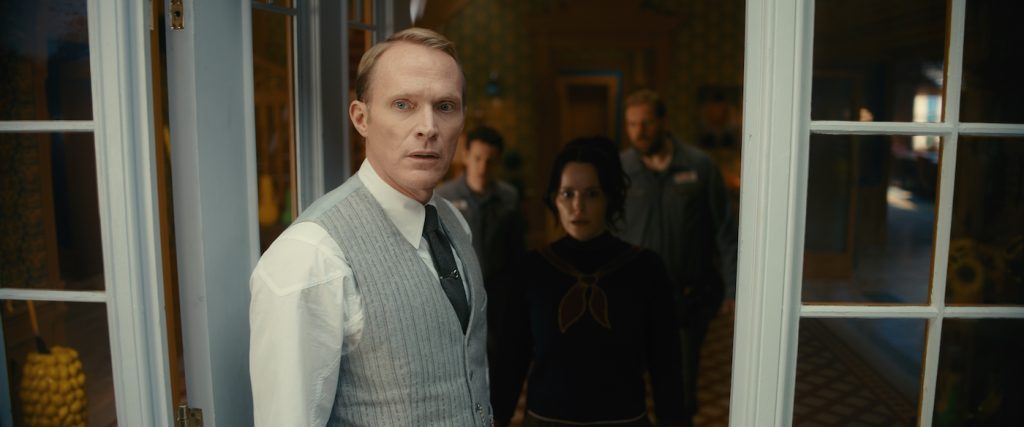
While yourmusic forThe Penguinwasquite somber,VisionQuestincorporates bits of humor, which is reflected in the music. For example, early in the season, Vision materializes on this palatial estate accompanied by super smooth music, complete with organ, that sounds very true to what you might hear in a department store or a roller rink in 1960. How did you go off on that tangent?
Well, the reason why it sounds so authentic is because it is. It’s Henry Mancini and his [1960 TV theme] “Mr. Lucky.”
Which explains why the music feels like it’s dropped in from another universe.
Exactly. And I mean, I love Mancini and all that kind of music. Show creator Terry Matalas also fell in love with this music that he was using as temp, and I told him, “Look, I can’t write anything better. If you’re able to license this music, go for it.
No ego.
It’s just so fun to hear this music because it makes you feel like you’re at home with these characters. It feels cozy, it feels warm, it feels familiar, even though all the visuals are a little quirky and odd, and some things are manifesting in weird ways. But yeah, I love those sequences.
Taking a step back for a moment,one of your first projects was J.J. Abrams’ 2011 movieSuper 8, where you worked as a scoring assistant?
I was just helping to set up microphones and stuff like that.
But at least you got to be on a movie set and see how things get done, because production in Los Angeles was booming. It’s different now. When you put together a big score for one of your projects now, are you mindful of the impact your work might have on fellow film music makers?
I have no idea what my impact, if any, is on my peers, but I can say I absolutely love the sound of a live orchestra. As you’ve mentioned, I grew up around the scoring stage.I had to go to school, but after school, my dad would say, “You can come by for the last hour or two.” And because I went to school close by to where most of the sessions were, I could just go over to the soundstage, and over the years, I got to know all these musicians.
That must have been exciting!
I spent a lot of time at those sessions, in the room itself. I’d either be with the string section, or I would sit by the brass or the percussion and just listen to what each section was doing and how they worked together to create a whole. There’s nothing more magical than stepping into a room and hearing 70 to 100 people all working together to create one thing.
That experience at an early age obviously shaped your path.
Well, that’s why the orchestra was always going to be a part of my sound, because it’s something that I love so much.
Where was the music forVisionQuestrecorded?
I worked with the fabulous musicians in Vienna. I would have loved to have been there in person, but when you’re on TV schedules, it’s hard. You record the first episode and still have six more to finish writing, so that makes travel a little bit difficult.
At this point in your career, you’ve probably developed a kind of vocabulary that enables you to express specific emotions with specific instrumentation. For example, if it’s a big action sequence, do you decide to bring out the timpani?
For full-blown action scenes where horrific things happen on screen, you might want to reflect that musically, but other moments might have incredible stunts and visuals on screen, and the core isn’t necessarily anxiety but a different emotional feeling. For me, it’s really important to be true to what the characters are feeling in that moment. If the character’s in a fight-or-flight [situation], you want the music to reflect that. But a character might be in a battle and yet their mind is elsewhere, in a more emotional headspace, so then you want to make sure it’s reflected in the music. And that determines whether you go to the timpani or not.
VisionQuest is streaming on Disney+.
Featured image: (L TO R) James Spader as Ultron and Paul Bettany as Vision in VisionQuest exclusively on Disney+. Photo courtesy of Marvel
