


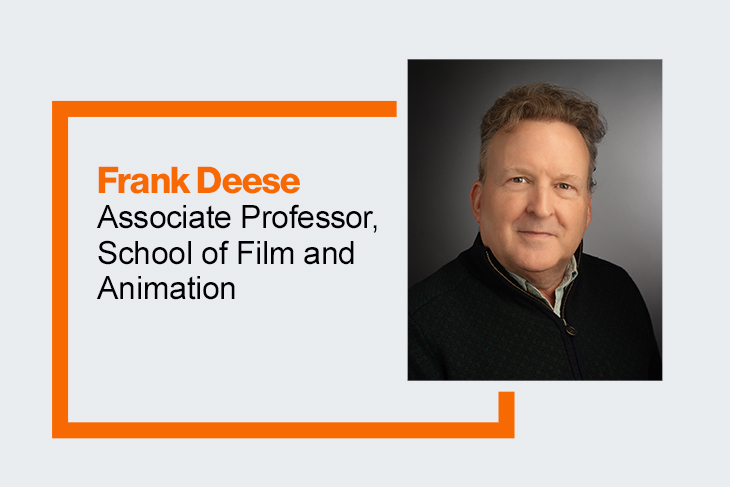
Frank Deese, associate professor of screenwriting in RIT’s School of Film & Animation, recently attended Digital Hollywood: The AI Summer Summit and shares his insights.
In the iconic 1984 film The Terminator, the killing machine’s murderous pursuit of the resilient and persistent Sarah Connor epitomizes the “unity of opposites” principle in dramatic writing which requires heroes to neither retreat from the fight, nor compromise with their adversary.
As I prepared for the Digital Hollywood: The AI Summer Summit panel, Screenwriters vs. The Machine, my adversary was the persistent belief that artificial intelligence can and will soon replace human screenwriters in the motion picture industry.
Having written dozens of original and adapted screenplays during my 25 years working in Hollywood, and having read and evaluated hundreds of student screenplays as a writing professor at RIT, I firmly believe written stories must be filled with the feelings and essence of authentic living.
While generative artificial intelligence, like OpenAI’s ChatGPT, is capable of sophisticated mimicry and synthesis in story creation, it can never replace the inspiration and originality of a human screenwriter. Audiences certainly may be enticed by polished, machine-made story mechanics, but will eventually spit out the artificial and long to taste the real artistry from an actual human being.
I expected at least some of my fellow panelists to fall on the side of the machine in the struggle between human screenwriters and AI in the film industry. Instead, I found myself among peers who shared my belief in the primacy of the human author as they brought unique and informed insights into exactly how screenwriters and machines could collaborate and work together.
Here’s a glimpse into each of the expert panelists’ unique insights:
Mark Goffman is a very accomplished television writer and showrunner whose recent series credits include The Umbrella Academy, Bull, Sleepy Hollow, Limitless, and White Collar. During our panel session, he voiced strong support for the primacy of human authorship with AI being best used in the creative process for brainstorming, storyboarding, and providing new and unexpected perspectives in the process. Goffman is adamant that AI should never be the sole method for creating polished and professional screenplays.
As the leader of the series writers’ room for the hit Netflix series The Umbrella Academy, Goffman acknowledged that the current use of AI in screenwriting faces many legal barriers due to authorship uncertainty and intellectual property concerns. These issues remain unresolved in series production.
Goffman also pointed out the potential loss of the apprenticeship system that has been an integral part of training new series writers and showrunners. This form of mentorship is rapidly eroding as AI increasingly takes over tasks typically performed by entry-level writers and assistants. This decline is further exacerbated by hybrid and work-from-home practices. The industry has yet to find a replacement to the important process needed to develop on-the-job training and preserve the pool of experienced writing talent.
Screenwriter and published novelist Christian Cantrell, who is also a former vice president of product at Stability AI and founder of the new generative AI startup called Concept.art, described how AI is already able to write effective coverage and break down scripts quickly, providing objective metrics that help elevate the written material and market it more effectively. He advocates for applying AI where it can add value to a creative endeavor by integrating it into the story-construction process. Nevertheless, Cantrell feels it is important to fully appreciate AI’s limitations and suggest writers use it as one of many choices in a creative toolkit.
Veteran TV writer Catherine Clinch weighed in on how she is actively using AI-generated imagery for story visualization, story research, and proof-of-concept pitches of written material, as she feels it is increasingly valuable to provide visual examples of her story ideas.
Mike Gioia is an experienced TV writer and director and both the co-founder and large language model engineer at Pickaxe AI, a platform “that allows anyone to create tools powered by AI, in minutes, no coding required.” As a designer of systems for TV and museum exhibits, he understands how AI can be leveraged to improve the storytelling process. Gioia encourages all creatives to experiment and become proficient in engineering effective AI prompts and integrating AI tools into their work. Ultimately, with practice, using AI to help craft detailed story elements can serve as an invaluable way to identify and eliminate redundancies and inconsistencies.
I took Gioia’s suggestion to be open-minded and adaptable to heart. Participating on the panel made me realize that just casually and occasionally sampling generative AI for both images and writing is not enough; I need to be proactive about gaining more knowledge about its practical possibilities in my own work as a professor and professional screenwriter.
For example, I’ve never much enjoyed figuring out the mechanics of chase scenes and action sequences in screenplays. AI could make this task easier, faster, and more effective without undermining the authorship of my work. Additionally, AI can be useful for analyzing the details of story worlds and eliminating inconsistencies within those worlds.
As a professor at RIT, I currently do not allow my students to use generative AI on creative assignments as I believe, at the learning stage, it’s like having a robot do one’s workout at the gym: it undermines the development of writing strength. I have, however, encouraged students to experiment with it on their own time. Thanks to the takeaways from this panel, I am committed to leveling up and finding ways to better incorporate AI use in classroom instruction, with all the appropriate caveats we discussed.
Three key takeaways from the panel
- Human touch in storytelling: Our panel’s consensus was that while AI can aid in the creative process, the essence and emotional depth of a story must come from human experiences.
- AI as a tool, not a replacement: AI can be effectively integrated into various stages of the writing process—brainstorming, storyboarding, script analysis—but should not be the sole method for creating professional screenplays.
- Legal and ethical considerations: Everyone agreed that significant legal barriers concerning authorship and intellectual property need to be overcome with clear guidelines for the ethical use of AI in the industry.
This panel reaffirmed that while AI holds powerful potential as a creative tool, it cannot supplant the unique human element essential to compelling storytelling. As much as technology advances, the irreplaceable value of human creativity remains at the heart of screenwriting.
As I said, I initially prohibited the use of AI in creative assignments at RIT, believing it undermined the development of writing skills. However, this panel discussion has inspired me to consider incorporating AI into my teaching, with careful guidelines to ensure it aids rather than replaces the creative learning process.
Unfortunately, too many people (including some studio executives) draw a human face on the technology and project onto it human capabilities. We are all immersed in media AI like HAL in 2001: A Space Odyssey, or C-3PO in Star Wars, or the sultry-voiced AI companion in Her. Computer intelligence seems to us sentient and conscious of itself, and so may ultimately reign supreme and subjugate human beings. For those fantastical, widespread, and ultimately unfounded beliefs that shape the public conception of artificial intelligence, there is no one to blame but human screenwriters.
Panel moderator Monica Landers, founder of StoryFit which provides AI analytics for the media and entertainment industry, wrapped up the conversation with the suggestion that our panel be renamed “Screenwriter and the Machine,” instead of “versus,” reflecting our collective belief that Artificial Intelligence was not going to “take over” and replace human screenwriters, and that AI should be integrated into the writing process rather than opposed. I wholeheartedly agree with that conclusion.
Frank Deese, associate professor of screenwriting in RIT’s School of Film & Animation.
Related News
artificial intelligence
games, film, and digital media
technology, the arts, and design
