


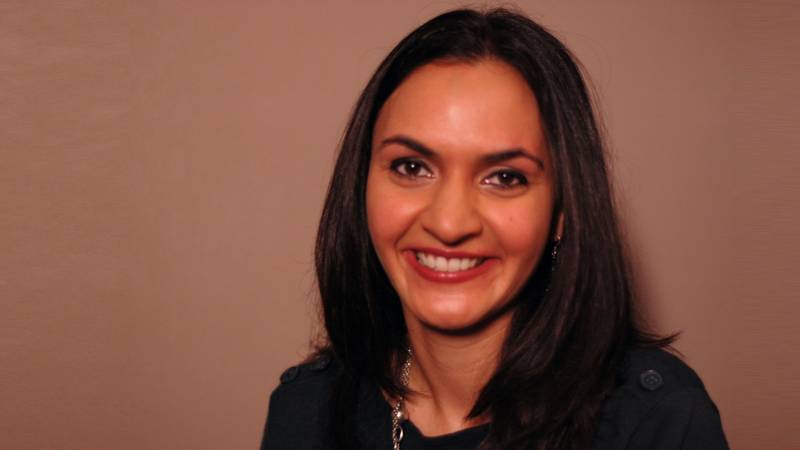
Sanam Hasan is warm, vibrant, and going from strength to strength, doing South Asian women extremely proud. Breaking glass ceilings, Sanam is a trailblazing female South Asian publicist. Involved in the production of Unsilencing Sabeen (2017), Sanam’s second production, Fabric, would have aired at Cannes by the time this article goes into print.
As the elusive Seattle sun pours unexpectedly but generously down, Sanam and I speak of media, of female empowerment, and of growth in cinema.
A Trailblazing Career in Cinema
With over 20 years of experience in publicity, communications, and distribution, Sanam has worked on a wide range of film and entertainment campaigns. As a publicist, she has worked for major studios and agencies, including 20th Century Fox, Warner Brothers, and international film festivals. As a distributor, Sanam co-led Mara Pictures—an independent South Asian theatrical distribution company in the UK.
At present, Sanam is the Senior PR Manager for British Film Institute Festivals, including the BFI London Film Festival and BFI Flare. A film and media professional, Sanam has won both accolades and awards during her 20 years in the industry.
Starting her career in NYC with Sakhi for South Asian Women, she handled screenings and fundraising for releases such as Bend It Like Beckham and Hollywood Bollywood. In 2003, Sanam moved to Pakistan to work in an industry throbbing with fresh blood and inspiration. Sanam joined Cinepax, the new multiplex company. As General Manager, she oversaw the distribution and release of major Hollywood films from studios including Paramount, Universal, and Disney.
Sanam and I start off by speaking of her upbringing and childhood experiences, which helped shape her to be the outstanding creative professional she is:
“I was exposed to a lot of the classics by my father at an early age; he wanted me to know what was out there… Casablanca, Gone with the Wind, etc., and it was not just about watching these films but also talking about them.”
Havi And The Rise Of Soft Masculinity In South Asian Music
I ask Sanam about her interest in media:
“I was interested in media because I was interested in journalism and communications. At college, I concentrated on communications with film being a strong secondary subject.”
“I didn’t speak great Urdu, nor did I come from a cinema family – but as it turned out, through the work that I was doing, I was able to inculcate cinema-going habits and explain what film culture was”
When asked about her early work life, Sanam says:
“I was communications coordinator at Sakhi, my first job in New York. We were approached by distributors who said we have films and we are not sure how they will play in the US, because we know that they are for the South Asian audience. They wanted to use us as a test screening. That was before the phrase ‘community screening’ came about. I did everything from organising the cinema to getting the guest list to organising the speakers. I was told it’s a football film from the UK. We had a packed audience in Times Square. As it turned out, the film was Bend It Like Beckham, and that was the first time it was screened in America!”
Sanam explains how that cultivated a feeling of realising the significance of bringing the right film to the right audience.
Navigating the Pakistani Film Industry
From NYC to Karachi, Sanam speaks of the change of landscape and experience, also of navigating the industry in Pakistan after having worked in NYC.
“This was 2003–2007; lots of privatisation of media was happening. It seemed like a really exciting time for media; it was on the cusp of something new and fresh. I was back in Pakistan and one morning, I opened up The Friday Times and came across a job advert to work in a multiplex company, Cinepax. I got the job.”
Regarding the positives and negatives about working in Pakistan, Sanam says that since the brain drain was quite strong, there were not a lot of people to bounce ideas off.
“I was an anomaly, not a lot of people my age. I don’t think people were anticipating my being able to gain the trust of cinema exhibitors. I didn’t speak great Urdu (not having grown up in Pakistan), nor did I come from a cinema family. So I was a little bit of a fish out of water in that respect. But as it turned out, through the work that I was doing, I was able to inculcate cinema-going habits and explain what film culture was. We were dealing with piracy issues, so we tried to screen films as close to their release dates in order to be able to deal with those particular issues. And yes, we did manage to bring people to the cinemas. We were able to generate the idea of what was screen culture! I felt very fulfilled professionally because I was on a very steep learning curve.”
The Sea-Based Nuclear Trap: Why India’s Maritime Triad Threatens South Asian Stability
Sanam was at the helm of pioneering the “back to cinema” culture in Pakistan. No mean feat for this steady young lady with a vibrant vision. What were the hurdles she may have expected?
“It was a very interesting time in terms of what was happening in the media. People were very receptive and open to ideas. One would think that I would have faced sexism, but I actually didn’t. Whenever I’ve experienced a boost in my career, it’s been due to gatekeepers who’ve seen my potential and helped me to find my way to the next place. It was very much that way with the team at Cinepax.”
Championing Independent South Asian Cinema
Sanam returned to London in 2007 and started the theatrical distribution company Mara Pictures. The company brought independent cinema from South Asia to UK cinemas, including Ramchand Pakistani, The Reluctant Fundamentalist, and Gangs of Wasseypur 1 & 2, earning the title of the preeminent distributor of South Asian independent cinema by Variety. Working very closely with cinemas UK-wide, the main thing was to create an event around the film’s release.
“Ramchand Pakistani was our debut film. The Reluctant Fundamentalist was our last but also our biggest; Mira Nair, Riz Ahmed, and Mohsin Hamid, they were all very involved. They were very collaborative and gave a lot of time.”
For those not savvy about distribution and the world of cinema, what did she accomplish that others had not?
“We literally gave a platform to films that deserved just that. We had seen that these films would do well at film festivals, so we would pitch to the film team. We were very lucky that Javed Jabbar saw the benefit of doing this and he trusted us, so we were very fortunate in that respect because Ramchand Pakistani was our first film. We would send out press releases and do interviews with directors and cast, have the films reviewed, try and create as much engagement on the ground as possible.”
US Strikes Iran | Pakistan MI-17 Crash | UK Bans Hasan Piker and Cenk Uygur | World News Updates
Returning to London and PR Leadership
After Mara Pictures, as Sanam had young children and family commitments, she ended up doing a lot of freelance work. “I worked with Fox and Warner Bros, short-term contracts.” Sanam mentions the great support she got from her husband, as this was a demanding time, juggling motherhood and work.
Sanam then got a freelance role with the London Film Festival:
“They asked me to come back every year for several years after that to work at the LFF. I gathered a lot of experience during this time, specifically with regard to festivals.”
Her recent work has found Sanam focused on film publicity with roles at 20th Century Fox, Warner Brothers, and as a consultant for leading PR agencies, which included several years working on the BFI London Film Festival (LFF) press team. She was brought in-house by the British Film Institute in 2023 and is currently the Senior PR Manager, BFI Festivals, overseeing the press and publicity campaigns for the institute’s leading film festivals. Handling international press junkets, press campaigns, and dealing with A-list talent is no mean feat, especially for a young mother and wife trying to do justice to both home and work.
Production Ventures and Inspiring the Next Generation
Sanam has produced her second documentary short titled Fabric under her new production company Tiny Circus Productions. Tiny Circus Productions is an independent film production company dedicated to developing and delivering high-impact storytelling across documentary, short-form, and scripted content.
The short documentary follows a team of refugees in Paris working towards sustaining French haute couture and delves into themes of identity, displacement, and craftsmanship. Fabric presents Paris-based non-profit Espero Atelier, which works on building pathways to access jobs in fashion for refugees. Produced by Tiny Circus Productions and Hemerscope Studios, the female-led production companies partnered with UK-based networking organisation The Female Film Club in their annual reception during the Cannes Film Festival on the 18th of May, where Fabric was showcased. The partnership is supported by content production company Analysis History.
UK Bans Hasan Piker & Cenk Uygur: Is Free Speech Dead in the West?
Sanam’s first production, Unsilencing Sabeen, was produced in 2017 and premiered at the WOW Women of the World Festival in London’s Southbank Centre. Coming across with youthful energy and dedication, Sanam mentions how younger women of colour often state that it is inspiring to see someone like her be a leader on the red carpet and manage the PR campaign for a big international film festival.
I ask Sanam about her perspective on current independent Pakistani filmmakers:
“These filmmakers are not letting production or funding obstacles stand in their way and are producing incredible films premiering at film festivals around the world. Interesting time for independent Pakistani cinema, and it is exciting to see it growing so quickly.”
Sanam mentions Ghost School opening the UK Asian Film Festival and Mera Lyari selling out at the same festival. Nature or nurture, how did this happen? You made a breakthrough in a field previously not dominated by South Asian women?
“I was raised by a very strong woman who was raised by an exceptionally strong woman. The women on my father’s side are some of the most awe-inspiring women. So I’ve been surrounded by many inspiring examples. And I was raised in an environment where I was expected to have an opinion. And I know that’s not common for South Asian women. There was little reason to doubt myself. I have had both journalists and junior team members say that it’s so great to have a woman of colour in charge. The average publicist is often female but definitely not South Asian, and especially not at a major film festival.”
It is obviously a pulsating time for Sanam Hasan, who has created a name for herself in a world where few women of South Asian descent have ruled or been remembered. To her credit, Sanam juggles it all with both grace and dynamism: a mother, a wife, and a vibrant professional whose star is shining bright.
Forgotten Masters Of Hindi Cinema: Rediscovering A Golden Age
Showcased on the 18th of May at the Cannes Film Festival, Sanam Hasan’s Fabric is also featured at the Raindance Film Festival (the 17th of June till the 26th of June) and is officially nominated for best documentary short.
