


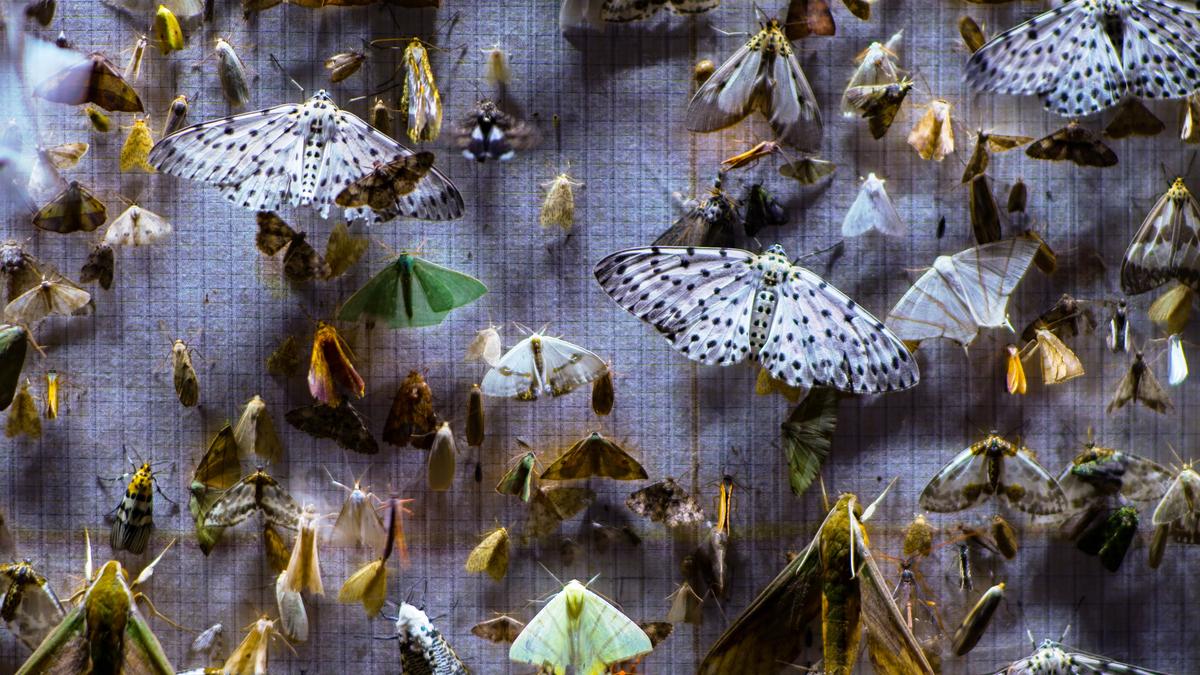
As many as 5,000 students from different schools in Hyderabad will attend special screenings of the documentary Nocturnes, beginning July 20, at PVR multiplexes across the city. The screenings are a part of the nationwide Nocturnes Travelling Cinema initiative by the film’s directors Anirban Dutta and Anupama Srinivasan.
Nocturnespremiered at the Sundance Film Festival in 2024, winning the World Cinema Documentary Special Jury Award for Craft. Since then, the film has been screened at over 60 film festivals including Hot Docs, Sheffield DocFest, and the Thessaloniki Documentary Festival.
What is Nocturnes about?
The film follows Mansi Mungee, an ecologist at the University of Leeds, and her colleague Gendan Marphew, as they set up illuminated screens in the forests of Arunachal Pradesh at night to attract moths and photograph them to understand their behaviour. The film is deliberately languid and urges its viewers to slow down and wait for the magic to unfold.Watching the film is a meditative experience until the netted screen attracts moths of varied shapes, sizes and colours. The film is also a subtle commentary on climate change.
Nocturneswas filmed in spurts, in April-May and September-October when the conditions are favourable to spot moths. Permissions were obtained from the forest department and involved ample research. When the filmmakers zeroed in on the subject, of a scientist studying moths in Eastern Himalayas, it wasn’t easy to raise funds initially. Gradually, help came from varied quarters, including Sundance Institute’s Sandbox Fund, IDFA Bertha Fund and Doc Society. “It isn’t easy to quantify the budget since help came from unexpected corners locally, in kind, when we filmed,” adds Anupama.
Anirban Dutta and Anupama Srinivasan
| Photo Credit:
Special Arrangement
The journey post Sundance
Anupama concedes that despite the Sundance win, the path ahead was not easy. While the film was released theatrically in the US, prominent distributors in India showed little interest. “Even those who sporadically back niche indie films put forth business conditions that did not seem feasible. We could have released the film on our own in theatres, but we had no marketing budget. Unless people know that a film has been released, how would they come to watch it?” asks Anupama.
Nocturnesis available on select streaming platforms in the US and the UK, but digital networks in India did not show interest.
“We were convinced that our film is meant for theatrical viewing for an immersive experience. So we decided to take the film to the audiences independently,” says Anupama.
Anirban echoes her sentiment, stating that avenues for screening documentaries remain scarce. “We could have screened it at film clubs, but we would only reach the small, niche audience that regularly patronises such films. In New Delhi, air pollution has prevented my son and daughter from training in skating or athletics. They aren’t getting the childhood I was lucky enough to enjoy. One of the reasons we made this film was to bring the sounds and visuals of the forest to children like them on the big screen. We had to find our own way to bring Nocturnesto a younger audience.”
Independent route
In November 2025, the filmmakers launched Nocturne Travelling Cinema. Their first stop was Arunachal Pradesh. They approached around 15 schools near the forest where they filmed. The team set up temporary screening rooms using dark curtains, a projector, a monitor and a sound system. Screenings were followed by optional workshops detailing the film’s theme that also aligned with the syllabus.
Next, screenings were held in Delhi-NCR for nearly 13,000 school students. The Bengaluru screenings earlier this week attracted more than 7,000 students. A tie-up with the PVR multiplex network came in handy in urban centres.
Anupama and Anirban relied on friends to reach out to schools. In Hyderabad, help came from theatre personality Vaishali Bisht and filmmaker Aparajita Sinha. Anupama will be accompanied by line producer Ruchika Gupta for the Hyderabad screenings.
A still from ‘Nocturnes’
| Photo Credit:
Metamorphosis Film Junction
The screenings for private schools are ticketed. Anupama says, “The funds collected through these screenings help us organise free screenings in government schools and in rural areas.”
Schools choose a PVR closer to the school’s location. “On weekday mornings when the footfalls are on the lower side, theatres are glad to organise these screenings at discounted prices for students.”
Prior to a screening, a team member gives an introduction to set the expectations right for the students. “This is not a regular commercial film or a typical Nature film that they see on television channels. So we want the children to calm down, stay still and pay attention to the sounds and visuals.”
She observed that once students got into the mood, they were drawn to the film. “There is very little dialogue in Nocturnesand it is wonderful to see how students observe and respond to the film. One student said she did not know there were more than 100,000 species of moths. Another said he could now identify a hawk moth.”
The screenings are open to students as young as class III.
Anupama and Anirban are keen to organise screenings in Chennai, followed by Lucknow and Dehradun, and maybe organise a second round of screenings in some cities. “By the end of the Bengaluru screenings, we have been able to reach 20,000 students. The goal is to double that, if not more.”
(For further updates, check Nocturnes Travelling Cinema @nocturnes_film on Instagram)
