

Every filmmaker knows the feeling.
The script is finished. The story is on the page. The characters are alive. For a brief moment, it feels like the hardest part might be behind you.
Then the real work begins.
A screenplay is not just a creative document. Once a project starts moving toward production, it becomes a map for nearly every decision that follows. Every character, location, prop, wardrobe change, vehicle, stunt, visual effect, animal, crowd scene, and small detail buried in the margins has to be found, organized, and tracked.
A bottle on page 12 becomes a prop note. A rainstorm in act three becomes a special effects conversation. A character walking into a diner suddenly means extras, wardrobe continuity, location permits, background vehicles, and someone asking whether that jukebox is cleared.
Anyone who has worked through a real script breakdown knows how quickly a screenplay turns into a stack of production documents. One pass becomes a breakdown sheet. The breakdown informs the shot list. The shot list affects the schedule. The schedule changes when a location falls through. Then the script changes, and the whole system has to catch up again.
This is one of the hidden costs of filmmaking.
It is not glamorous work, but it shapes everything that eventually happens on set. Before the first camera is built, before the first slate is clapped, before anyone calls action, the production is already being defined by hundreds of small organizational decisions.
That pressure has only increased. Independent productions are running lean. Crews are smaller. Budgets are tighter. Expectations keep going up. Whether you are producing a feature, documentary, commercial, short film, or online series, the audience does not care how small your team was. They only see what made it to the screen.
This is where artificial intelligence can make a practical difference.
Not by replacing filmmakers or deciding where the camera goes. The most useful AI tools in production are not trying to take over the creative process. They are helping organize the mountain of information that surrounds it.
Imagine uploading a screenplay and getting a first-pass breakdown in minutes instead of losing half a day to manual tagging, then using that same information as the starting point for storyboards, shot lists, schedules, and call sheets, without retyping the same details into separate documents.
That does not remove the filmmaker from the process. It gives them a better starting point. The director still decides what matters. The producer still decides what is possible. The crew still has to solve the problems only human beings can solve. But they should not have to waste creative energy chasing down information that was already sitting inside the script.
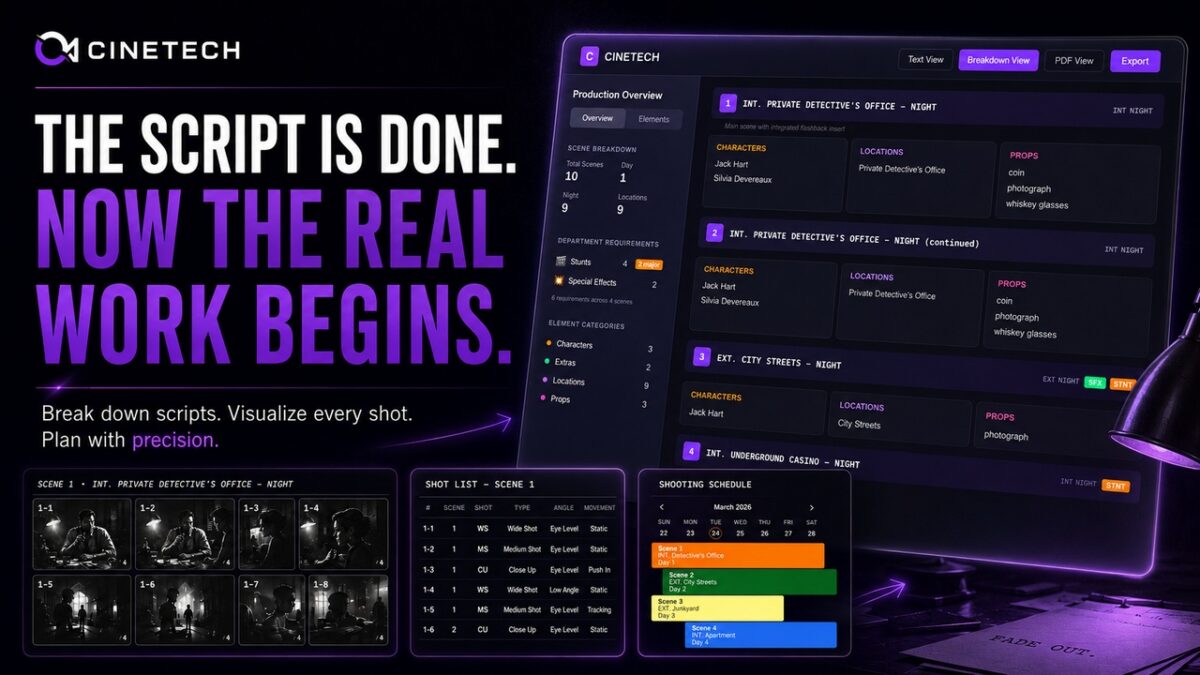
That is the idea behind Cinetech, a filmmaking platform designed around the messy reality of moving from script to screen. Scripts can be analyzed into production elements. Scenes can move into storyboards. Coverage can become shot lists. Schedules can adapt as plans change. The goal is not to replace established workflows, but to connect the pieces that too often live in separate documents, separate apps, and separate versions of the truth.
Every production has its own rhythm. Every director thinks differently. Every producer has a different tolerance for chaos. Good production software should not force everyone into the same rigid process. It should help the team move faster while leaving creative control where it belongs.
Independent filmmakers may benefit most because they rarely have separate departments handling every detail. The same person might be producing, scheduling, revising, coordinating locations, checking props, updating the crew, and still trying to protect the creative heart of the project.
Filmmaking has always been about solving problems creatively. The best tools do not remove that challenge. They remove the clutter around it.
And if technology can give filmmakers even a few more hours to focus on what actually ends up on screen, that is not a shortcut. It is a smarter way to move through production.
