


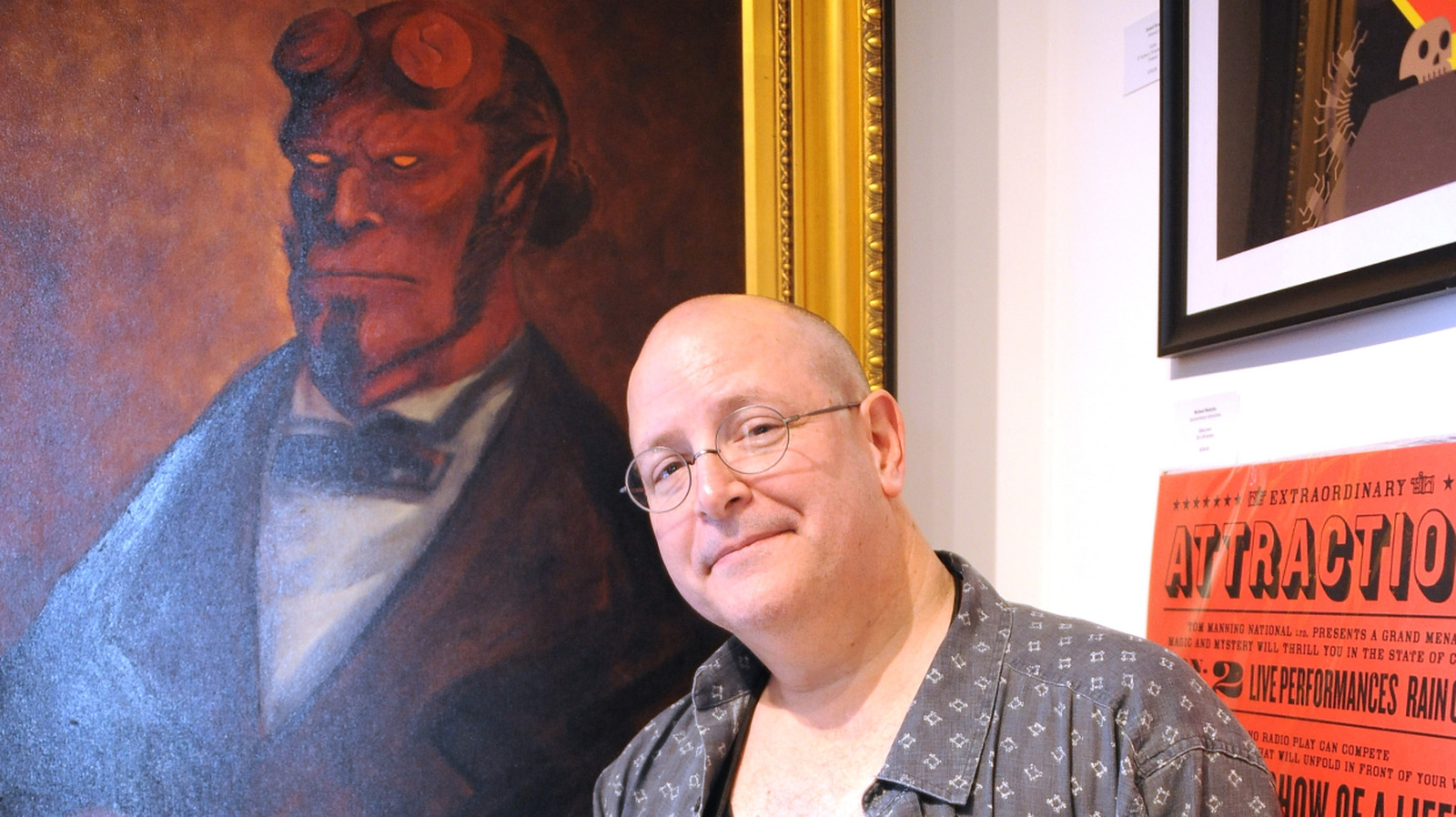
Few American comic artists build up a style as revered or a legacy as consequential as Mike Mignola, the creator of Hellboy, has. His stories are an alchemical blend of pulp adventure, B-horror, monster movies, and spooky literature, but even those one-of-a-kind storytelling instincts couldn’t be realized without Mignola’s skill with a pen and paper.
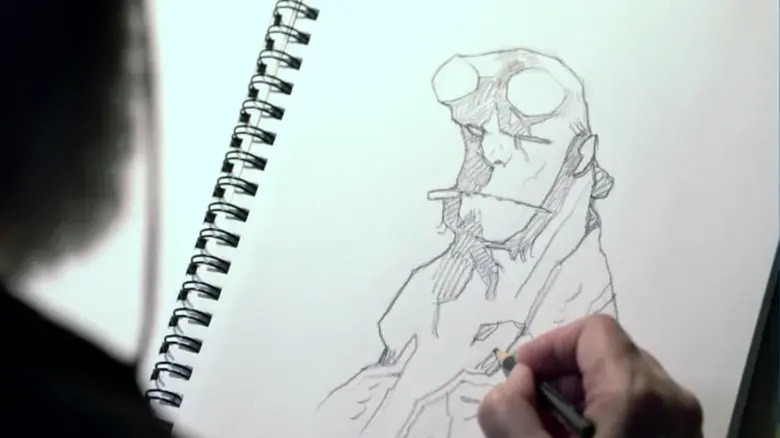
Mignola’s art style, often colored by his collaborator Dave Stewart, relies on striking simplicity and heavy black inks to create shadows. My go-to description of his style is “gothic minimalism.” Another phrasing, often attributed to legendary comic writer Alan Moore, is “Jack Kirby meets German Expressionism.” (This quote does not appear in the reputed primaryured because it’s so apt.)
Born in Berkeley, California in 1960 to a Catholic family (which helps explain why he loves drawing church statues and graveyards so much), Mignola has been a voracious reader since childhood. He particularly credits reading “Dracula” at age 12 as a formative experience. After graduating from the California College of the Arts in 1982 with a BFA in Illustration, he moved to New York City and found work inking and drawing comics at Marvel and DC, including the Victorian-era Batman, “Gotham by Gaslight” (later adapted as an animated film).
Mignola made a name for himself drawing superhero comics, but he’d always preferred drawing monsters. After writing and drawing “Sanctum,” a one-shot Batman set in a haunted graveyard, Mignola conceived Hellboy. Mignola has joked that the character didn’t seem primed for commercial success, but since his 1993 debut, Hellboy has become the premier title of Dark Horse Comics and anchor of a massive shared universe. Its name? The Mignolaverse.
Quote of the Day by Mike Mignola
“Writing is no fun. Making s*** up is fun. Sitting around, writing something for someone else to draw, is no fun at all. So I’m starting to cook up some comics stuff so I can sit there and I can be the guy having fun.”
Mignola said that to Vulture in 2019, when they asked him what projects he had in the pipeline. That year, a new “Hellboy” movie had come out, and the Mignolaverse had recently come to a definitive close in “B.P.R.D.: The Devil You Know.” Mignola easily could’ve thrown in the towel, but his imagination won’t let him rest. He’s kept going back to Hellboy and his world, iterating on his tapestry with new prequels and epilogues. This year, Mignola is returning to “Hellboy in Hell,” a 10-issue series he wrote and drew all himself, because he wanted to work with French artist Cyrille Pomès.
Note, too, that Mignola says he finds greater creative fulfillment in drawing than writing. That shouldn’t be surprising, given he studied and worked as an artist first. Since he wasn’t drawing what he wanted to be drawing, he created Hellboy as the vehicle to finally do that. Even then, he entered slowly; the first “Hellboy” miniseries, “Seed of Destruction,” was scripted by John Byrne before Mignola felt comfortable enough to write the books.
Mignola has proven himself a damn good writer by now, but he still sees the act of writing as work. He hits on something important, too, by delineating between writing and “making s*** up.” Anyone can imagine some pretty good ideas, but it takes time and effort to hone your craft and execute an idea to make it as good as it seemed when it first popped into your head.
Deeper meaning of Mike Mignola’s quote – Imagination is fun, but great art takes work too
Mignola’s words strike me especially hard seven years after he first said them, when generative AI technology has taken off. Those who aren’t willing to put in the work of making art, whether that be writing or filmmaking, treat it like a cheat code; coordinated algorithms produce something, and the human who just had the initial idea tries to reap all the glory of making art.
But art can only come from sincere human expression. Take Mignola’s own magnum opus. Hellboy is something only Mignola could’ve created, forged through a decade drawing superhero comics and a lifelong affinity for ghost stories. Hellboy comes from an even more personal place; Mignola’s father was a carpenter and Korean War veteran, an unfazed tough guy who didn’t show much emotion even with army stories to spare. That personality is the one Mignola gave to Hellboy.
Being able to express yourself in a way that resonates with others takes talent, but the mechanics of doing so (like wielding a pencil, whether to craft prose or pictures) are skills that can be learned. Circling back to writing for others to draw being “no fun,” Mignola has put himself in a very privileged position for a creative person. He’s the architect of the entire “Hellboy” universe, but while all the ideas flow from him, he’s built a web of regular collaborators who’ve in turn helped make “Hellboy” the greatest shared universe in comics.
Mignola can do the fun part of writing, imagining, but unlike most people he doesn’t have to prioritize which ideas are worth his limited time. But if a younger Mike Mignola had only ever imagined, we wouldn’t be writing and reading about Hellboy today.
More quotes by Mike Mignola
- “I’ve just always liked monsters, since I was a little kid. It was always the thing I found interesting, it’s always what I wanted to draw, it’s always what I wanted to read, and so, yeah, I don’t know. It’s a good question for a therapist, why I like monsters.”
- “When the first ‘Hellboy’ series came out, in the same batch of fan mail I got a letter from somebody from the Church of Satan, and I got a letter from a minister, and they both liked it. And I thought, ‘What am I doing that I’m making both these guys happy?’ So yeah, I just think because Hellboy is essentially a good guy, and he fights bad guys, it’s pretty cut and dried, and I think the humor element does make it go down a lot easier.”
- “I really like my work in black-and-white, but when I’m telling a story, color is such an important tool. […] It’s like adding a soundtrack, you can manipulate so many different things with color, it’s such an important tool. I would kind of be lost trying to work without color.”
- “My father was a very tough guy. Not a mean guy, but physically he’s strong and tough. […] He was a cabinet maker so he always came home scarred up, and bloody, and his hands were dried and hard. […] My dad always had a cigarette hanging out of the corner of his mouth, and he just had a very casual way about injury.”
- “I guess [the documentary ‘Mike Mignola: Drawing Monsters’ is] a little like being able to go to your own funeral and hear people say nice things about you. The truth is – for me at least – it’s really hard to wrap your head around how you or your work impacts other people.”
