


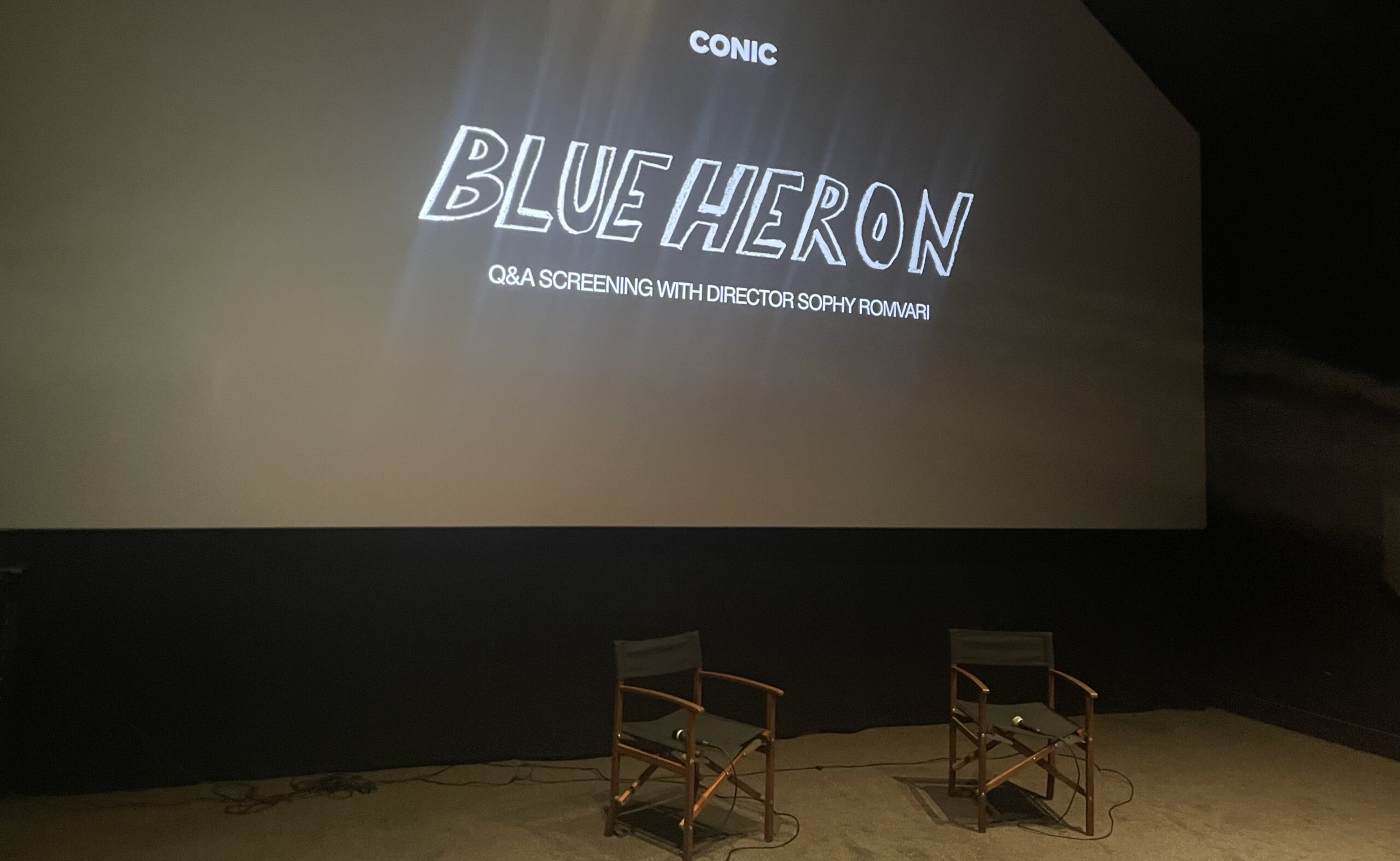
Photo taken by Thomas Deakin, Post-Film Q and A for ‘Blue Heron’ at Hackney Picturehouse
Culture Editor Thomas Deakin commends Sophy Romvari’s first feature picture, ‘Blue Heron’, for demonstrating that contemporary independent film may prosper by putting emotional authenticity ahead of financial gain.
As Hollywood blockbusters such as Christopher Nolan’s ‘The Odyssey’, Phil Lord and Christopher Miller’s ‘Project Hail Mary’, and Antoine Fuqua’s ‘Michael’ continue to dominate public and critical consumption of cinema, it is rare to find a small independent movie that simultaneously wins over critics and universal audiences without surrendering to compromise.
Yet ‘Blue Heron’, the first feature from Canadian filmmaker Sophy Romvari, has achieved just that by reconfiguring her trauma and emotional authenticity into a resonant masterwork. Set in Vancouver Island across multiple time periods, the movie functions as both a tribute to cinema as a device of memory and a confession of its limitations. This lack of resolution was a central theme in her recent post-film Q&A at Hackney Picturehouse, an intimately fascinating session hosted by director Charlie Shackleton as the last stop of her recent European tour.
Whilst most filmmakers shy away from directly importing events from their personal lives, Romvari forged a distinctive filmography that uses her familial trauma to dissect the fragility of memory as either preservable or irretrievable. These reflections on the dialectic between memory and authenticity began with her 2018 short ‘Still Processing’, directed as the thesis film for her MFA at York University. The film utilised childhood photos taken by her father to document her internalised emotional turmoil over the deaths of two of her three brothers.
Her use of cinema as a recollective medium continued with the 2020 documentary ‘Remembrance of József Romvari’, containing home video footage of the only time she ever met her grandfather, a renowned Hungarian production designer. Both these films alluded to the question of whether modern technologies could reignite the past by studying previously dominant modes of cultural production. This emerges as the forefront concern of ‘Blue Heron’, an emotionally authentic movie that offers many questions tainted by the reality of very few answers.
The Technological Memory of Romvari’s Vision
Romvari’s grounding of her emotions within an uncertain material reality is also demonstrated by her work on the ‘social platform for cinephiles’ Letterboxd, an app launched in 2011 to log film reviews, becoming a haven for both comedic and serious film criticism. Romvari’s reviews on this site grappled with the notion of authenticity and uncertainty, synthesising critical analysis with the instinctual reactions these intellectual observations provoke within her.
This approach is clearly represented by her review of Ryusuke Hamaguchi’s 2021 film ‘Drive My Car’, serving as a manifesto for the 21st-century realism that generically defines her films. Specifically, Romvari insinuates that the communicative breakthroughs of the 21st century (i.e. iPhones and Zoom calls) create silence and uncertainty that stimulate emotional growth within a cinematic audience. Thus, the illusion of a manufactured happy ending is destabilised by the openness encouraged on sites like Letterboxd, where phenomenology supersedes objectivity.
As a fictionalisation of the family trauma central to ‘Still Processing’, the first half of ‘Blue Heron’ focuses on the main character, Sasha’s, childhood on Vancouver Island and her family’s failure to stop her elder brother Jeremy from being forced into care due to an undiagnosed mental illness. The melancholic nostalgia of these opening scenes contrasts with the uchronic second half of the movie, where Sasha revisits her memories of her now deceased brother to reckon with the tragic breakdown of her family.
The most interesting scenes take place at the climax of the film, where Sasha has a flashback to a memory of Jeremy’s removal from the house as a social service agent informs her parents of the decision. Although most of Romvari’s film hinges on the uncertainty of processing memories, the linear timeline is fractured in this moment as Sasha breaks the memory barrier and confesses, as herself, that Jeremy will never get the help he deserved. This blunt statement evokes a limited catharsis in a film with so many questions, but so few answers.
The Despairing Uncertainty of Male Mental Health
The gradual revelation of ‘Blue Heron’ that it is a film about evolving perceptions of male mental health doubles the film’s only other consistent linear element: the evolution of technologies implemented for preservation and recollection. One of Jeremy’s few euphoric moments, undamaged by his mental health, occurs when Sasha’s father takes photos of his children and Jeremy playing a game with flour.
Yet this scene is followed shortly afterwards by Sasha inadvertently capturing Jeremy’s arrest for shoplifting on the same camera, a reminder that joy and despair exist in proximity to each other when discussing mental health. By the end of the film, Sasha is anchored to the tragic uncertainty of Jeremy’s condition through a message her brother’s friend put on the announcement of his death on Facebook.
Despite so many questions regarding Jeremy and Sasha’s family remaining firmly unanswered by the end of ‘Blue Heron’, this acceptance of the lack of answers only makes the film’s comments on mental health feel more sincere. Ultimately, Romvari’s cinematic approach to mental health prioritises understanding and authenticity over a reductive need for conformity. This emotional resonance underlines the importance of her message as reassuring and empowering for men at a time where they make up 75% of suicides across Canada, the US and the UK.
Sophy Romvari’s Post-Film Q+A at Hackney Picturehouse
These colliding issues of technology as a means of evolving attitudes towards male mental health were some of the many things Romvari reflected upon in her Q&A with Charlie Shackleton. Though she clarified that ‘Blue Heron’ is a fictional film with documentary elements, the filmmaker also maintained that the film’s authenticity emerged from the actors’ capabilities to react and process information naturally.
For example, she noted how the scenes involving the father’s camera involved the children being taught on camera how to use a darkroom. This authenticity was also reflected in her casting choice to hire actors from a series of diverse backgrounds and languages, not limited to Canadian or Hungarian like her family, to craft the isolating atmosphere of the film.
This commitment to ensuring genuine reactions from her cast was matched by her own reactionary experiences during the production. By making ‘Blue Heron’ and reflecting on her real-life relationship with her brothers, the film’s ending gradually evolved into its nuanced comment on the limitations of art forms to process memories.
After the Q&A ended, due to the small size of the cinema, I was grateful enough to have a brief conversation with Romvari and was refreshed by her genuine willingness to talk about how her film affected the audience personally. This proved her commitment to authenticity, a reflection of her desire as an independent filmmaker to privilege audience connection over commercial profit.
The Style of ‘Blue Heron’
A diverse number of films had influenced the style and narrative of ‘Blue Heron.’ In an interview with Letterboxd, Romvari cited Jacques Rivette’s ‘Celine and Julie Go Boating’ for its “use of time and space” and ‘A.I. Artificial Intelligence’ for its shared theme of “the broken connection between a mother and son.” Freelance film critic Esther Rosenfield also utilised her Substack to compare Romvari’s film to the work of Nobuhiko Obayashi for their shared interest in exploring the ‘overwhelming temptation to re-enter one’s past.’
As a film student and freelance critic myself, I was reminded of the temporal ambiguity of Andrei Tarkovsky’s ‘Mirror’ and the fracturing of the family unit within Sally Potter’s ‘Ginger and Rosa’, among others. There are moments in ‘Blue Heron’ that recall all of these films to an extent. However, the brilliance of Romvari’s film is that, as a synthesis of the director’s experiences with her love of film and the tragedy of her familial circumstances, the result is something unique for the nuance that the narrative of the film is bound by.
Stylistically, ‘Blue Heron’ thus becomes, as argued by film critic Neil Bahadur, an art film for the mass public, in that it mixes the soul of these masterful, yet often inaccessible arthouse films with an unavoidably personal narrative that renders it an impressively unique film.
How ‘Blue Heron’ Could Change The Future of Cinema
In a modern cinematic landscape being assimilated at a near-unstoppable rate by Hollywood productions and their related franchises, cinemagoers are often encouraged to watch films twice, but mostly for means of commercial profit. Yet ‘Blue Heron’ is a film that should be watched twice because its complexities and revelations are even more rewarding on a rewatch.
This is how I felt after watching the film for a second time, without Romvari’s Q&A, at ArtHouse Crouch End. Knowing how the film would play out both heightened the tragedy of the narrative and confirmed the legitimacy of its structure as a personal tale. Rather than resembling a film, it read more as a poetic reflection on the meaning of emotional struggles for artistic and personal growth and a testament to cinema as an essential tool for memory.
The emotional catharsis of ‘Blue Heron’ also sublimates itself perfectly into the growing brilliance of the Canadian independent film scene. Along with Matt Johnson’s nerd comedy about time travel, ‘Nirvanna the Band the Show the Movie’, Romvari’s film reestablishes the evolving identity of Canadian cinema. As a counterbalance to cinema that is ideologically caught by a reliance on filmic traditions, these films show the peril of exploiting nostalgia to exalt the past. As a result, the success of Romvari’s film positively foreshadows that independent filmmakers will maintain the prevalence of the art form for decades to come.


Culture
The Cultural Artefacts in DreamWorks’ Forgotten Island
What happens when a DreamWorks film looks beyond the Philippines’ colonial past? In its first Forgotten Island trailer, precolonial figures and symbols—including the sandugo,…

Culture
Teen Authenticity, Uncovered: Camden’s New Museum of Youth Culture
Culture Editor Thomas Deakin writes about the recent opening of the Museum of Youth Culture’s first permanent space in Camden and its importance as…
Culture
Bleak Week at the Prince Charles and Beyond: The Essentiality of International Cinematic Collaboration
Culture Editor Thomas Deakin analyses the importance of the recent Bleak Week season at the Prince Charles Cinema as the epicentre of a worldwide…


Culture
‘The Cases’: Pop-Rock’s Sonic Descendants
Head of Culture Evelyn Shepphird discusses ‘The Cases’ latest EP ‘Mr. Penny’ with lead vocalist Harry Hornsby and lead guitarist Will Bullen.
