


Our dirty questions to Umair Bilal – DMovies
The fields “country of origin” and “actor” were created in May 2023, and the results are limited to after this date.
« previous
next »
Our dirty questions to Umair Bilal




//=the_title();?>Nataliia Serebriakova interviews the Pakistani director of “sensory” Sufism doc As Light As Air; they discuss Islam, spiritual paths, purification, the problem with filming women, Dziga Vertov, and more
In a remote Sufi town, where music, ritual, and devotion blur the boundaries between the physical and the spiritual, pilgrims arrive each day carrying their private burdens – grief, longing, and hope.
In his debut feature As Light as Air(click here in order to read our exclusive review), Pakistani filmmaker Umair Bilal transforms this gathering into a deeply immersive cinematic experience, tracing a collective journey toward transcendence. Rooted in personal memory yet open to mystery, the documentary film moves beyond observation tocapture the rhythms of Sehwan from within, inviting viewers to surrender to its hypnotic pulse and glimpse a fragile space of freedom in an increasingly constrained world.
Natalia Serebriakova – I read in your director’s statement that the idea came from a personal story, particularly your mother’s connection to Sufism. Could you please tell us more about that?
Umair Bilal – My mother practiced – and still practices – Sufism. It’sa spiritual path within Islam that involves visiting shrines and participating in various rituals. When I was a child, she used to take me to these places, and that’s where I first encountered Sufism. At the time, I was too young to understand it intellectually, but what stayed with me were the sensory impressions – the atmosphere, the visual textures, the emotional states of people. It felt like a space that existed outside the logic of the everyday world.
Later, I became more distant from that environment, especially after moving away from Pakistan. Butthose early memories remained very vivid. I always felt a need to return to them and explore whether I could translate those sensations into an audiovisual form. That’s really where my relationship with the subject begins.
NS – The cinematography is very striking. I understand you worked with a co-cinematographer – how did you divide the work, and how did you arrive at this visual style?
UB – At the beginning, I didn’t have a fixed idea of what the film would look like. I approached it with curiosity. My co-cinematographer, Konstantin Stell, is also a close friend – we studied together. For the first shoot, I simply asked him to join me, and we treated it as an exploration.
We both used separate cameras and experimented extensively. One day we would shoot entirely on a tripod, another day with a gimbal. Sometimes I focused on long tracking shots while he worked with telephoto lenses. We tested as many visual approaches as possible. When we reviewed the material, one particular style stood out – it aligned with the internal logic of the place we were filming.
For the following shoots, Konstantin handled the camera, but the visual language had already emerged from our collaboration. It was a very organic, shared process of discovering what the film needed.
NS – How did the editing process evolve? Did the idea of layering images come during editing?
UB – Editing followed a similar philosophy to shooting – we tried to surrender to the material rather than impose a rigid structure. Initially,we attempted a conventional approach, thinking in terms of plot points, characters, and narrative arcs, but it didn’t work at all.
So we shifted our method. We started with an image we knew we wanted – the opening shot – and then built the film in blocks. Each block followed an emotional trajectory rather than a narrative one. We would construct a sequence, reach a certain emotional peak, and then ask how to move forward from there. It became a very intuitive, exploratory process. We didn’t know where the film would go—the direction was always determined by what came before.
NS – And what about the overall dramaturgy? The ending, with the ritual and the sense of spiritual ecstasy—did you always know the film would conclude that way?
UB – Yes, that was one of the few elements that was clear from the beginning. We knew the film would end with the Dhamal, the central dance ritual. In Sufi practice, this ritual represents release – a way of letting go of accumulated tension. People come to the shrine carrying the weight of everyday life, andthrough the dance they reach a point of exhaustion, even collapse, after which they feel lighter.
The structure of the film mirrors that dynamic: tension builds and releases throughout, but the final sequence provides a more profound release – for both the participants and the audience.
NS – Is Sufism the main form of religion in your region?
UB – Sufism is better understood as a spiritual path or philosophy within Islam rather than a separate religion. In Islam, there are different branches, like Sunni and Shia, but Sufism functions more as a way of being. Importantly, it is not exclusive to Muslims. The shrine where I filmed is open to people of all backgrounds – Hindus, Christians, even atheists.
At its core, Sufism emphasises love, tolerance, and inner purification. It encourages people to transcend ego and connect with the divine through practices like prayer, music, or dance. That “divine” can be understood in many different ways, which makes Sufism very inclusive.
NS – Are there specific prohibitions or sins defined in Sufism?
UB – Not in a rigid sense. Sufism doesn’t operate like an organised system with a fixed rulebook. It’s very fluid and shaped by local culture, history, and traditions. For example, the practices you see in my film are specific to a particular region in Pakistan. If you go elsewhere – even within the country – you’ll find different interpretations. And in places like Turkey, Sufism looks entirely different again.
The shrine I filmed in is located in Sindh, a region historically influenced by both Islamic and Hindu traditions. Many of the rituals you see – like the use of lamps, bells, or certain colours – are rooted in that cultural blending. This hybridity was also important in my choice of collaborators.I worked with artists from India, and they immediately understood the material because of these shared cultural elements, even if their backgrounds were different.
NS – In your film, you focus mostly on men. We only see one woman, a young protagonist. Why is that, if you mentioned that anyone can be part of Sufism?
UB – Yes, that’s where my own identity as a filmmaker came into play. It was a challenge for me. Even though there are many women present in that space and they are part of its daily life, as a man I didn’t have access to certain areas. I felt that if I pointed the camera at women, they might feel uncomfortable. I also tried to find a female cinematographer to join the project, but since we were shooting in a very remote part of Pakistan, it was extremely difficult to make that happen. So I had to accept this limitation and navigate the film accordingly. I captured as much as I could, but there were clear boundaries.
NS – How did you choose these beautiful locations? Can you tell me more about them?
UB – Do you mean the overall location or the specific places within the film?
NS – The specific places!
UB – I’ll start with the broader setting. The film was shot in the town of Sehwan. There are many towns in Pakistan with Sufi shrines, but I chose this one because the saint buried there, Lal Shahbaz Qalandar, is one of the most popular Sufi figures in South Asia – across India, Pakistan, and Bangladesh. He’s also widely present in popular culture, with many singers performing songs and poetry dedicated to him.
This shrine is also historically significant, as he was among the first to introduce Sufism to the region. Another reason I chose Sehwan is that the form of Sufism practiced there closely aligns with my own worldview. It is very subversive, anti-authority, and has remained so for over 800 years.
In contrast, some other shrines in Pakistan have gradually become more conservative, sometimes even segregating men and women. Sehwan has resisted that shift. Despite external pressure from religious orthodoxy, the community there continues to practice Sufism in its own open and inclusive way.
In 2017, there was a suicide bombing at the shrine carried out by Isis, who opposed the practices there – men, women, and transgender people dancing together. Many people were killed. But that same night, after the bodies were removed, people insisted on continuing the ritual dance in the courtyard. That resilience deeply inspired me.
As for the specific images in the film, they were captured intuitively.I wandered through the space like a seeker, much like the pilgrims who have been coming there for centuries. Whenever I saw something meaningful, I set up my camera and filmed it. There was no strict plan –I was responding to the space.
NS – What about the voiceover? Did you write it yourself?
UB – There’s an interesting story behind that. After the second shoot, I initially wrote a voiceover in my own voice, reflecting on the place. But after sitting with it for a few months, it didn’t feel right. The place is much bigger than me, and I didn’t want to centre myself in it.Still, I needed a voice to hold the film together. So I decided it should come from the people who belong to that space. I returned to Sehwan without a camera, only with a microphone, and spent a few days recording conversations with locals.
At first, the recordings felt too didactic – people were explaining the shrine in a very straightforward way. Then one day, I met an old man sitting on the street. Something drew me to him. When I sat down, he began speaking immediately, without waiting for questions. His voice had a poetic rhythm – he spoke in riddles, shifting between stories, sometimes whispering.He spoke for two hours, and I barely said anything. At times, it felt like he was talking to himself. When he finished, he simply said he was done and left. I knew immediately that this was the voice I wanted. That’s the voice you hear in the film.
NS – That’s fascinating. And one sequence I didn’t quite understand – was it about cannibalism?
UB – No, not exactly. There are many folk stories associated with Lal Shahbaz Qalandar, and one of them includes elements of cannibalism. It’s just part of a traditional story referenced in the film.
NS – And my last question – what cinematic influences shaped your experimental style?
UB – Two filmmakers have been especially influential for me. The first is Mani Kaul, the Indian director. His work deeply inspired my approach to duration – how holding a shot long enough can create new meanings. He also showed how elements like lighting and camera movement are not just technical choices but expressive tools.
The second is Dziga Vertov. I often return to Man with a Movie Camera [1929] for its powerful use of editing. His ideas about cinema revealing realities beyond everyday human perception really resonate with me – the idea that the camera can uncover something magical when used with intention.
Those are the two that come to mind immediately, though there are many others.
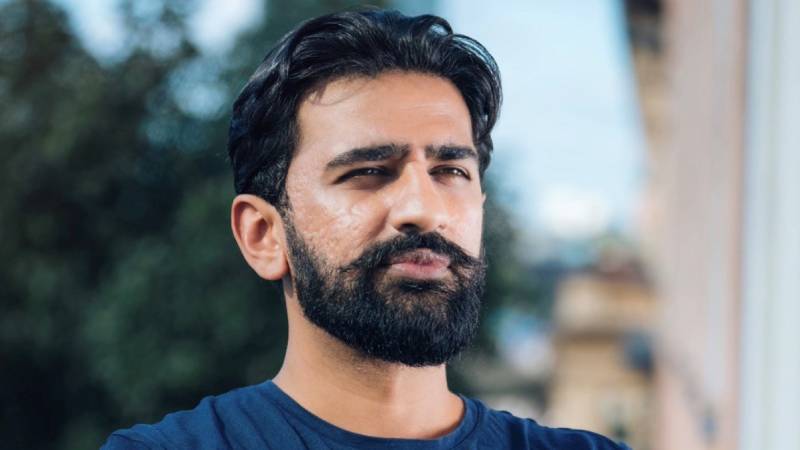
Umair Bilal is pictured at the top of tis interview. The other image is a still from As Light As Air.
The fields “country of origin” and “actor” were created in May 2023, and the results are limited to after this date.
79th Locarno Film Festival
more…
Articles inspired by/based on books by Steve Naish
more…
