

Three weeks ago I pulled up my own time log to see how many hours the last Lost Garden episode had actually cost me. I expected a small number. That’s the whole pitch of generative video: less time, more output. It wasn’t small, and it wasn’t where I thought it would be. Generating the shots took about eleven hours spread across a week. Deciding which of them were any good took thirty-one.
AI video generation does not save time in filmmaking overall. It moves the time from physical production into review, comparison, and judgment, a cost researchers are now calling decision fatigue. That’s the short answer, and it’s the reason a tool that renders a clip in ninety seconds can still leave you more tired at the end of the week than a camera ever did.
Does AI video generation actually save time in filmmaking?
Some of it, yes. Rough cuts that used to take an editor a day now assemble in an hour. Concept frames that used to require a full art department pass come back from a text prompt before lunch. The parts of production that were mechanical, waiting for a render, waiting for a crew call, waiting for a location to open, have genuinely gotten faster.
What hasn’t gotten faster is the part where a human looks at the output and decides whether it’s right. Every generation is a maybe. A camera on a tripod gives you the take you shot. Open Runway or Kling and generate a shot, and the model gives you a candidate, and then another candidate, and then eighteen more, and none of them arrive pre-approved. Somebody still has to watch each one, compare it to the last, and decide.
That somebody, on most indie productions, is one person. Me
Screenshot: Runway website, 2026
Screenshot: Kling AI website, 2026
What is “decision latency,” and why does it hit filmmakers hardest?
Decision latency is the pause before a person accepts or rejects an AI-generated output, repeated dozens of times a day. WalkMe’s CHRO-facing research, published through HR Executive in May 2026, coined the term to describe what happens inside companies that rolled out AI tools without rethinking the review step: workers stay in a “hypervigilant state,” continuously asking whether an output is accurate, whether it matches what came before, whether it’s actually safe to use. Only 12% of workers in WalkMe’s 2026 State of Digital Adoption report said they were fully confident AI tools understood the context of their work. That gap between output speed and reviewer trust is where the fatigue lives.
The same HR Executive piece cites Upwork research showing AI users reported a 40% productivity boost, and yet 88% of the most productive AI-enabled workers also reported burnout, and were twice as likely to say they were considering leaving their job. A separate study covered by Harvard Business Review in March 2026 linked what researchers called “AI brain fry” to a sharply higher quit intent: 34% of workers experiencing it planned to leave, against 25% of workers who weren’t.
None of that research was written about filmmaking. It didn’t need to be. Swap “output” for “take” and “worker” for “director,” and it describes exactly what happens when a model hands you twenty variations of one shot and asks, silently, which one you meant.
A negative prompt fights the model in a text field. Decision latency fights you, at 11pm, on your fourteenth near-identical clip of a character crossing a room.
Where did the hours on Lost Garden actually go?
I’ve written before, from logging actual shot work on this series, that generation is roughly 15% of the real job. Selecting and discarding takes another 30%. Continuity and fixing eats 35%. Planning takes the remaining 20%. That breakdown held again this episode, but this time I isolated the selecting slice specifically, because it’s the one that quietly ruins a schedule.
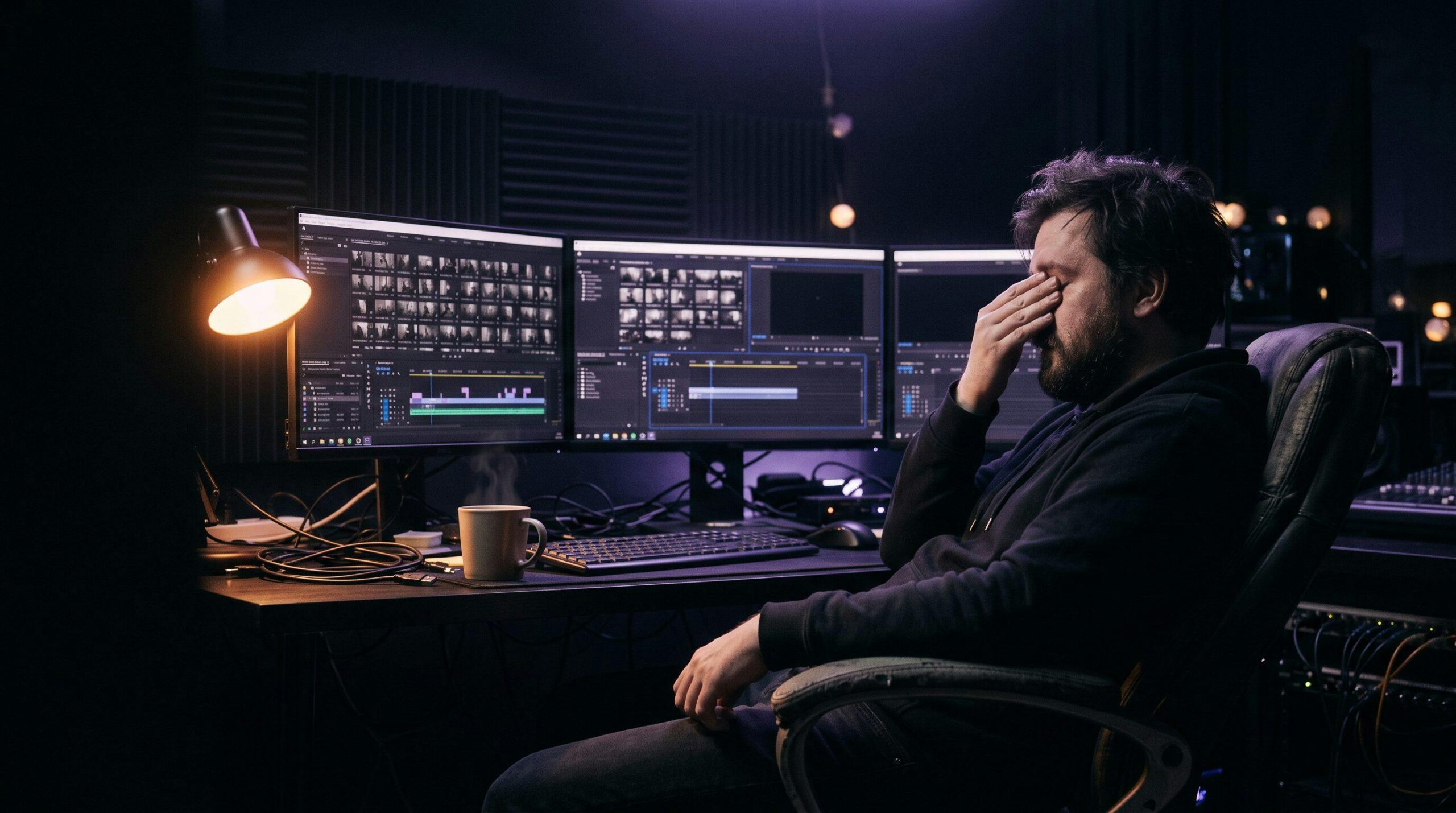
One evening I sat down to pick a single walk-and-turn shot from forty-seven generated takes. Not forty-seven wildly different attempts, forty-seven takes of the same three seconds, because the model doesn’t remember what it did the last time and every regeneration is a fresh roll. Watching each one at full resolution, pausing on the hand, checking the eye color hadn’t drifted, comparing it against the previous best candidate, took most of that evening. The generating had been done in twenty minutes. The deciding took four hours.
What made it exhausting wasn’t the number of clips. It was that every single one required the same small, real decision, made from scratch, with no memory of the nineteen decisions before it carrying any weight into the twentieth. A film crew shooting the same beat forty-seven times would never happen; the cost of film stock and crew time would kill the idea by take five. A generative model has no such brake. The brake has to be a person, deciding, again and again, whether “good enough” has arrived yet.
- Generation is nearly free, so nothing stops the clip count from growing past what any one reviewer can sanely evaluate.
- Every take looks plausible in isolation, so rejecting one takes real attention, not a quick glance.
- There’s no assistant editor doing a first pass, on a one-person production the director is also the entire selects department.
How do you actually fight decision fatigue in an AI filmmaking pipeline?
You don’t fight it by generating less and hoping for the best. You fight it by moving the decision earlier, so there’s less left to decide when you’re staring at clip forty-seven.
A few things changed my week once I took this seriously:
- Write the rejection criteria before you generate, not while you’re reviewing. If “hand must stay in frame, eye color must match the reference, turn must complete within three seconds” is written down before you hit generate, you’re checking a list instead of relitigating the shot’s whole premise on every clip.
- Set a hard cap on takes per shot and stop at it. Twenty variations with a real cutoff beats forty-seven with none. If nothing clears the bar by the cap, the problem is the reference or the prompt, not the twenty-first roll of the dice.
- Batch review in one sitting, not across a scattered week. Comparing five clips against each other is faster and more accurate than comparing each one, cold, against a memory of clips you watched three days ago.
- Decide “good enough” out loud before you look at options. Naming the bar first keeps you from drifting toward “the best of what I generated” instead of “what the scene actually needed.”
This is the discipline I now keep written into the shot notes inside ScreenWeaver, attached to the shot itself, so the rejection bar isn’t something I have to reconstruct from memory every time I sit down to review. It doesn’t make the review faster in some dramatic way. It makes it a decision I make once instead of a debate I have with myself forty-seven times.
Is this just a solo-creator problem?
No, and that’s worth saying plainly. Decision fatigue from AI review isn’t unique to small teams; it’s showing up in the same research covering enterprise knowledge work. What’s unique to a one-person AI production is that there’s no one else to hand the review queue to. A studio can hire an assistant editor to do a first culling pass. On Lost Garden, that first pass and the final call are the same person, on the same night, usually after everything else on the to-do list is already done.
That’s not a complaint about the tools. The tools did exactly what they promised: they made generating a shot nearly free. Nobody promised that deciding which shot to keep would get cheaper too, and on the evidence of one very long Tuesday, it hasn’t.
Three questions people ask about this
Does AI filmmaking still save money even if it doesn’t save time?
Often, yes. Cost and time are different axes. Generating a shot for a few dollars in compute is real savings over a crew day, even if the hours spent reviewing candidates land back in the ledger somewhere else.
Is decision fatigue specific to video generation, or does it hit every AI workflow?
General. The WalkMe and Upwork research cited above covers office knowledge work broadly, not creative production specifically. Filmmaking just makes it visible faster, because every take is watched at full attention.
Should solo creators just generate fewer variations per shot?
Not automatically fewer, but fewer without a cutoff. A cap you actually enforce, paired with rejection criteria written down before you generate, does more for the fatigue than an arbitrary lower number.
Track your own split before you trust the pitch
If you’re logging hours on an AI production and the generation column looks small while you still feel wrecked by Friday, you’re not imagining it. The clock didn’t get shorter. It moved. Track where the hours actually go for one week, honestly, before you decide the tools bought you anything.
What does your own hour split look like, generating versus deciding? I’d like to know if thirty-one hours of review against eleven of generation is normal, or if I’m just bad at saying no early enough.
