




EDITION→
Global
•
USA
•
UK
•
AUNZ
•
CANADA
•
IRELAND
•
FRANCE
•
GERMANY
•
ASIA
•
EUROPE
•
LATAM
•
MEA
Edition : InternationalLanguage : English
HOME
NEWS
CREATIVE LIBRARY
IMMORTAL AWARDS
MEMBER COMPANIES
PEOPLE
JOBS
How LBB WorksPlans & PricingEditorial Toolkit

news
NEWS
CREATIVE LIBRARY
IMMORTAL AWARDS
MEMBER COMPANIES
PEOPLE
JOBS
Login or Register
Creative in association withLittle Black Book

Ramen Has Entered the Chat: How Virtual Production Helped Build Kraft Dinner’s Latest Innovation

lbbonline.com
0
LIKE
ADD TO COLLECTION
15/07/2026
Share
LBB’s April Summers speaks to the teams behind the new Canada-exclusive KD Ramen launch, to explore the ways in which modern technological capabilities elevated the creative concept
Kraft Dinner is a bonafide Canadian classic. A staple in homes across the nation, KD’s roots span back as far as 1916. More than 100 years later, Canadians are more hooked on the product than ever, with an average1.7 million boxes consumed in the country per week.
For those outside North America, let me explain. The brand’s boxed macaroni pasta and cheese powder may seem like a pretty simple and underwhelming offering. But, over the course of its history, KDhas consistently represented an easy, filling and unexpectedly delicious comfort meal that is both affordable and widely available. OneRedditorsums it up rather nicely, “To me, KD will always be one of my many favourite comfort foods. Winters can be long here, it feels good to go home on a cold day and whip up a quick KD meal with some melted butter!”
So, when Kraft decided to launch ‘KD Ramen’ exclusively in Canada, it marked one of the brand’s biggest product innovations in recent memory. For the first time, the iconic cheddar cheese flavour was paired with instant ramen noodles, introducing a bold new offering to one of Canada’s most recognisable brands.
Bringing that launch to life on screen demanded a visual world that felt fresh enough to signal something new, while remaining unmistakably KD. Developed by creative agency Rethink and produced by Impossible Studios, the campaign relied onSP Studios’virtual production expertise to create a stylised, Tokyo-inspired streetscape that seamlessly blended practical craftsmanship with digital world-building. Rather than replacing traditional production techniques, the technology gave the creative team greater control over the environment, while preserving the authenticity of the physical set.
Here, LBB’s April Summers speaks with Geoff Baillie, partner and general creative director atRethink, Jennifer Tam, production designer for Impossible Studios, and Chris Reef, creative director and virtual production supervisor at SP Studios, about the collaborative process behind the campaign, and why, when virtual production is used with intention, it can elevate creative ambition without ever becoming the centre of attention.
LBB> From the earliest creative conversations, where does SP Studios fit into the process? How do you work alongside agencies like Rethink and production partners like Impossible Studios to help shape an idea before the shoot even begins?
Chris> We joined the process midway through pre-production, and worked alongside the creative team to help shape the look and feel of the city. The creative called for a very specific look, so the challenge for this spot was finding a middle-ground between Asian and Western architecture, while maintaining a colour palette complementary to the branding. We ended up optioning a few different city looks and colour palettes before landing on what you see in the final spot.
LBB> What did virtual production allow you to achieve that would have been difficult or simply impractical through a traditional location shoot or physical set build?
Geoff> It allowed us to consider the details of what appeared in every shot, without having to worry about editing around unwanted distractions. If we had shot on location, we’d have to worry about the continuity of the outside world in every shot, or unwanted reflections appearing throughout the set. Using a volume wall allowed us to focus on making the best spot possible, without worrying about background details.
LBB> One of the biggest compliments virtual production can receive is that nobody notices it. On ‘KD Ramen’, what were the small technical or creative decisions that helped the virtual environment feel completely believable?
Geoff> In the pre-production, we worked closely with SP Studios and Impossible Studios to build out the environment of the volume wall. We were able to get extremely detailed with every element in the scene to create a distinctive visual world.
Chris> The key to believability is the blend. We worked closely with the DoP to shape the lighting of our world to match everything being done practically. Another element that ties the worlds together – and one of the true advantages of virtual production – is the Unreal Engine environment reflecting onto the practical set as it gives the viewer a sense that everything they’re seeing in the frame is occupying the same space.
LBB> Virtual production has become significantly more common in commercial production over the past few years. After making this spot, where do you think it offers the greatest creative advantage? and where do traditional production methods still have the edge?
Geoff> It’s always about using a combination of approaches based on the specificities of the creative ask to achieve the best results. For ‘KD Ramen’, using virtual production methods helped add dimension to our traditional set. It’s always in service of what makes the work the best.
LBB> From a production standpoint, what were the biggest creative or logistical challenges in bringing the ‘KD Ramen’ world to life?
Jennifer> I think the biggest challenge was finding the right creative balance. Director Parker Seaman and I were both excited about pushing the ramen world further and creating something a bit more elaborate and immersive, while the agency’s vision leaned toward a cleaner, simpler aesthetic.
As the production designer, my job isn’t to design my favourite version of the project; it’s to design the best version of the client’s vision. Once the direction was clear, the challenge became making a relatively minimal environment still feel cinematic, authentic and memorable.
LBB> How did working with SP Studios influence your approach to production design and shot planning?
Jennifer> Working with SP’s volume stage definitely influenced how I approached the physical build. Knowing that the volume wall would create a larger world meant that I could focus on designing the immediate environment that the actors interacted with, rather than extending every street and building practically.
The size of the volume wall can also play a role in the design, as you have to be mindful of how much you build in front of the wall, so you don’t compromise the virtual environment or limit camera movement.
LBB> One of the strengths of virtual production is the ability to iterate in real time. Were there moments during the shoot where adjusting environments on the LED wall in real time fundamentally improved the final result?
Jennifer> I don’t think we made any dramatic changes to the environment during the shoot. By that stage, most of the creative decisions had already been made. Being able to see everything together in camera was very valuable. Instead of imagining how the practical and virtual environments would combine later in post, everyone could evaluate the final image as we shot.
LBB> What role did practical set pieces play alongside the virtual environments, and how did you strike the balance between physical and digital elements to create something that felt believable
Jennifer> Practical elements are essential when you’re working with a volume stage, because they give the actors something tangible to interact with and help ground the environment in reality.
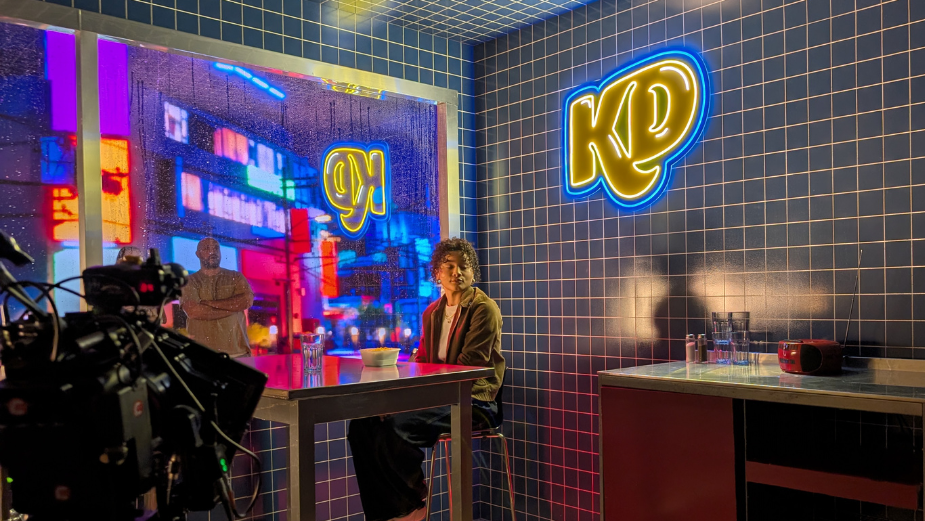
For this project, that balance came quite naturally. The entire interior was built as a practical set, while the volume wall extended the world beyond the windows. This allowed us to create the feeling of a much larger environment, without having to build it all. To help blend the transition between the real and the virtual worlds, I also brought practical exterior elements – things like a street lamp, mailboxes, trees, and other streetscape details. This all helped make the world feel more cohesive.
LBB> Looking back, what’s the one thing people would be surprised to learn about how this commercial was made?
Jennifer> People often assume that because you’re shooting on a volume stage, everything you see is digital. In reality, there was still a lot of practical craftsmanship involved. The KD LED sign, for example, was custom built for the shoot, rather than added later in post. A lot of what makes virtual production successful still comes down to traditional production design and building the right practical elements to support the digital world.
LBB> Virtual production has become significantly more common in commercial production over the past few years. After making this spot, where do you think it offers the greatest creative advantage? And where do traditional production methods still have the edge?
Jennifer> The greatest advantage of virtual production is the freedom it gives filmmakers. It allows you to place a story almost anywhere in the world, or create environments that don’t exist at all, without the time, cost, or logistical challenges of travelling or building everything practically.
That being said, there’s still something about a real location that feels different on camera. Lighting on a volume stage can be a bit more challenging, and experienced filmmakers can often tell when something has been shot on a volume wall. That’s not criticism, it’s just a different medium with its own strengths and limitations.
Virtual production is an incredible tool, but like any tool, it’s most effective when it’s used for the right reasons. I don’t think every project needs it. For me, the most exciting applications are the ones where it enhances what’s possible creatively while still embracing practical sets and real world craftsmanship, and all the things that make physical production feel authentic.
LBB> Beyond this campaign, where do you think agencies and filmmakers still underestimate virtual production? What’s possible today that people may not realise has become achievable or accessible?
Chris> I think the biggest misconception about virtual production is that it is cost-prohibitive. While the upfront investment may seem higher than a traditional shoot, one of its greatest benefits is production efficiency. With the right planning, you can capture multiple locations in a single day, significantly reducing company moves, shooting days, and expensive location fees. When you factor in travel, logistics, weather delays, and the time saved in post-production, those efficiencies quickly add up, often making virtual production a more cost-effective solution overall.
Visit SP Studios LBB page here
Read more from April Summers here

Creative in association withLittle Black Book
More News from SP Studios

SP Studios Pushes Virtual Production Beyond Carbon Savings with ‘Build and Reuse’ Approach29/04/2026

SP Studios’ Strong Start to 2026 Reflects Growing Confidence in Virtual Production27/03/2026

SP Studios Appoints Ben Valiquette as EP and COO to Fuel Next Phase of Virtual Production Growth19/12/2025
ALL THEIR NEWS
Work from SP Studios

AI Utilisation ReelSP Studios
08/07/2026

Kraft Dinner RamenKraft Dinner
08/07/2026
Behind the Scenes with SP StudiosZiploc®
26/03/2026
ALL THEIR WORK
SUBSCRIBE TO LBB’S newsletterEnter your email
FOLLOW US
Events
DPA + SLA (+ US Add.)
About Us
Contact
Editorial Toolkit
Help & FAQ
Privacy Policy
Main Terms & Conditions
Newsletters
Create your own LBB icons
How it works
Plans & Pricing
LBB’s Global Sponsor

