

Close Menu
CinemaMix360

    Subscribe to Updates

    Get the latest creative news from FooBar about art, design and business.

    What's Hot

    Orange Pi 5B SBC gets Ubuntu Desktop and Audio Production OS images with Bluetooth/Wi-Fi fix missed for 8 years

    July 30, 2026

    Sydney Sweeney and Noah Centineo complete filming on Netflix’s live-action Gundam film

    July 30, 2026

    Exclusive | ZEE Network Withdraws ‘Rotational Credit’ Policy For TV Writers After Screenwriters Association Pushback

    July 30, 2026
    Facebook X (Twitter) Instagram
    CinemaMix360
    Facebook X (Twitter)
    • Home
    • Movies
    • TV
    • Film School
    • Festivals
    • Indie
    • Trailers
    • Videos
    • Careers
    • AI & Tech
    • More
      • Cinematography
      • Directing & Producing
      • Editing & Post Production
      • Screenwriting
      • Sound & Music
    CinemaMix360
    Home»Cinematography»The Unique Photography Techniques That Help Preserve Spectacular Night Skies (U.S. National Park Service)
    Cinematography

    The Unique Photography Techniques That Help Preserve Spectacular Night Skies (U.S. National Park Service)

    AURAMEDIAPROBy AURAMEDIAPROJuly 18, 2026No Comments6 Mins Read
    Facebook Twitter Pinterest LinkedIn Reddit WhatsApp Email
    The Unique Photography Techniques That Help Preserve Spectacular Night Skies (U.S. National Park Service)
    Share
    Facebook Twitter Pinterest Reddit WhatsApp Email

    Equipped with special cameras and gear, National Park Service scientists help parks counter the impacts of artificial light at night. They share tips for successful night sky photography.

    About this article

    This article was first published online on March 31, 2026, as part of the Picturing the Unseen series.

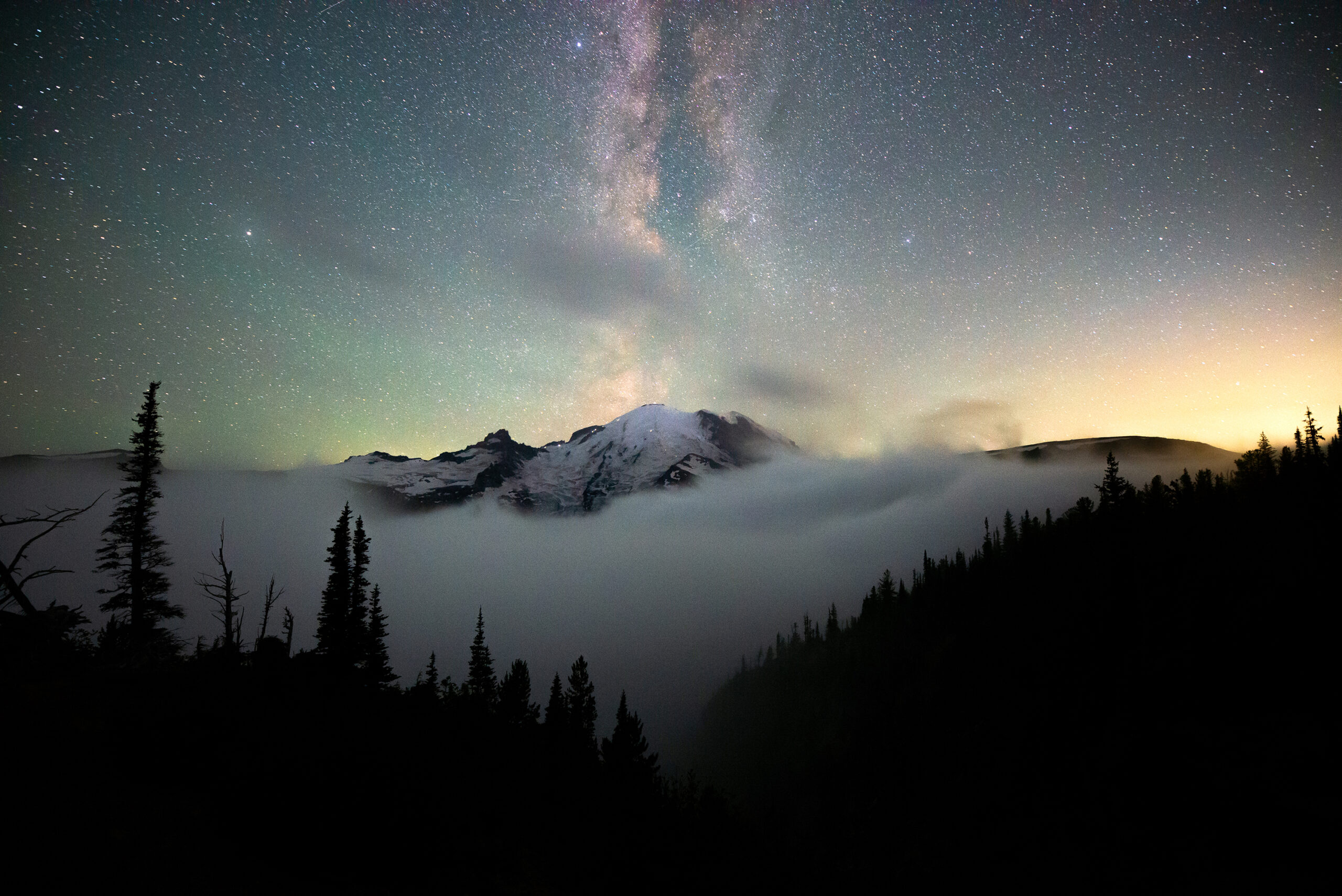
    Capturing this photograph in Mount Rainier National Park required patiently waiting for a break in the clouds while bundled in layers of clothing to protect from the cold. Just after 3 a.m., the clouds cleared, revealing a stunning show of the Milky Way above the mountain. Copyright © M. S. Griffin. Used with permission.

    Dark night skies draw tens of thousands of visitors and photographers to national parks. In 2019 alone, over 12,000 visitors attended the Grand Canyon Star Party. But light pollution from artificial light at night is a growing concern, with impacts on people, wildlife, and plants. Scientists from the National Park Service’s Natural Sounds and Night Skies Division help parks understand and counter the effects of artificial light, preserving dark night skies for visitors and for animals and plants who depend on the dark. Photography is a key tool they use.

    Prepare for Success

    Nighttime photography requires planning, preparation, and sometimes specialized gear. Before setting out, it’s helpful to consider ambient conditions. Weather, moon phase, viewing direction, where stars and other celestial objects appear in the sky, and light pollution are all important when choosing a time and location to capture images.

    Time of year can play a big role in gaining access to parks and events, as well as in the visibility of celestial objects.

    It’s also important to know park rules and regulations. And it may be worth looking into night sky programs, star parties, or photography workshops. Time of year can play a big role in gaining access to parks and events, as well as in the visibility of celestial objects.

    <img src="https://cinemamix360.com/website_97b25373/wp-content/uploads/2026/07/Night-sky-view-at-Spanish-Bottoms.webp" alt="A group of campers with gear lit by red lights under a star-filled night sky”>
    A group of campers under a nighttime view of the stars at Spanish Bottoms, Canyonlands National Park. Taking images using a tripod and a camera with manual settings generally produces the best results. A wide aperture lens also helps by allowing more light to reach the camera sensor. But many smartphones can also handle long exposures and have options to take nighttime images without needing so much gear. Copyright © Ben Banet. Used with permission.

    Tools to Monitor Light Levels

    For over 20 years, the Natural Sounds and Night Skies Division has been using nighttime photography as a means of monitoring light pollution levels. The division’s flagship camera system includes a Nikon lens, a V-band filter, and a monochromatic charge-coupled device (CCD) for recording the images.

    This astronomical-grade system captures 45 images that can be stitched together to create a 40-million-pixel panoramic image covering the entire night sky.

    A V-band filter lets through primarily green light, which estimates human perception of night sky brightness. A CCD is a black-and-white digital camera sensor that measures light very accurately, from the darkest of parks to more urban areas. The camera sits atop a robotic telescope mount and is operated using a computer. This astronomical-grade system captures 45 images that can be stitched together to create a 40-million-pixel panoramic image covering the entire night sky. With this high level of accuracy, it takes 30-40 minutes to image the night sky, and skies must be clear of clouds.

    A view of the night sky depicted as a dome-shaped mostly blue area above a high, snow-covered mountain on the left and a mountain range on the right. Colors ranging from green to yellow, red and white occupy a smaller dome-shaped region in the center.
    A CCD-system-generated image taken from Burroughs Mountain, Mount Rainier National Park, in August 2007. It shows measured brightness levels of different areas of the sky. The bright white, red, and orange region of the image just to the right of Mount Rainier is the Seattle-Tacoma light dome. NPS / Natural Sounds and Night Skies Division

    The division also uses a newly developed fisheye system to capture a single 180-degree hemispherical image. This system takes images in just 10-15 minutes and is much more portable than the CCD system. It can take images on nights with clouds.

    Camera on tripod with wires attached to it standing on green grass in front of a rocky stream
    The NPS Fisheye Night Sky Imager. This system has a camera, a Johnson V filter, and an 8 mm F3.5 fisheye lens. The entire system can be wirelessly controlled. See Hung and others, 2024, for details. From Hung and others. 2024. Fisheye Night Sky Imager: A Calibrated Tool to Measure Night Sky Brightness. Publications of the Astronomical Society of the Pacific 136: 8.

    Predictive Models

    For modeling light pollution, division scientists use satellite imagery captured with a special sensor. Annual composite images from this sensor are then converted into Simplified All-Sky Light Pollution Ratio (SALR) values using a predictive model. SALR is a way to measure the amount of artificial light in the night sky compared to the natural night sky brightness.

    Map of the United States with the eastern half having many yellow and red-colored areas, while the western half has mostly blue and black-colored areas. On the right is a legend that shows which brightness values the different colors represent.
    Model-predicted Simplified All-Sky Light Pollution Ratio (SALR) values for the conterminous United States in October 2016. The map shows how bright the night sky appears due to artificial lights. Brighter areas (yellow/white) indicate high levels of artificial light, while darker areas (blue/black) show more natural night sky conditions. See Duriscoe and others, 2018, for details. From Duriscoe and others, 2018. A simplified model of all-sky artificial sky glow derived from VIIRS Day/Night band data. Journal of Quantitative Spectroscopy and Radiative Transfer 214.

    Urban Stargazing

    Remote parks often offer the best night viewing, but there are also plenty of urban parks that allow for stargazing. Saguaro National Park near Tucson, AZ, for example, is an Urban Night Sky Place, a designation given by the International Dark Sky Association.

    A nighttime photo of a tall cactus plant against a backdrop of stars with city lights in the background.
    Despite close proximity to a large city, Saguaro National Park visitors can view starry night skies throughout the park. The park neighbors the Tohono O’odham Nation and is 50 miles from the Kitt Peak National Observatory. NPS

    Nighttime “lightscapes” are important regardless of a park’s location, and night sky photography is a rewarding way to enjoy nature as well as a tool to help preserve dark night skies.

    About the authors

    selfie of man with glasses in a cap and jacket in front of a glacier

    M. S. Griffin is a GIS and photogrammetry intern with the National Park Service’s Natural Sounds and Night Skies Division. Learn more about GIS and photogrammetry. Photo copyright © M. S. Griffin. Used with permission.

    Man in NPS uniform working on equipment with grassy field, mountains, and blue sky in the background

    Ben Banet works as a physical scientist and dark sky coordinator for the Natural Sounds and Night Sky Division. He uses all the camera systems mentioned in this article and helps parks improve their lighting to be more night-sky friendly. Photo credit: NPS

    Republishing this article

    This article is available for unedited republication, free of charge. We ask that you use the following credit: Originally published as “The Unique Photography Techniques That Help Preserve Spectacular Night Skies” on nps.gov, March 31, 2026.

    Important: Some images may becopyrighted. Permission from the copyright holder is needed to reuse these. Check image credits for details.

    Pleaselet us knowif you republish this article or have any questions.

    Cite this article

    Griffin, M.S., and Ben Banet. 2026. “The Unique Photography Techniques That Help Preserve Spectacular Night Skies.” National Park Service, March 31, 2026. https://www.nps.gov/articles/000/psv40n1_the-unique-photography-techniques-that-help-preserve-spectacular-night-skies.htm

    ‘;
    itemHTML += ‘
    ‘;
    jQuery(“#related_B9F06285-D58F-DB3C-039BFFCF6841D7EC”).children(“div”).eq(childToUse).append(itemHTML);
    } ,runFunctionAfter: function(){
    if(jQuery(“#related_B9F06285-D58F-DB3C-039BFFCF6841D7EC div.RelatedGridItem”).length > 0){
    jQuery(this.element).parent().show();
    }
    }
    })
    });

    Loading results…

    help Photography Techniques that Unique
    Share. Facebook Twitter Pinterest LinkedIn WhatsApp Reddit Email
    Previous ArticleBrenda Fricker: Oscar
    Next Article What I Learned Directing My First Franchise Film
    AURAMEDIAPRO

    Related Posts

    After months of speculation, DJI’s dual

    July 30, 2026

    “Switch” showcases bisexuality with humor and heart

    July 30, 2026

    Emilie Lowe’s short film wins praise for cinematography

    July 29, 2026

    Ask Me Anything: Train Dreams cinematographer Adolpho Veloso

    July 29, 2026

    Reuters appoints Éric Baradat as global director of photography

    July 28, 2026

    In-Flight Safety Videos That Are Better Than The In-Flight Entertainment

    July 28, 2026
    Add A Comment
    Leave A Reply Cancel Reply

    Editors Picks

    Guild Wars 2 Art Shows Upcoming Projects

    January 12, 2021

    Scary Movie 6: Release Date, Plot, Cast & Preview

    January 12, 2021

    Where is Pearl in the Mist Filmed?

    January 12, 2021

    How Conspiracy Inspired ‘Scary of Sixty-First’

    January 12, 2021
    Top Reviews
    Sound & Music

    Orange Pi 5B SBC gets Ubuntu Desktop and Audio Production OS images with Bluetooth/Wi-Fi fix missed for 8 years

    By
    Editing & Post Production

    Sydney Sweeney and Noah Centineo complete filming on Netflix’s live-action Gundam film

    By
    Screenwriting

    Exclusive | ZEE Network Withdraws ‘Rotational Credit’ Policy For TV Writers After Screenwriters Association Pushback

    By
    • Facebook
    • Twitter
    • Pinterest
    • Instagram
    • YouTube
    • Vimeo

    Subscribe to Updates

    Get the latest creative news from SmartMag about art & design.

    About Us
    About Us

    CinemaMix360 is your trusted destination for the latest movie news, TV updates, official trailers, and filmmaking resources. We bring together entertainment industry coverage and educational content to inspire film lovers, creators, and aspiring filmmakers around the world.

    Our Picks

    Watching Wonder Woman 1984 with an HBO Max Free Trial?

    January 13, 2021

    Wonder Woman Vs. Supergirl: Who Would Win

    January 13, 2021

    PS Offering 10 More Games for Free, Including Horizon Zero

    January 13, 2021

    Subscribe to Updates

    Stay tuned for more movie news, TV updates, trailers, and filmmaking insights.

    Facebook X (Twitter) Instagram Pinterest
    • About Us
    • Get In Touch
    • Disclaimer
    • Privacy Policy
    • Terms & Conditions
    © 2026 CinemaMix360. All Rights Reserved.

    Type above and press Enter to search. Press Esc to cancel.