


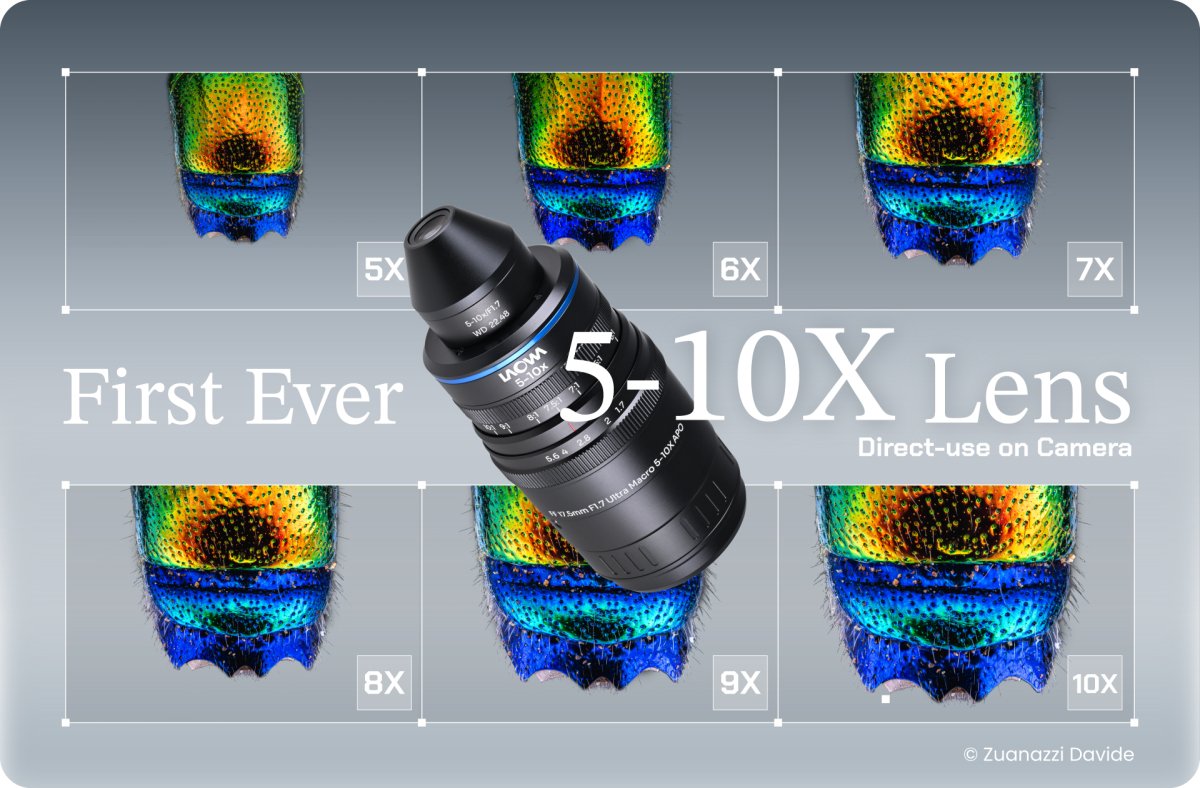
Venus Optics has opened sales today on the Laowa Aksen Ultra Macro Series — two lenses that, for the first time in the commercial market, allow a camera to zoom continuously through extreme magnifications without ever losing focus. The 5–10x model, in particular, occupies territory that no standard-camera-mount optical system has ever covered: a parfocal zoom spanning magnifications where insects become landscapes and a coin becomes a continent, all held in focus through the entire range.
Until today, shooting at 5x to 10x magnification on a standard camera body meant choosing between a compound research microscope — which uses fixed objectives, offers no zoom, and requires an adapter to connect to a camera mount — or a precarious improvised stack of extension tubes, reversed lenses, and bellows that cannot be parfocal by design. A parfocal lens maintains focus as magnification changes; an extension-tube stack changes working distance as each tube is added, making continuous zoom impossible without losing the subject entirely. The Aksen 17.5mm f/1.7 5–10x Ultra Macro APO solves that problem with an internal cam mechanism that holds the focal plane stationary through the entire zoom range, a design Venus Optics describes as a distinct mechanical engineering breakthrough.
The parfocal zoom design was first publicly demonstrated at NAB Show 2026 in April, when Venus Optics showed the lenses under their pre-commercial name. They ship today as the Aksen series, available through the Laowa website at venuslens.net and authorized resellers including B&H Photo.
Why Parfocal Zoom Matters at Extreme Magnifications
The term “parfocal” appears often in camera marketing where it means almost nothing — consumer zoom lenses drift slightly in focus as they zoom, and a fast autofocus system compensates before anyone notices. In extreme macro work, that approximation stops being acceptable entirely.
At 5x magnification, the depth of field for a typical macro setup is measured in fractions of a millimeter. A subject the size of a grain of rice fills the frame. Under those conditions, even the microscopic vibration of a focusing ring turning can shift the subject completely out of frame. Conventional “zoom” at extreme macro means physically moving the entire camera rig forward or backward — which repositions lights, disturbs subjects, and breaks any possibility of smooth video zooming.
A true parfocal design solves this through an internal cam mechanism: as magnification increases, compensating lens groups move to keep the focal plane stationary relative to the subject. The barrel does not extend, the working distance does not change, and the subject stays in the same position in the frame. This is why broadcast and cinema zoom lenses are engineered to be parfocal — and why applying the same principle to extreme macro required a distinct mechanical engineering breakthrough by Venus Optics’ own account.
What Parfocal Working Distance the Aksen Achieves
The engineering challenge at the heart of the Aksen’s design is the relationship between magnification, working distance, and numerical aperture (NA). As magnification increases, physics tends to push the front element closer to the subject — a 10x research microscope objective typically works within millimeters of the specimen. The Aksen 17.5mm f/1.7 5–10x Ultra Macro APO maintains a fixed working distance of 22.48mm (about 0.88 inches) across its entire zoom range. That working distance — nearly an inch — is generous enough to place a small LED light between the front element and the subject, which changes what is practically achievable in the field.
The tradeoff for that working distance is a numerical aperture of approximately 0.1–0.25 across the zoom range, which is lower than a dedicated 10x research microscope objective at equivalent magnification. For scientific users requiring maximum resolution at a fixed magnification, a research objective still wins on that metric alone. For photographers, cinematographers, and applied scientists who need the ability to zoom continuously through the range — or who need the subject to survive without being crushed by the front element — the Aksen’s design makes a different argument entirely.
Apochromatic Correction: Why It Matters at These Magnifications
Both lenses in the Aksen series carry an APO designation, indicating apochromatic optical correction. Where a standard achromatic lens focuses two wavelengths of light to the same plane, an apochromatic design corrects three — typically red, green, and blue — reducing residual chromatic aberration by up to an order of magnitude compared to an achromat of equivalent aperture.
At 1x or 2x magnification, a small amount of color fringing might be barely visible and easily corrected in post. At 10x, chromatic aberration is physically magnified along with everything else. An uncorrected lens at 10x produces color fringing wide enough to obscure fine detail — the veins in an insect wing, the grain structure of a metal surface, the cellular patterns that a forensic photographer or biologist needs to resolve. The APO correction in both Aksen lenses is not a premium-tier luxury at these magnifications; it is practically necessary for scientifically useful output.
Two Lenses, One Continuous System
The Aksen series is designed so its two models hand off seamlessly, together covering the 1x to 10x range.
The Aksen 45mm f/2.8 1–5x Ultra Macro APO handles the first half of the range, from life-size to five times magnification. Built from 13 optical elements in nine groups with an 11-bladed aperture, it holds a fixed working distance of 40.35mm (about 1.59 inches) throughout. A coaxial illumination block is integrated directly into the lens barrel — an arrangement borrowed from industrial machine-vision optics — which illuminates subjects from the same optical axis as the lens itself. For flat subjects like stamps, coins, printed circuit boards, or text, this geometry eliminates the edge shadows that a ring light or oblique source would cast, producing the uniform, shadowless coverage that forensic imaging, numismatics, and philatelic documentation require.
The Aksen 17.5mm f/1.7 5–10x Ultra Macro APO covers the range that previously had no commercial camera-mount solution. Built from 17 elements in 12 groups, it offers a bright f/1.7–f/5.6 aperture — significant because at 10x magnification, light reaching the sensor is reduced dramatically relative to what the metered aperture suggests. An included 8mm Coaxial Light Adapter provides the same shadowless illumination option as the 45mm. The barrel is stationary through the zoom range, meaning the front element neither advances toward nor retreats from the subject as magnification changes — which eliminates the “lens crash” risk, where a barrel extending toward a fragile specimen makes contact with it. The NAB 2026 first look confirmed these capabilities in person on the show floor.
Who Fills the Gap Before Today?
For photographers working below 5x magnification, the market has offered solutions for decades, the most notable being the Canon MP-E 65mm f/2.8 1-5x Macro. That lens has been the reference point for extreme close-up photography on Canon systems since its introduction — but it is varifocal (focus shifts as magnification changes), it caps at 5x, and it works only with Canon EF-mount bodies. For non-Canon shooters, Laowa’s own 25mm f/2.8 2.5-5x Ultra Macro provided part of the range for all major mounts, but also without parfocal behavior and without extending to 10x.
Above 5x, the commercial market offered nothing. Macro photographers reaching for higher magnifications built improvised systems: extension tubes stacked behind reversed prime lenses, bellows extensions, or microscope objectives adapted to camera bodies with specialty adapters. These systems worked, but the extension tube and bellows limitations meant the working distance changed with every addition, the barrel extended physically toward the subject, and continuous zoom was mechanically impossible.
Mount Compatibility and What Ships Today
Both photo versions of the Aksen series are available now for $749 each through the Laowa website at venuslens.net and authorized resellers including B&H Photo. Photo mount compatibility includes Sony E, Nikon Z, Canon RF, L-Mount, Nikon F, Canon EF, Fujifilm X, and Micro Four Thirds — effectively every major still-camera system in current production.
Cine versions at $1,499 are housed for Arri PL mount, with interchangeable bayonets covering Sony E, Nikon Z, Canon RF, Canon EF, L-Mount, Fujifilm X, and Micro Four Thirds. Both versions ship with a dedicated tripod collar designed for Arca-Swiss compatible heads and 15mm rod attachments, pointing clearly at the video and cinema workflow where parfocal zoom is not an option but a requirement.
Both lenses are manual focus only — autofocus systems cannot lock reliably at magnifications where the depth of field is measured in fractions of a millimeter. The 17.5mm 5–10x does not accept rear filter threads; the 45mm 1–5x accepts a 37mm rear filter in its PL cine version.
What Is a Parfocal Zoom Lens?
A parfocal lens maintains focus when its focal length or magnification changes. The term comes from “par” (equal) and “focus” — the focal plane stays at equal distance from the subject regardless of zoom position. This property is standard in broadcast cinema lenses and in laboratory microscope objective systems, where switching from a 10x to a 40x objective does not require refocusing. In camera lenses designed for conventional photography, true parfocal behavior is rare and expensive to engineer; most “zoom” lenses are actually varifocal, meaning focus shifts as zoom changes — a problem autofocus compensates for in still photography but cannot solve in macro work, where autofocus cannot lock at these magnifications.
Frequently Asked Questions
What is the difference between a parfocal and varifocal lens for macro photography?
A parfocal lens holds focus as magnification changes, using an internal cam mechanism to keep the focal plane stationary. A varifocal lens loses focus when zoomed and must be refocused manually or automatically. For conventional photography, autofocus makes varifocal lenses practical. At extreme macro magnifications — where depth of field is a fraction of a millimeter and autofocus cannot lock — varifocal behavior makes smooth zoom effectively impossible. The Aksen series is parfocal throughout its range.
Can the Aksen 5–10x replace a research-grade microscope objective?
Not for pure resolution at a fixed magnification. Dedicated 10x research objectives achieve higher numerical apertures (NA) at their fixed magnification than the Aksen’s 0.1–0.25 range — giving them more resolving power for a given magnification. The Aksen’s advantage is everything else: it connects to a standard camera mount, zooms continuously from 5x to 10x without losing focus, maintains nearly an inch of working distance across that range, and produces video-capable continuous zoom. For field scientists, cinematographers, and photographers who need those capabilities, there has been nothing comparable available commercially before today.
What are the best applications for the Laowa Aksen Ultra Macro Series?
Natural history and wildlife cinematography, where continuous zoom lets a camera hold a subject while changing composition without repositioning; forensic and evidence photography, where the coaxial illumination on both models produces shadowless images of flat surfaces; scientific specimen documentation; product and materials imaging for quality control; numismatics and philately (coin and stamp photography); and any application where a macro photographer has historically had to choose between a compound microscope and an improvised extension-tube stack. The combined 1x–10x range of the two lenses covers more of the near-microscopic visual spectrum than any previous off-the-shelf camera-lens system.
Does the lens pose a privacy or data security risk?
No. The Aksen series are entirely passive optical devices — mechanical glass-and-metal lenses with no electronic components, no microprocessors, no wireless connectivity, no firmware, and no data collection capability of any kind. They do not connect to networks and do not transmit information to any party.
ⓒ 2026 TECHTIMES.com All rights reserved. Do not reproduce without permission.
