


Film industry coalition reaches agreement with trade and industry department to start clearing funding application backlog
13 August 2026
| News
|
Cape Town
Add GroundUp on Google
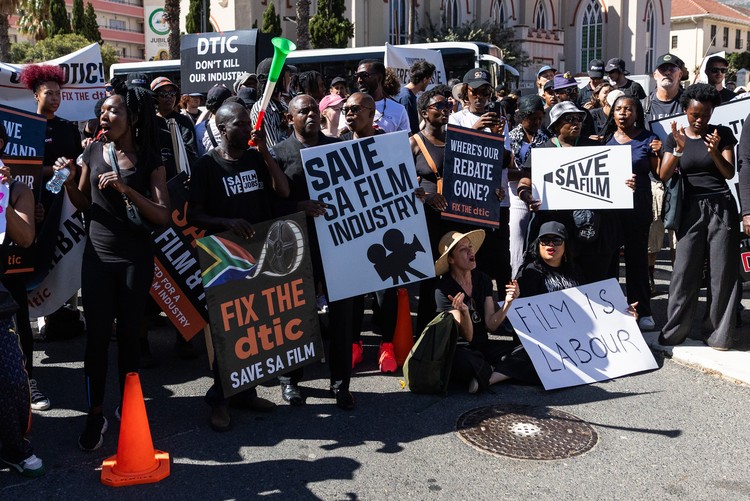
Hundreds of film industry professionals protested in Cape Town on 28 January 2026. Archive photo: Ashraf Hendricks.
- The process to address the backlog of about R700-million in film production applications is expected to resume on 30 September. This comes after adjudication meetings stalled for more than two years.
- The industry says 1,850 jobs and R822-million in production spending have been lost this financial year.
- New applications are expected to be adjudicated from November under an agreement – between the Save SA Film and TV Jobs Coalition and the Department of Trade, Industry and Competition – to revise the film incentive programme.
The Save SA Film and TV Jobs Coalition and the Department of Trade, Industry and Competition (DTIC) have reached an agreement to address the crisis in the industry caused by the paralysis of the South African Film and Television Production Incentive.
The incentive was launched in 2004 to support the local film industry and is regarded as essential if the local industry is to compete international-feature-2027-turkey-lithuania-kick-off-race/” title=”Oscars best international feature 2027: Turkey, Lithuania kick off race”>internationally. But it has collapsed in recent years.
The coalition and the DTIC jointly agreed to reconvene adjudication meetings on 30 September to clear a backlog of about R700-million in film production applications, the Portfolio Committee on Trade, Industry and Competition heard on Tuesday.
The coalition told MPs that 1,850 jobs and an estimated production spend of R822-million were lost this financial year.
The coalition is made up of film and TV organisations representing producers, writers, actors, directors, editors, cinematographers, documentary filmmakers, animators, stunt performers, and many others.
In January, hundreds of film industry workers marched to Parliament calling for the resumption of the film incentive, which has processed no new applications since 2024.
The coalition told MPs in February that the film industry is a major driver of youth employment and economic growth.
DTIC Minister Parks Tau said at the time that the programme stalled due to fiscal pressures. During the covid pandemic, the budget for the film incentive was reallocated as productions stalled, incurring a significant “contingent liability” through a backlog of payments for approved productions.
On Tuesday, DTIC acting deputy director-general for incentives Justice Ngwenya said the contingent liability stood at approximately R2-billion for the year ended March 2021, but since September 2025 has “shown a consistent downward trend” and was R255-million as at June 2026.
Ngwenya adjudication meeting will resume once the contingent liability has been cleared.
The coalition released a statement on 25 July, declaring that after several meetings with the DTIC since February, talks had deadlocked. It called for the DTIC to resume adjudication committee meetings, which had been stalled for more than two years.
Unathi Malunga, coalition representative and entertainment lawyer, told Parliament that the department received a budget allocation for 2026/27 of R236-million.
“The budget has been allocated but the department still does not convene adjudication committee meetings, the continued paralysis becomes an administrative failure, and that … has consequences,” said Malunga.
Malunga said in addition to the more than R800-million production spend lost, the government also “forfeited” between R100-million and R125-million in tax revenues.
The coalition is also calling for the removal of the DTIC director of film and television production Nelly Molokoane for alleged lack of oversight over the incentive programme that “has effectively collapsed”.
The DTIC told GroundUp it is “unable to comment on this matter at this stage”.
In Parliament, DTIC deputy minister Zuko Godlimpi said the department is “mindful of industry’s view that discussions have reached an impasse on certain matters. We acknowledge these concerns and we remain committed to engaging in good faith to find practical and sustainable solutions”.
He said the department has been in talks with the National Treasury on the possibility of introducing a tax rebate system aimed at “building an incentive framework that is fiscally sustainable” and “administratively efficient”.
MPs raised concerns about the delayed resumption of the adjudication committee meetings. Nobuntu Hlazo-Webster (BOSA) welcomed the progress in reducing the contingent liability, but said “progress in paying off historic liabilities is not the same as restoring a functioning incentive”.
The DTIC and coalition agreement sets out a timeline to establish short-term working groups and to jointly develop revised incentive guidelines. The adjudication cycle for applications submitted but not yet approved will start at the end of September. According to the plan, by the end of November, adjudicating new applications should resume.
The portfolio committee chairperson Mzwandile Masina said in a statement that the committee welcomed the progress and urged the department “to resolve its capacity constraints to ensure that the industry is adequately supported”.
Support independent journalism
Donate using Payfast

Arts and cultureEconomyUnemployment
Next:
Protests force CPUT to withdraw student payment plan
Previous:
Makhado plans new RDP houses but homes built in 2021 still lack water and electricity
Write a letter in response to this article
