


On the morning of August 22, 2023, Pakistan watched eight people hang precariously from a cable-car gondola suspended hundreds of feet above a ravine in the village of Allai in northern Pakistan. The cable car had been carrying schoolchildren across a valley in Allai when two of its cables snapped.
For hours, the country waited, transfixed, as rescuers attempted to reach the stranded passengers.
The footage was extraordinary: a boy suspended by a helicopter above the valley; rescuers inching towards the cable car; a military helicopter hovering nearby; villagers watching helplessly from below. There was a sense that the entire country was holding its breath.
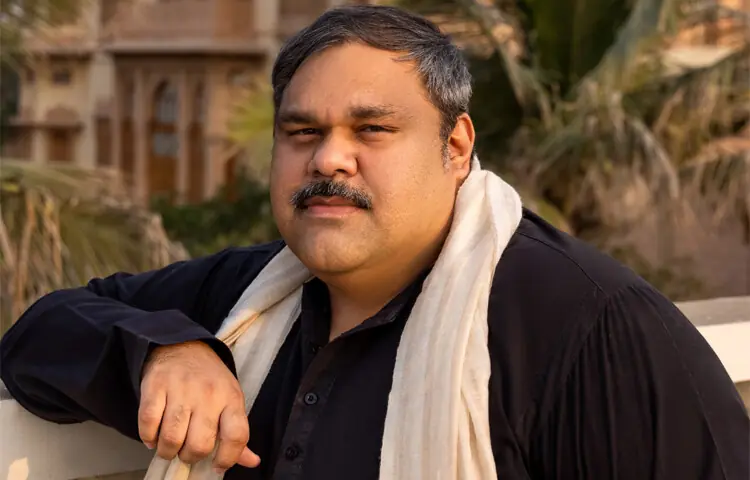
Filmmaker Mohammed Ali Naqvi was watching too. “I think everyone was glued to their TV that day,” he says. “It was a play-by-play unfolding on the TV.”
After two decades of making films about Pakistan, the critically acclaimed documentary filmmaker is done with the expectation that Pakistani filmmakers must explain their country to the Western gaze. With his new film, Hanging by a Wire, heading into international cinemas, he explains what brought about the change in his thinking
But while the rescue was being broadcast live, Naqvi saw something beyond the immediate drama. He saw a story about a remote community that had found itself at the centre of national attention, partly because its residents had taken matters into their own hands — using social media to amplify their plight and force the rest of the country to look towards them.
“They were so isolated that they were worried: would anyone even care that they were in this predicament?” he says. “So, what do they do? They turn to social media to amplify their own stories and voices.”
The result of what Naqvi saw in his mind is Hanging by a Wire, his documentary about the rescue, which premiered in the World Cinema Documentary Competition at Sundance 2026 in January. The film is now preparing for an international theatrical rollout, opening across North America and the UK before, Naqvi hopes, reaching Pakistan towards the end of the year.
Mohammed Ali ‘Mo’ Naqvi is a Pakistani-American filmmaker, producer and cultural strategist whose two-decade career has spanned documentary and fiction. His films include Shame, Pakistan’s Hidden Shame, Among the Believers, Insha’Allah Democracy and The Accused: Damned or Devoted?, while he has also worked as an executive producer on Netflix’s Turning Point series.
Alongside filmmaking, Naqvi has increasingly focused on building pathways for South Asian filmmakers into the international industry. He was the Artistic Director of the Tasveer Film Market, which connects South Asian filmmakers with producers, financiers, distributors and other industry decision-makers. In 2024, he also helped lead the Crescent Film Collective at Cannes, creating a dedicated platform for Pakistani cinema and connecting local filmmakers with the international film industry. The Collective partnered with Tasveer to host the first international South Asian Film Market outside South Asia.
Over six feet tall, Naqvi towers over most people during his productions in Pakistan. He approaches filmmaking with an almost ferocious intensity, but his seriousness is frequently undercut by a quick, irreverent wit. The wit doesn’t disappear when the cameras stop rolling; it is part of his personality, following him well beyond the set and into the long conversations that inevitably continue once a film is finished.
For a filmmaker whose career has frequently involved examining some of Pakistan’s most difficult subjects, Hanging by a Wire represents something of a departure. The film contains all the elements of a disaster thriller: a ticking clock, lives hanging in the balance, a community racing against time and a rescue that seems increasingly impossible.
But Naqvi was determined that it would not become another film in which Pakistan is presented primarily through catastrophe. “I’m not going to perform trauma this time,” he says.
A HOLLYWOOD FILM MADE IN PAKISTAN
I’ve worked with Naqvi before as a producer — on The Accused: Damned or Devoted?, which was also nominated for a Primetime Emmy. Naqvi and I had been discussing the idea of the film almost immediately after the rescue. We had spoken about the possibility ourselves as the events unfolded. But it was only when he travelled to Battagram for the initial recce that the story began to take shape.
“There’s an informal infrastructure that exists already in this community and in these areas where they are cut off from the city,” Naqvi tells Icon.
When we talk about the rescue, Naqvi tells me that it challenged something he had spent much of his career doing: making films that critique Pakistan.
“Documentary films are the art form of being critical and I’ve done that. And that’s fine,” he says. “But Pakistan can always surprise you, totally unexpectedly.” That, he says, is one of the reasons he keeps coming back.
“That’s why you always have to love the country.”
Naqvi’s relationship with Pakistan has always been complicated by geography. He grew up moving between Pakistan and the United States — elementary school in Pakistan, middle school in America, high school back in Pakistan, college in America, his 20s in the US and his 30s in Pakistan.
Now, in his 40s, he is back in the US. Yet Pakistan remains the
Being based in North America has its advantages, particularly when it comes to accessing international platforms, streamers and financiers. But during production on Hanging by a Wire, he returned to Pakistan four times, staying for almost a month on some visits.
His physical location may have shifted, but his cinematic preoccupation has not. However, what has changed is the way he wants to tell those stories.
Naqvi began his career in scripted film and theatre, including off-Broadway work in New York. But in the early 2000s, after 9/11, he moved increasingly towards documentaries. Pakistan and the Muslim world were being represented through what he saw as deeply distorted narratives in the West.
“I thought it was more honest of me to correct that story and do that through pursuing a documentary lane,” he says.
Two decades later, he has arrived at a different conclusion.
He does not want to spend his films translating Pakistan for Western audiences. “I could have certainly made this film into a film that studies infrastructure problems, studies socio-economic disparity and all of that,” he says. “But those ingredients are already inherent in the film.”
If he had to make Hanging by a Wire traditionally, how documentaries have been made so far, he argues, it would have meant making Pakistan “legible” to a Western audience.
“I would be playing translator,” he says. “I would have to carry the burden of representation. That burden,” he says, “is one that filmmakers from the Global South are constantly expected to carry. Because as brown people, we have to explain ourselves all the time.”
Instead, Naqvi wanted to give his subjects the same agency normally afforded to characters in a Hollywood action film. “I’m going to show long-bearded men talking about how much they love their kids, rather than talking about ‘let’s blow something up’.”
He points to the female police chief, Sonia Shamroz (then serving as the District Police Officer in Battagram), who played a critical and widely praised frontline role in managing the tense August 2023 cable car rescue operation.
“I’m not going to show you the head of police, who is a woman, who wears a hijab, who is from KP [Khyber-Pakhtunkhwa], and have her explain how she got that job, how come she wears a hijab in this patriarchal society,” he says, quoting the kind of questioning usually inherent in a documentary film produced for the Western gaze. “Because maybe she’s just competent,” he says.
“I refuse to perform trauma for this film.”
The film was produced over roughly two-and-a-half years — relatively quickly by Naqvi’s standards. Insha’Allah, Democracy took seven years, while Shame took six.
The production brought together a predominantly Pakistani crew with international partners, including Mindhouse, the production company founded by Louis Theroux. Eventually Universal Pictures came on board. For Naqvi, the scale was unprecedented for one of his documentaries.
On August 28, Hanging by a Wire is opening on around 100 screens in the UK, while its North American rollout spans 25 cities and markets.
And the Sundance selection came before the film was even finished. “We were filming until mid-November,” he says. “We were supposed to edit until March.” Then came the news. “I never expected to get into Sundance.”
The film that they had originally submitted to the festival was essentially a rough cut, incorporating storyboard material for sequences still being filmed. Once they were accepted, the team worked round the clock.
“And then we opened on day one of the Sundance Film Festival.” For a Pakistani documentary, it was an extraordinary trajectory.
After the film completes its North American, UK and Ireland circuit, it will eventually find releases in South Asia, Southeast Asia, the Middle East and Latin America. A Pakistan release is also being worked on, potentially towards the end of the year.
“I’m really excited about that,” he says. “The boys are there, the rescuers are there and they can take part in that.”
Naqvi’s ambitions extend beyond his own films.
For the past few years, he has been involved in building connections between South Asian filmmakers and the international film industry. He has served as Pakistan’s chair for the Oscars selection process and has worked as an artistic director and producer, while developing initiatives such as the Crescent Collective. He describes the international film industry as “crazy” and fiercely competitive.
For much of his career, he says, he hoped simply to get a seat at someone else’s table.
“I was always hoping to be the person on the table of the movies foreigners have,” he says. “Maybe they’ll make space for me. Maybe they’ll include me.”
Sometimes they did. Sometimes they did not. Now he wants to build a different kind of industry.
“With this younger generation, there’s a huge ‘we-don’t-care’ attitude,” he says. “And I’m like: yes, let’s encourage that. Let’s build our own rooms and our own table and make our own industry.”
The question of who controls that table becomes particularly important when it comes to streaming platforms. Pakistani audiences have watched the explosion of Indian content on global platforms, while Pakistani films and original productions remain comparatively scarce.
Naqvi believes the problem is not simply one of quality. “The editorial portion of that is kind of dictated by India, for this entire region, about what you can show,” he says. The political environment has become increasingly complicated, he adds, and censorship affects not only Pakistani artists but progressive filmmakers in India, Bangladesh and Sri Lanka too.
His own international successes are not necessarily evidence that the doors are wide open. Among the Believers was acquired by Netflix at a time when its editorial environment was different. Turning Point, which Naqvi executive produced, was a Netflix original but was not a Pakistani project.
“The two projects that you’re talking about … were not Pakistani Netflix originals,” he says.
So should Pakistan stop trying to get on to the major global platforms?
“I think the solution is both,” Naqvi says. “We should absolutely make our own platforms but the reality is we have to engage with some of the bigger streamers and platforms all over the world.”
Pakistan, he argues, cannot afford to make content exclusively for a domestic audience. “Look at Squid Game,” he says. “It was made in South Korea, but it was made with a global audience in mind. Hanging by a Wire is made for a global audience. All of our [Pakistan] stories are compelling, they are universal.”
Naqvi believes the global cultural landscape is changing. “Pop culture is not Western or US-centric anymore,” he says. “That’s true all over the world.”
For Pakistan, he sees an emerging generation of filmmakers already pushing into international spaces — citing recent festival appearances by filmmakers such as Sarmad Khoosat, Seemab Gul and Sana Jafri, alongside Pakistani documentaries and films finding audiences at major festivals.
There are more opportunities than there were when he began. “When I started out, there was barely anyone,” he says. The old culture was one of scarcity: if one Pakistani filmmaker was invited into an international space, others were seen as competitors for the same limited slot. I’m glad to see it changing,” he says. “There is more than enough room for all of us.”
What is required now is infrastructure: producers, financing, distribution, international networks and institutions that can help Pakistani filmmakers build sustainable careers.
And perhaps, most importantly, a willingness to stop waiting for permission. “The old gatekeeping mechanisms have become antiquated,” he says. “You’ll see a lot more people engaging and working internationally.”
His advice to filmmakers is simultaneously optimistic and brutally realistic. “This is such a crazy way to live your life,” he says. “It’s so insane. You have everything in the world going against you.” Filmmaking demands uncertainty and resilience. It means accepting rejection and often living without financial stability.
“You have to be really brutally honest with yourself,” he says. “Is it more important for you to start a family, have kids and have a nice peaceful life, or be a filmmaker?”
It is not that one choice is better than the other, he stresses. But filmmaking demands an enormous amount of dedication.
“And ask yourself: are you okay with uncertainty and rejection? You have to be resilient. Do you want a stable life or put yourself through hell? Then do it.” He laughs.
“It can also be amazing,” he adds. “I cannot tell you how amazing of a life it can be. But it can also be devastating and horrible.”
For Naqvi, perhaps the point is not to choose between Pakistan and the world, or between criticism and celebration, or even between local and global audiences. It is to insist that Pakistani stories can contain all of those things at once.
Hanging by a Wire is, after all, a film about a broken infrastructure. But it is also about ingenuity, community and an unlikely victory. And that, Naqvi believes, is a story Pakistan has every right to tell without explaining itself.
The writer is a journalist, an award-winning documentary filmmaker and a radio correspondent. She can be reached at syed.madeeha@gmail.com
Published in Dawn, ICON, August 23rd, 2026
