


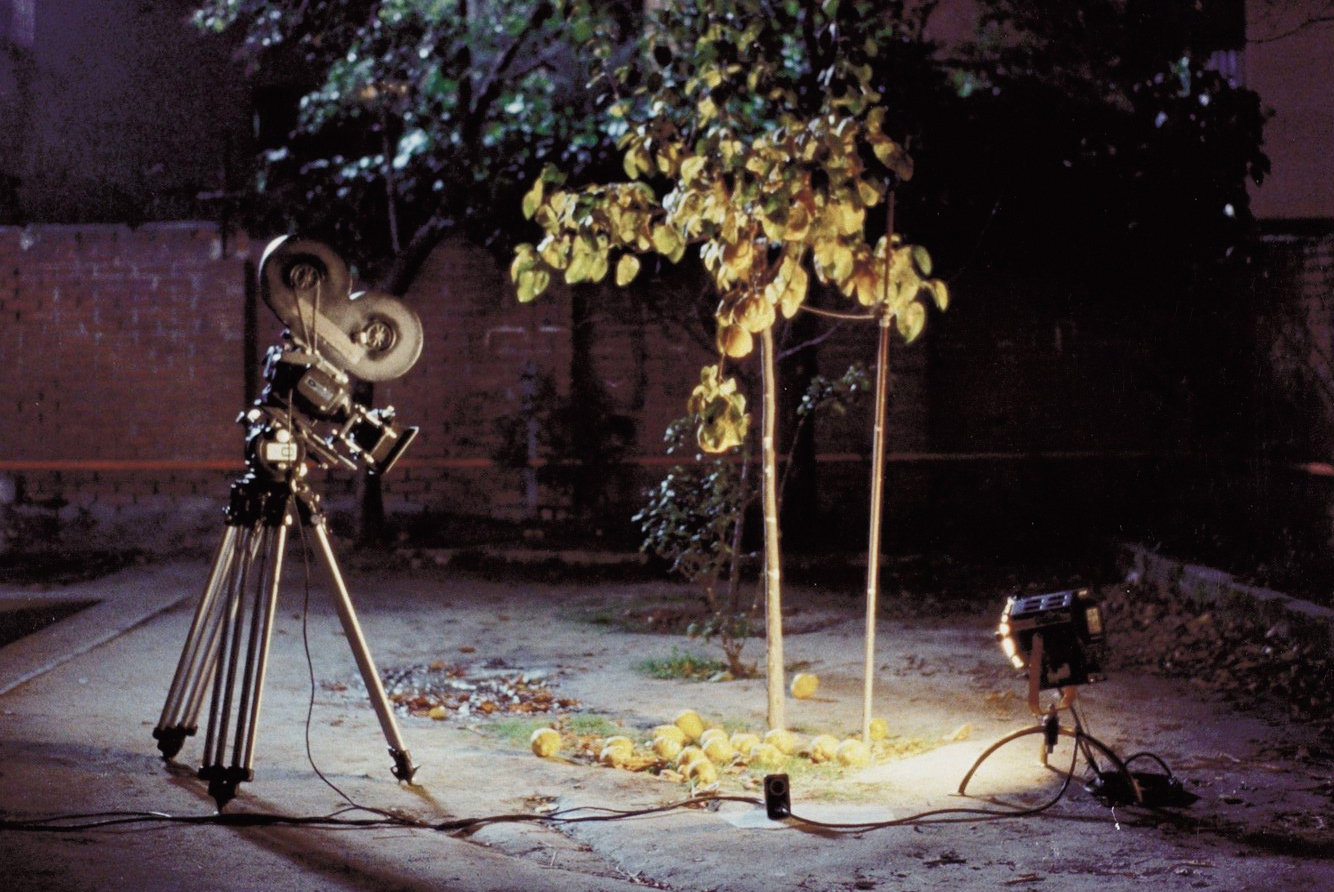
One of the most moving screenings I’ve ever attended was the premiere, at the 2023 Cannes Film Festival, of Close Your Eyes, the third narrative feature made by the Spanish director Víctor Erice. Erice, who was eighty-two at the time, did not attend the screening, but it had a momentous quality to it nonetheless. The director—whose 1973 debut feature, The Spirit of the Beehive, remains one of Spanish cinema’s most important works—had not released a feature-length film in decades.
A kind of existential mystery, Close Your Eyesfollows Miguel (Manolo Solo), a once promising director who abandoned his career decades earlier after Julio (José Coronado), his best friend and star, walked off the set of one of their movies and was never heard from again. Now living an austere and anonymous existence in a small seaside shack, Miguel is coaxed back into the world and begins to investigate what might have happened to Julio.
Close Your Eyes is an expertly made, absorbing work in its own right. But the film’s power in that Cannes setting certainly owed something to the way it reflected Erice’s own history of thwarted projects. He had to wait a decade after The Spirit of the Beehiveto make a new film, 1983’s magnificently melancholy El Sur, and then famously had to cut that movie short after a producer pulled its financing, leaving it without its planned final act. Unlike Miguel, Erice did not disappear—over the years, he’s taught, and written, and worked on installations and short films—but his decades-long absence from the big stage had stirred in us a longing for a grand statement, a major work that might justify all that time away. And we got it. Close Your Eyes begins and ends with scenes from Miguel and Julio’s incomplete movie: for a moment, the screen seems to open up to reveal not just a fiction but a personal meditation on what it means for an artist to lose his voice, and what it might take to find it again.
i was remindedof Erice this past February, when the Berlin International Film Festival hosted the premiere of Queen at Sea, a new feature from the American director Lance Hammer. Queen at Sea, which stars the British stage and screen legends Anna Calder-Marshall and Tom Courtenay and the French actress Juliette Binoche, is an unflinching, disorienting, and yet extraordinarily rigorous film about dementia. It is also a deeply humane work; Hammer’s characters constantly push against narratives of victimhood and villainy. Within the contours of its highly specific story, we can sense a broader vision of the world, as if the filmmaker has seen through these individual lives to express a more universal despair. It came as no surprise when the movie won the festival’s Silver Bear Jury Prize, as well as the Silver Bear for Best Supporting Performance for Courtenay and Calder-Marshall.
As with Close Your Eyes, though, the power of watching Queen at Sea in Berlin was not just about the movie itself. It was also about the fact that it was the first time we had seen anything from Hammer in almost twenty years. In 2008, his debut feature, Ballast, a low-budget vérité-style drama about a Black family, set among the bleak flats of the Mississippi Delta and starring a cast of unknowns, had been one of the toasts of the Sundance Film Festival. A picture that the director had developed over years spent in the region, it was filled with lived-in performances and a deep sense of place. Hammer took a page from artists like Mike Leigh and Robert Bresson (both of whom he cited as influences), working with nonprofessional actors and weaving a minimalist, unadorned story.
The results were something akin to an American variation on the work of Jean-Pierre and Luc Dardenne, the internationally acclaimed Belgian filmmakers who have artfully and sensitively chronicled the lives of the dispossessed in award-winning movies like Rosetta (1999) and L’Enfant (2005). Ballastwon the directing and cinematography awards at Sundance and later received a host of critics’ prizes. For a moment, Hammer seemed to represent a more hopeful future for American film.
