


The New Stanford Prison Experiment review – surely no one believes this insulting TV show is real?
This rehash of the notorious study in which volunteers role-play as prisoners and guards pretends to be science. It isn’t – it’s patronising reality television
Television has rerun the Stanford prison experiment before, most notably in 2002 when the BBC aired The Experiment, which advertised itself as a more rigorous version of the stunt where volunteers role-play as prison guards and prisoners. The creator of the original 1971 experiment, Philip Zimbardo, would probably have criticised the new versions to preserve his own status, but the main point he made was valid. These people all know they’re on TV, he said. They’re playing to the cameras.
Whether the participants in a behavioural study forget they’re part of a study is an eternal debate point. One of the strengths of the other notorious American people-are-awful research project, the Milgram experiment, was that it made the artifice part of the process, telling the volunteers that they’d spoil the science if they didn’t keep giving strangers electric shocks: “The experiment requires that you continue.” Without that, the stooges may never act naturally; if they know the experiment is also a TV show, they definitely won’t.
Reality TV has a similar credibility problem: although a show might say it’s found a group of ordinary people and put them in such-and-such a situation, the obvious answer is always that they’re not ordinary people. They applied to be on reality TV, which ordinary people don’t do.
The two issues combine in Netflix’s The New Stanford Prison Experiment, which has hired part of a real county correctional facility in Georgia and filled it with 30 people divided into two factions: eight guards, three of whom are women, and 22 prisoners, all male. The haves wear sleek grey uniforms, set the rules and retire to their hotel between shifts; the have-nots are given bright yellow jumpsuits and scratchy bunk beds, and eat tasteless slop under harsh strip-lighting.
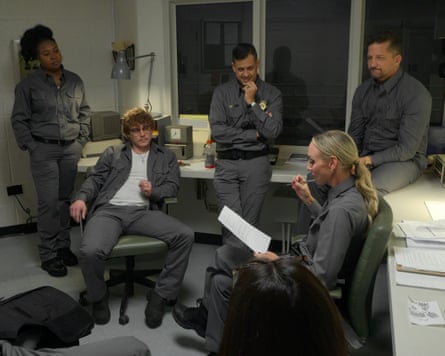
It keeps pretending to be a study of whether power corrupts in an institutional environment, but it is undeniably reality TV to its core, starting with how it’s presented to us. As well as seeing what the prisoners and guards have done, we’re told about it by them in the obligatory to-camera interviews, filmed afterwards. Also informing us about events we have just witnessed for ourselves are a trio of experts – a behavioural psychologist, a former federal correctional officer and, er, a journalist – watching a bank of screens. The series runs to six episodes, which could have been four if the patronising recaps had been edited out.
Inside the jail, any hope that the TV prisoners and guards might forget where they are and start behaving like actual prisoners and guards is soon lost. Everyone constantly references the “experiment”, and the show refuses to sit still for more than half an episode before drawing on textbook reality TV tricks to engineer discord: the guards are split into night and day teams, which undermine each other by approaching the task differently; they are asked to elect a head guard, which irks those not picked; at the halfway point in the series, some prisoners and guards switch roles.
None of it is real, and nobody thinks it is. The show doesn’t create any moments where the contestants suspend their disbelief – as in The Traitors, where the faithfuls sometimes start genuinely seeing the traitors as duplicitous villains. There is no game to win, no goal to work towards and, apart from the unspoken potential reward of a media career in every reality show, no prize. There’s nothing incentivising anyone to continue. More than one participant realises this and simply walks off the show.
What is interesting – not enough to make The New Stanford Prison Experiment worth nearly six hours of your time, but it’s something – is how reality TV contestants, with their unusually high self-regard and their tendency to use a lot of loud, confident words to say very little, behave when they know what and where they are. The most fertile conflict here springs up between prisoners who want to disobey the guards to see what happens, and those who’d rather stick to the current dynamic. It’s not an illustration of how a carceral institution restricts free will and removes individuality. It’s people who know they’re co-authors of a piece of entertainment and disagree on how the story should develop. Who know they’re characters in a story and have ideas for their own narcissistic reality “journeys” that clash with those of the others.
There is, however, one group that does fall for the conjuring trick. Up in the gallery, the three superfluous experts rather adorably persist in analysing hierarchies and interpersonal power struggles and the rest of it, as if any of those things are meaningfully occurring. They seem to have bought into The New Stanford Prison Experiment – watching at home, that’s impossible.
Explore more on these topicsShare
Reuse this content
