


A vintage camera from the 1940s, decades-old film and more than 40 years of photography experience are coming together in a unique exhibition celebrating the beauty of Saskatchewan’s rural landscapes.
Photographer Kevin Hogarth is bringing his latest collection, The Truth of Film, to the Jasper Cultural & Historical Centre in Maple Creek, with an opening reception scheduled for Saturday, Nov. 14.
The exhibition offers a different perspective on the familiar prairie landscape, using traditional film photography techniques to create soft, dreamlike images that capture the character of rural Saskatchewan.
For Hogarth, the exhibition represents a return to the photography techniques that first inspired him as a young teenager.
Returning to his photographic roots
Hogarth’s passion for photography began when he was just 13 years old, eventually leading him to study photographic technology at Red River Community College in Winnipeg in 1979.
It was there that he learned the technical aspects of working with film, including exposure, developing and processing photographs in the darkroom.
Now in semi-retirement, Hogarth has shifted his focus toward fine art photography, embracing the slower, hands-on process of shooting with film.
“So what I did is I went back to my roots and I like to shoot film,” Hogarth told West Central Online.
Rather than relying on modern digital equipment, he chose to work with a point-and-shoot camera dating back to the late 1940s.
The older camera’s optics produce a distinctive softness that has become central to the exhibition’s visual style.
“That’s why the title, The Truth of Film, and I’ve used a late 1940s point-and-shoot camera, and that gives me a nice soft edge in the optics of the images,” he explained.
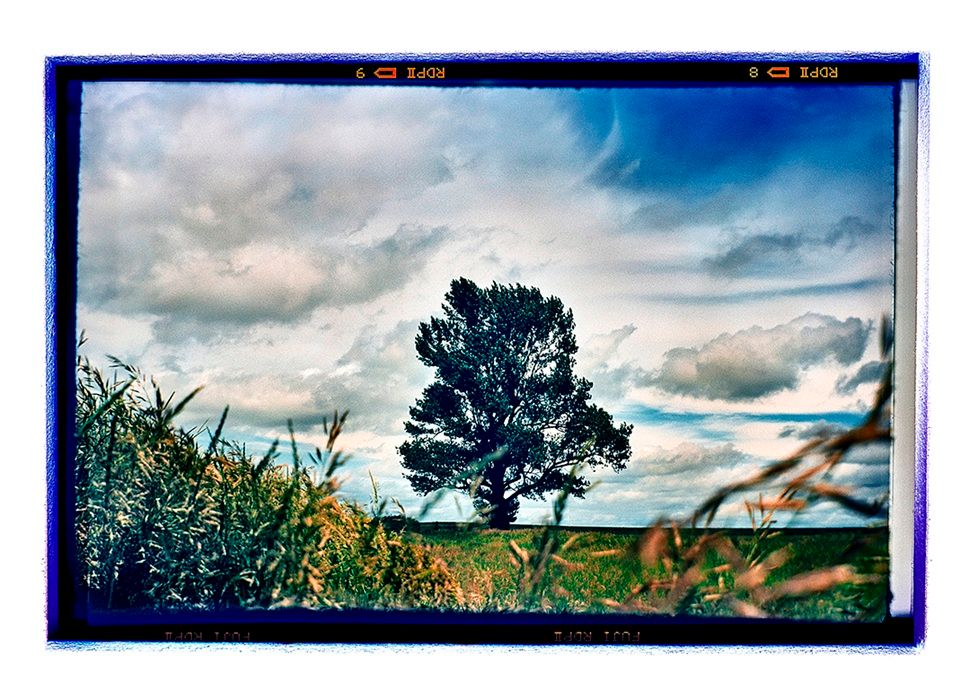
Lone Tree near Swift Current
Twenty-five-year-old film creates unique prairie images
One of the most unusual elements of the exhibition is Hogarth’s decision to use colour slide film that expired approximately 25 years ago.
Rather than processing the film traditionally, he used a technique known as cross-processing, developing colour slide film in chemicals intended for colour negative film.
The technique can produce unexpected colours, tonal shifts and visual effects that differ from conventional photographs.
Hogarth also composed his photographs using the full frame and manually advanced the film, allowing overlapping exposures to create cinematic, dreamlike scenes.
The combination of vintage equipment, expired film and experimental processing gives the photographs an appearance that would be difficult to reproduce using conventional modern techniques.
The final images have been produced as large-format archival Giclée fine art prints, allowing viewers to appreciate the film grain, soft focus and distinctive textures of each photograph.
For Hogarth, the process is as much about the experience of creating the images as it is about the finished artwork.
