


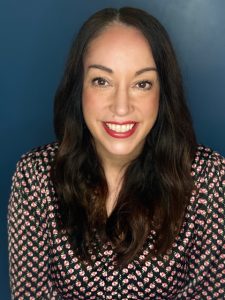
Added on May 14, 2026 Staff Writer Jane Ann Gonzales , Triangle Girls
Creative Screenwriting Unique Voices Screenplay Competition Grand Prize Winner Jane Ann Gonzalez on “Triangle Girls”

Decrease Font SizeIncrease Font SizeText SizePrint This PageSend by Email
Jane Ann Gonzalez is the daughter of a Puerto Rican, Vietnam veteran father and a Northern Irish immigrant mother. She grew up in a duality world searching for narratives about the in-between spaces that reflect the complexities of American life. She’s drawn to stories about the quietly heroic people navigating systems they didn’t build, characters trying to find themselves within their family, their community, and/or the societal expectations. She’s especially interested in writing stories about women in midlife, historical stories about working-class families, and blending humor with heartbreak.
Jane discusses her prize-winning television series Triangle Girls.
Describe the story behind Triangle Girls
Triangle Girls is an eight-part, limited series that explores the worst workplace disaster in New York City prior to September 11, 2001. The Triangle Shirtwaist Factory fire of 1911 took the lives of 146 young women, mostly immigrant women. No definitive investigation concluded the origins of the fire. Inspectors only know for sure that it started on the 8th floor, and workers on the 9th floor suffered the most casualties. My story proposes the question, “What if the fire wasn’t an accident? How would a person live with the guilt?”
The emotional story behind Triangle Girls began for me before I even learned about it during my NYU days, where the site of the factory is now a school building. My mother is an immigrant. When she was eighteen, she had two choices. She could work at the factory down the road and marry the boy next door, or leave Northern Ireland and go to America. She chose to leave.
At the heart of Triangle Girls is the story of all our mothers, or grandmothers, and great-grandmothers. At some point, they arrived here. And maybe they came the “right way.”
Hell, all my mom had to do in 1971 was marry my dad, an American citizen, and seven years later she became naturalized. Easy-peasy pathways were the norm then. Or, maybe they came by uncertain or traumatic means. Either way, they took risks, crossed oceans, and built their lives despite unsafe working environments. But all of them shaped this country in ways history books don’t always fully acknowledge. And it’s time we do! Audiences will learn about the contributions of Clara Lemlich, Frances Perkins, Dr. Anna Shaw, Claudia Jones…
The story unfolds across two eras — 1910 and 1945 New York City — where the rise of the labor movement and early union organizing collides with the fear-driven, anti-communist hysteria of the Red Scare. At the center is Sa’mara Vaserman, a brilliant Jewish immigrant who escapes the labor strikes and sweatshops through sheer intellect and courage. For decades, she has carried a devastating secret: the Triangle Shirtwaist Factory fire was not an accident. She believes her group was responsible for starting the fire as an act of radicalization when the strike of 1909 failed to create lasting change for better working conditions.
Now, a fed agent under the Un-American House Activities Committee is investigating socialists and communists from the decades earlier labor movement. Sa’mara must decide whether to expose the truth and risk destroying the legacy of the labor movement… or protect the myth and live with the guilt.
How does it align with your personal writing brand?
I want to tell stories that inform, that illuminate truths, and that challenge perspectives in order to spark change. My influences — Mark Twain, Joseph Campbell, Ray Bradbury, bell hooks, Henry Louis Gates Jr., and Esmeralda Santiago — tell stories about identity, belonging, and resistance to oppression.
My personal and professional work as an educator in various socio-economic settings informs the characters I create – people in dialectical battles, exploring the intersectionality of race, class, and gender. I love ideas around the individual versus society, illusion versus the reality of technology, and historical memory cooks in the cauldron
How might it be positioned in the marketplace?
From a market standpoint, Triangle Girls sits squarely in the prestige limited series space — Chernobyl meets TheGilded Age. It’s a true-event-anchored story with strong historical recognition.
The Triangle Shirtwaist Factory fire is already embedded in the cultural consciousness and taught in schools. At the same time, the series reframes that history through speculative fiction. What if the fire wasn’t an accident?
It features a female-driven ensemble cast and offers a vast array of cameo opportunities for character actors to play historical figures such as Mark Twain, women’s suffrage activist Alva Vanderbilt Belmont, Frances Perkins, Clara Lemlich, and Claudia Jones (plus many more!).
The ensemble of working-class immigrant women opens the door to a wide audience, while the political framing of the Red Scare 1945 timeline appeals to fans of political thrillers. In a moment where audiences are actively re-examining national narratives, Triangle Girls feels both relevant and necessary. It invites viewers to question not just what happened, but why certain stories are preserved and others are buried under the ashes.
One of the most surprising elements is the paradox at the heart of the factory itself. For many of these young immigrant women, the factory, ironically, was also a space of independence. It offered wages, community, and a sense of identity outside the home. For some, it was the first place they experienced any kind of freedom. That duality, freedom and confinement existing in the same space, complicates how we understand the tragedy.
The series also challenges the mythology of the Triangle Shirtwaist Factory fire. Instead of presenting it as a closed chapter of history, the project reopens it as a moral question. What if the story we’ve been told is incomplete? And what happens when the truth threatens to destabilize the legacy built from that loss?
Structurally, the dual timeline adds another layer of tension. The 1911 story gives us immediacy and emotional stakes, while 1945 reframes the conflict through the lens of political fear and ideological policing, which is a place we find ourselves now in 2026 with legacy media and in our educational institutions.
How did the story evolve over time?
Triangle Girls has been with me for a long time. I first wrote it as a feature back in 2000 under the title Made in America. At that point, it was a more contained historical narrative, focused primarily on the events surrounding the fire.
But life intervened in a meaningful way. In pursuing a career as an educator, I put my writing on hold for nearly twenty years. During that time, I was still telling stories, just in a different form, in the classroom, helping students find their voices through writing.
It wasn’t until the COVID pandemic that I really had the time to pause and revisit my own creative ambitions. That period forced a kind of reflection, and I remembered that writing was an ache and a pleasure worth acknowledging.
When I returned to Triangle Girls, I saw it completely differently. I expanded it into a limited series, introduced the dual timeline, and leaned into the psychological and political dimensions of the story. Now, I’ve found a way to hold both parts of my life. Teaching and writing aren’t in a battle anymore for my time. They inform each other.
What elements are you focusing on in subsequent drafts?
In the next phase, which includes finishing the last three episodes to complete the eight-part limited series, I’m focused on expanding the dimensionality of the ensemble. I need to make the world feel as lived-in and diverse as the women inside it. One of the things I’m very aware of as a writer is that I don’t come from a primarily comedic background, and these girls need humor. It’s part of their survival.
In terms of building a writers’ room, I want a range of voices, writers who can bring levity, cultural specificity, and texture to these characters. I don’t want these young women to be solely defined by tragedy and working-class woes. Some are funny, some are boy-crazy, some are ambitious, some are desperate, and some are navigating sexual harassment and abuse. On a craft level, I’m sharpening each character’s point of view so that no two voices feel interchangeable. Many of these characters were, in fact, real people!
Ultimately, the goal in these drafts is to ensure that when the audience watches the fire, they’re seeing individuals. They understand the burden Sa’mara had to carry for 34 years. That’s the emotional punch that bruises.
Who are your dream cast and director?
Dream project, dream job, dream team? Here are my wishes upon the stars:
- For midlife Sa’mara, I’m drawn to Winona Ryder or Natalie Portman.
- For the younger Sa’mara, Millie Bobby Brown or Odessa A’zion.
- For Tamar, the mother: Rachel Weisz.
- For Clara Lemlich, the real-life labor activist: Sadie Sink.
- The investigator, the Man in Black, needs presence and authority. Adam Driver or Oscar Isaac.
- Triangle Girl Tessie: Beanie Feldstein
- Triangle Girl Katie: Maude Apatow
- Triangle Girl Sylvia: Dianna Agron
- Triangle Girl Rose: Molly Gordon
- Triangle Girl: Leighton Meester
Then they are the cameos! Josh Brolin as Mark Twain? Kathy Bates as Dr. Anna Howard Shaw, Uzo Aduba as Claudia Jones? Amanda Seales as Sarah J. Garnet.
Tonally, I’m drawn to directors who understand that spectacle only works when it’s framed by real American experiences. Minkie Spiro (Plot Against America), Salli Richardson-Whitfield (The Gilded Age), John Wells (Maid).
