


From Philly and the Pa. suburbs to South Jersey and Delaware, what would you like WHYY News to cover? Let us know!
On a recent morning outside the Philadelphia Film Society East Theater, Woody Shticks, director of the Philadelphia Film Festival, crouched over a loose sidewalk brick that had been tripping pedestrians.
It was an unexpected task for someone overseeing the operations of an 11-day film festival, but for Shticks, it was just another item on an already crowded to-do list.
“The most unexpected part of my job is having to pivot into 100 jobs in the course of a day,” he said. “I go from fixing light switches to scanning tickets to greeting sign language interpreters to introducing films to supporting staff through tough transitions.”
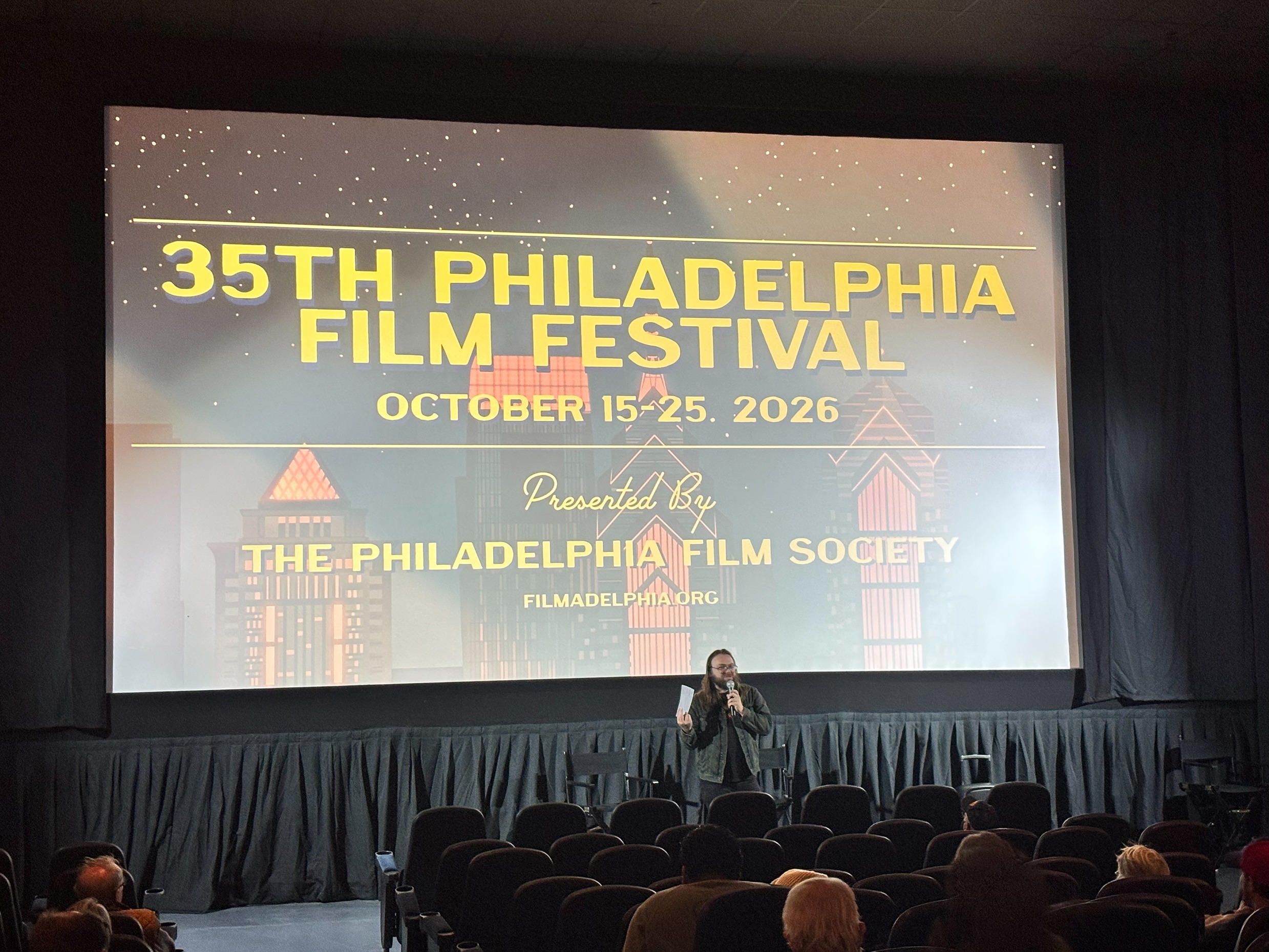
Now in its 35th year, the festival showcases films from local and international filmmakers across multiple venues in the city. Its 2026 run ends Sunday.
Behind the scenes, the Philadelphia Film Society’s programming team spends months watching films, reviewing submissions and working with distributors to secure screenings.
During the festival, the operations team coordinates staff, volunteers and equipment across multiple venues, while managing schedules and addressing unexpected problems.
A morning at the festival
Around 11 a.m., staff members gathered at the Philadelphia Film Society’s East Theater lounge for their morning meeting to prepare for the day’s screenings.
“I’m the space and time guy,” Shticks said. “It’s my responsibility to make sure that we have the right people and the right equipment in the right places at the right time.”
Inside a theater inside the Philadelphia Film Society East Theater (Jassmyn Nesmith/WHYY) The lobby of the Philadelphia Film Society East Theater (Jassmyn Nesmith/WHYY)
Next, he headed around the corner to check in with theater employees preparing for the day.
Inside, he spoke with staff about managing lines and directing festivalgoers. With multiple films scheduled throughout the day, the team must coordinate introductions, post-screening question-and-answer sessions and preparations for the next showings.
Shticks also checks that projection equipment is working, theater seating is in good condition and staff members have the rements for projectionists to accommodate. Even the curtains around a theater screen sometimes require adjustments, Shticks explained
From the East Theater, Shticks continued to the Film Society’s Bourse Theater, where he checked in with another group of employees to make sure the venue was prepared for the day’s screenings and ask if they needed additional assistance.
Choosing what audiences see
While Shticks and the operations team focus on keeping the festival running, another group is responsible for determining what audiences will see.
Trey Shields, the Film Society’s director of programming, works alongside programmers Catherine Preston, Violet Riveras and Tina Ngo to select the films.
The process begins months before the festival opens, with preparations typically overlapping with the Film Society’s year-round programming and annual Spring Fest, according to the programming team.
Asked when planning begins, Shields said, “The cutesy answer is probably Nov. 1. It’s like right after this festival ends.”
Outside the Philadelphia Film Society Bourse Theater (Jassmyn Nesmith/WHYY) Philadelphia Film Festival attendees find their seats ahead of a screening inside the Philadelphia Film Society Bourse Theater (Jassmyn Nesmith/WHYY) Philadelphia Film Festival attendees purchase concessions in the lobby of the Philadelphia Film Society Bourse Theater. (Jassmyn Nesmith/WHYY) Stairs inside the Philadelphia Film Society Bourse Theater (Jassmyn Nesmith/WHYY) The upper lobby of the Philadelphia Film Society Bourse Theater (Jassmyn Nesmith/WHYY) A sign inside the Philadelphia Film Society Bourse Theater (Jassmyn Nesmith/WHYY)
The team follows major international film festivals, watches hundreds of films and reviews submissions and works with distributors and sales agents to secure screenings.
But making those choices involves more than identifying the year’s most anticipated releases. Programmers must consider how the lineup represents different genres, countries, filmmakers and perspectives.
“The name of the game is balance,” Riveras said. “We want those big, buzzy Palme d’Or or big studio celebrity titles, and we also want something people maybe haven’t heard of but we think is really good and interesting.”
The selection process also involves a screening committee made up of volunteers, interns and other reviewers. Films submitted for consideration can pass through several rounds of screenings before reaching the programming team.
Audiences might not realize the number of films that don’t make the cut, Preston said.
Even when programmers identify a film to screen, securing it isn’t always guaranteed. Distributors and sales agents have their own strategies for when and where films will be shown.
Making the festival run
“Once programming chooses films, and when they play, everything else falls to the operations team,” Shticks said.
He’s responsible for scheduling staff members including projectionists, custodial workers, administrators and volunteers, as well as coordinating equipment across the festival venues.
Tables, chairs, microphones, projectors and other supplies must be accounted for, transported and maintained throughout the event.
The festival also heavily relies on volunteers — about 400, according to the programming team — to assist audiences and support operations.
During the festival, his days can stretch as long as 16 hours as he moves between venues, communicates with vendors, coordinates with producers and staff, and navigates unexpected challenges.
“The most rewarding moments come to me when I can step back and allow the hard work and planning to manifest into a thoughtful environment for people to exchange ideas and dream up a better world,” he said.
The people behind the screenings
For Tina Ngo, the Film Society’s year-round programming coordinator, the work doesn’t end when the lineup is announced.
During the festival, her responsibilities include communicating with distributors, introducing films and engaging with audiences across the venues.
Before each introduction, Ngo researches the film and its director, looking for interesting details to share with moviegoers while also acknowledging sponsors and providing festival information.
One of the most rewarding parts of her job is connecting with audiences, she said. She enjoys hearing their thoughts on screenings and making recommendations of other films, sometimes hearing back from attendees who enjoyed her suggestions.
Although the festival lasts just 11 days, the Film Society’s year-round screenings and community partnerships help maintain connections with audiences beyond the annual event.
Members of the programming team said Philadelphia’s filmgoing community has grown in recent years. They pointed to the growth of local film clubs and smaller screening events, which have created additional opportunities for moviegoers to connect over their shared interest in cinema.
“I think there’s been a big generational shift where I feel like younger people, especially right post-COVID, it’s a huge craving for a third space, a shared community, and especially around something art and human-made,” Riveras said.

Get daily updates from WHYY News!
The free WHYY News Daily newsletter delivers the most important local stories to your inbox.
WHYY is yournprofit organization, we rely on financial support from readers like you. Please give today
