


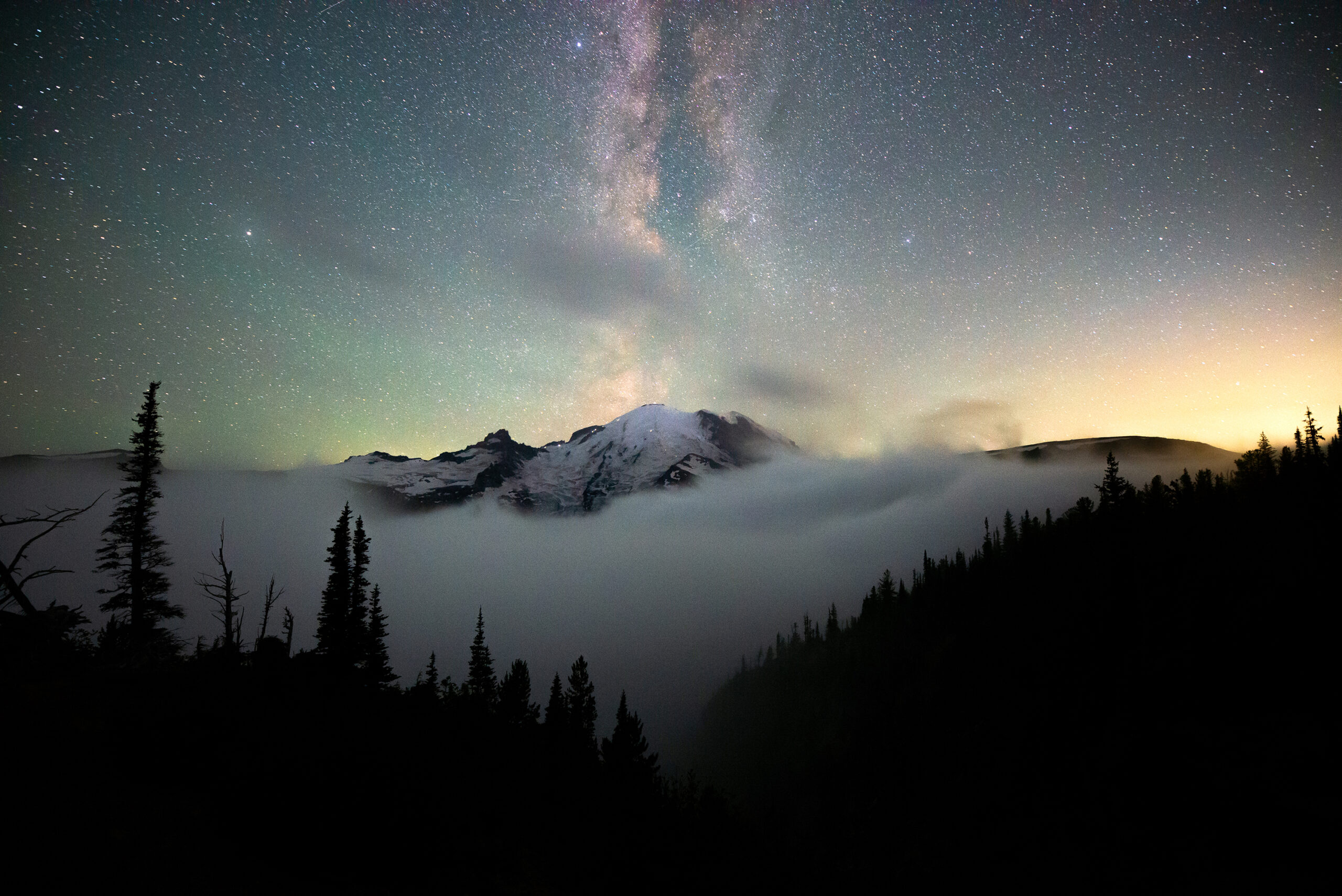
Equipped with special cameras and gear, National Park Service scientists help parks counter the impacts of artificial light at night. They share tips for successful night sky photography.
About this article
This article was first published online on March 31, 2026, as part of the Picturing the Unseen series.
Dark night skies draw tens of thousands of visitors and photographers to national parks. In 2019 alone, over 12,000 visitors attended the Grand Canyon Star Party. But light pollution from artificial light at night is a growing concern, with impacts on people, wildlife, and plants. Scientists from the National Park Service’s Natural Sounds and Night Skies Division help parks understand and counter the effects of artificial light, preserving dark night skies for visitors and for animals and plants who depend on the dark. Photography is a key tool they use.
Prepare for Success
Nighttime photography requires planning, preparation, and sometimes specialized gear. Before setting out, it’s helpful to consider ambient conditions. Weather, moon phase, viewing direction, where stars and other celestial objects appear in the sky, and light pollution are all important when choosing a time and location to capture images.
Time of year can play a big role in gaining access to parks and events, as well as in the visibility of celestial objects.
It’s also important to know park rules and regulations. And it may be worth looking into night sky programs, star parties, or photography workshops. Time of year can play a big role in gaining access to parks and events, as well as in the visibility of celestial objects.
Tools to Monitor Light Levels
For over 20 years, the Natural Sounds and Night Skies Division has been using nighttime photography as a means of monitoring light pollution levels. The division’s flagship camera system includes a Nikon lens, a V-band filter, and a monochromatic charge-coupled device (CCD) for recording the images.
This astronomical-grade system captures 45 images that can be stitched together to create a 40-million-pixel panoramic image covering the entire night sky.
A V-band filter lets through primarily green light, which estimates human perception of night sky brightness. A CCD is a black-and-white digital camera sensor that measures light very accurately, from the darkest of parks to more urban areas. The camera sits atop a robotic telescope mount and is operated using a computer. This astronomical-grade system captures 45 images that can be stitched together to create a 40-million-pixel panoramic image covering the entire night sky. With this high level of accuracy, it takes 30-40 minutes to image the night sky, and skies must be clear of clouds.

The division also uses a newly developed fisheye system to capture a single 180-degree hemispherical image. This system takes images in just 10-15 minutes and is much more portable than the CCD system. It can take images on nights with clouds.

Predictive Models
For modeling light pollution, division scientists use satellite imagery captured with a special sensor. Annual composite images from this sensor are then converted into Simplified All-Sky Light Pollution Ratio (SALR) values using a predictive model. SALR is a way to measure the amount of artificial light in the night sky compared to the natural night sky brightness.

Urban Stargazing
Remote parks often offer the best night viewing, but there are also plenty of urban parks that allow for stargazing. Saguaro National Park near Tucson, AZ, for example, is an Urban Night Sky Place, a designation given by the International Dark Sky Association.

Nighttime “lightscapes” are important regardless of a park’s location, and night sky photography is a rewarding way to enjoy nature as well as a tool to help preserve dark night skies.
About the authors

M. S. Griffin is a GIS and photogrammetry intern with the National Park Service’s Natural Sounds and Night Skies Division. Learn more about GIS and photogrammetry. Photo copyright © M. S. Griffin. Used with permission.

Ben Banet works as a physical scientist and dark sky coordinator for the Natural Sounds and Night Sky Division. He uses all the camera systems mentioned in this article and helps parks improve their lighting to be more night-sky friendly. Photo credit: NPS
Republishing this article
This article is available for unedited republication, free of charge. We ask that you use the following credit: Originally published as “The Unique Photography Techniques That Help Preserve Spectacular Night Skies” on nps.gov, March 31, 2026.
Important: Some images may becopyrighted. Permission from the copyright holder is needed to reuse these. Check image credits for details.
Pleaselet us knowif you republish this article or have any questions.
Cite this article
Griffin, M.S., and Ben Banet. 2026. “The Unique Photography Techniques That Help Preserve Spectacular Night Skies.” National Park Service, March 31, 2026. https://www.nps.gov/articles/000/psv40n1_the-unique-photography-techniques-that-help-preserve-spectacular-night-skies.htm
‘;
itemHTML += ‘
‘;
jQuery(“#related_B9F06285-D58F-DB3C-039BFFCF6841D7EC”).children(“div”).eq(childToUse).append(itemHTML);
} ,runFunctionAfter: function(){
if(jQuery(“#related_B9F06285-D58F-DB3C-039BFFCF6841D7EC div.RelatedGridItem”).length > 0){
jQuery(this.element).parent().show();
}
}
})
});
Loading results…
