


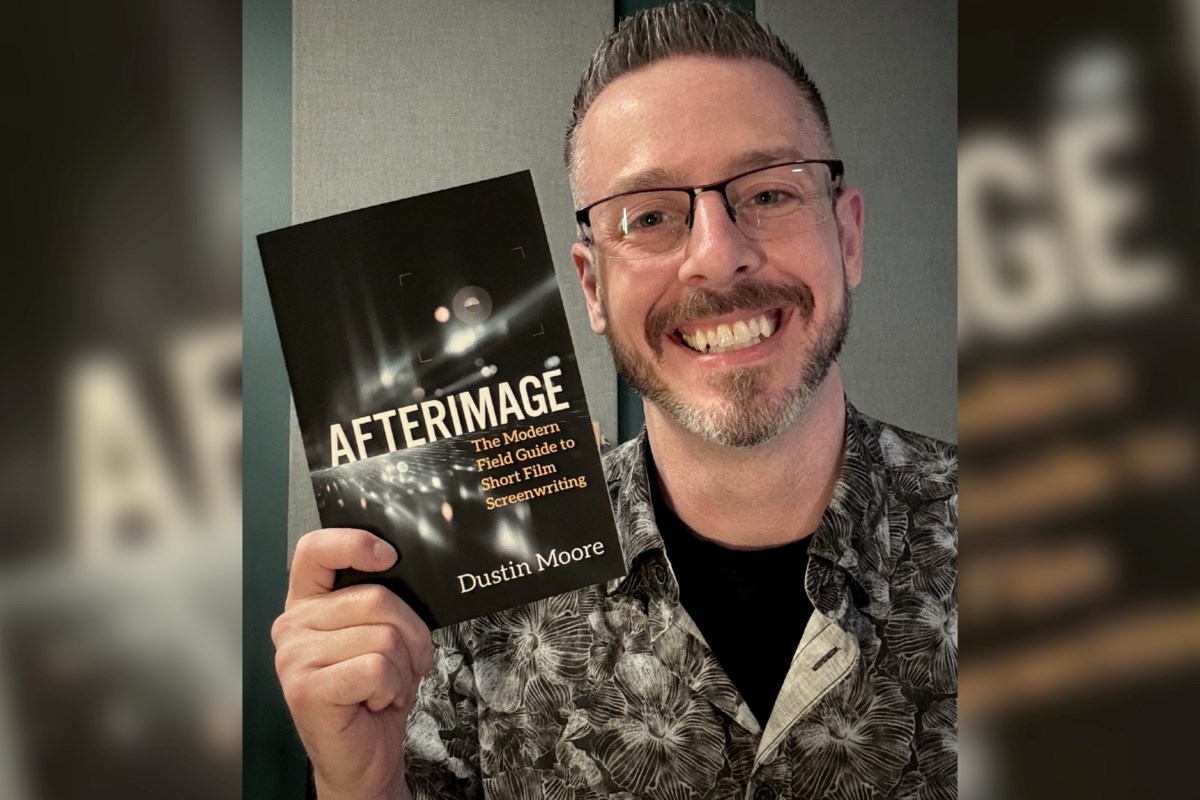
Dustin Moore is a Sudbury filmmaker,screenwriter, producer, actor, musician, and founder of Moore Film and Sound. He also firmly believes that a short film is an artform in itself, not what is so often inferred: that creating a short film is merely a “stepping stone” to creating a long one, a feature film.
Conventional wisdom in the film industry treats short films like training wheels. Aspiring writers are often advised to draft a few shorts simply to get used to the mechanics before upgrading to write a full-length feature.
So, Moore decided to add “author” to his repertoire with the release of his new self-published book, Afterimage: The Modern Field Guide to Short Film Screenwriting.
Well, maybe ‘decided’ is the wrong word.
Named one of Killer Shorts’ “10 Killer Canadian Screenwriters to Watch in 2025,” Moore’s work has also garnered accolades from competitions, including the Sudbury Indie Creature Kon, Cineverse Austin,and the Filmmatic Horror Screenplay Awards.
In an interview with Sudbury.com, he said that as his local profile grew, fellow filmmakers and writers began approaching him for advice, notes, script consults and revision help. They also asked for suggested reading.
But when Moore began scouring existing literature for a modern, practical guide on short screenwriting to improve his work, and share with others, he told Sudbury.com he came up mostly empty-handed.
Most books were either decades out of date or heavily theoretical, focusing on history and abstract dramatic concepts rather than actionable execution.
Determined to help local creatives avoid the work he did to find only a modicum of help, Moore set out to build a quick, three-to-four-hour afternoon workshop. But as he compiled his notes, the curriculum kept expanding.
“I thought, ‘this might be a weekend workshop’,” he told Sudbury.com. Soon, it grew into a proposed five-week course. Before long, he said he realized: “I’m writing a book.”
Over the course of a year, Moore worked through the writing and publishing process, bringing on an editor from the UK as well as dedicated layout and cover designers to bring the book to fruition.
The result is a guide that Stephen Dudas, a literature professor at Albion College, praised for its “simultaneous accessibility and depth,” calling it “a must-read for practitioners of the form and writing educators alike.”
And while Moore said it’s important for any writer to expose themselves to as many different schools and disciplines of writing as possible, “so that you can find the path that works best for you and your writing,” he admits it’s also a little frustrating to walk that path. Not many offer more than the theory behind the writing: there aren’t many practical suggestions.
That’s where his field guide comes in.
Rather than offering a rigid, “one-size-fits-all” formula, Moore said he designed Afterimage as a flexible toolkit. It includes screenplay examples, practical exercises, end-of-chapter checklists, and concrete strategies for shaping character, conflict, and theme.
“Throughout the book, I present a lot of different concepts and ideas, but doing it this way is a known good. If you do it this way, you’re sticking with convention and you’re going to end up with something that’s at least solid,” Moore said. And while it’s often a case of learning the rules so you know when to break the rules, the technical aspects of the script are important.
In fact, Moore said technical errors in screenwriting can be deal-breakers.
“When you’re submitting for studio consideration or competitions, there’s immense competition, you have to demonstrate technical competence in your writing immediately, and also be able to hook them within half a page,” Moore told Sudbury.com. “As soon as you show that you don’t have an understanding of fundamentals or your writing is lacking in technical aspects, they’re done reading. They have a hundred other scripts to get through that day.”
And while every piece of advice in the book is important, Moore said, “If readers could only take one thing from this book, I think it would be the parts on structure and formatting.”
That’s because unlike novels or prose, a screenplay is fundamentally a production document designed to guide a crew putting images on camera. Standard formatting rules are vital, said Moore.
From there, you can write the short film script: but based on the singular art form, not the first step to a feature, which is a challenge in and of itself.
Moore told Sudbury.com that writers transitioning from prose or feature-length scripts tend to fall into two major traps when tackling a short: either trying to cram all the traditional structures, subplots, and conventions of a 120-minute feature into a 10-minute script, or; assuming that because it’s a short film, standard rules don’t apply at all, resulting in an unstructured, purely experimental pieces that lack narrative momentum.
Afterimage seeks to bridge that gap, said Moore. It treats short screenwriting like short story writing — a discipline demanding precise narrative focus, emotional clarity, and a solid grasp of beginning, middle, and end.
Moore said the book can be read cover to cover, or used more as a diagnostic tool for an existing script. Starting at page one takes the writer step-by-step from the blank page to a complete, structurally sound script, but writers with an existing draft can flip straight to the revision sections. “If you’re not a true novice, the chapters are broken apart such that they can be used in a diagnostic sense. You can take a script you’ve already written and go, ‘Hmm, something’s not working, why?’ Use what’s helpful and discard the rest.”
Included in the field guide is Moore’s Four-Pass Rewrite Process. If a writer feels a scene isn’t working, the diagnostic process guides them back to specific chapters—such as evaluating character motivations through what Moore calls the “emotional causality chain” or troubleshooting scene structure to ensure proper narrative arcs.
Ultimately, Moore hopes the book gives writers the foundational confidence they need to take creative risks.
Afterimage: The Modern Field Guide to Short Film Screenwriting is published by Moore Film and Soundand is available in both paperback and digital formats through online retailers like Amazon, as well as Sudbury’s Bay Used Books. You can find the book’s website here.
Jenny Lamothe is a reporter at Sudbury.com.
