

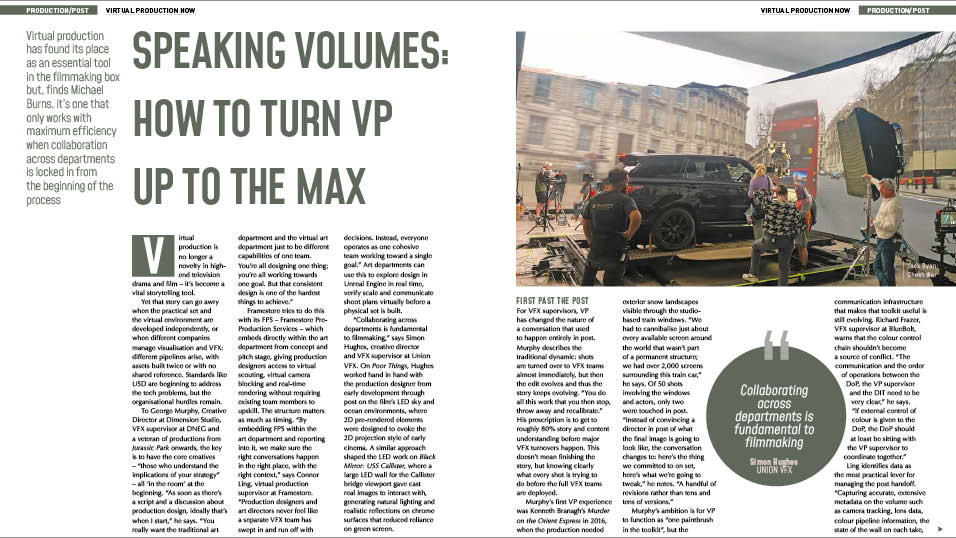
Virtual production has found its place as an essential tool in the filmmaking box but, finds Michael Burns, it’s one that only works with maximum efficiency when collaboration across departments is locked in from the beginning of the process
Virtual production is no longer a novelty in high-end television drama and film – it’s become a vital storytelling tool.
Yet that story can go awry when the practical set and the virtual environment are developed independently, or when different companies manage visualisation and VFX: different pipelines arise, with assets built twice or with no shared reference. Standards like USD are beginning to address the tech problems, but the organisational hurdles remain.
To George Murphy, Creative Director at Dimension Studio, VFX supervisor at DNEG and a veteran of productions from Jurassic Park onwards, the key is to have the core creatives – “those who understand the implications of your strategy” – all ‘in the room’ at the beginning. “As soon as there’s a script and a discussion about production design, ideally that’s when I start,” he says. “You really want the traditional art department and the virtual art department just to be different capabilities of one team. You’re all designing one thing; you’re all working towards one goal. But that consistent design is one of the hardest things to achieve.”
Framestore tries to do this with its FPS – Framestore Pre-Production Services – which embeds directly within the art department from concept and pitch stage, giving production designers access to virtual scouting, virtual camera blocking and real-time rendering without requiring existing team members to upskill. The structure matters as much as timing. “By embedding FPS within the art department and reporting into it, we make sure the right conversations happen in the right place, with the right context,” says Connor Ling, virtual production supervisor at Framestore. “Production designers and art directors never feel like a separate VFX team has swept in and run off with decisions. Instead, everyone operates as one cohesive team working toward a single goal.” Art departments can use this to explore design in Unreal Engine in real time, verify scale and communicate shoot plans virtually before a physical set is built.
“Collaborating across departments is fundamental to filmmaking,” says Simon Hughes, creative director and VFX supervisor at Union VFX. On Poor Things, Hughes worked hand in hand with the production designer from early development through post on the film’s LED sky and ocean environments, where 2D pre-rendered elements were designed to evoke the 2D projection style of early cinema. A similar approach shaped the LED work on Black Mirror: USS Callister, where a large LED wall for the Callister bridge viewport gave cast real images to interact with, generating natural lighting and realistic reflections on chrome surfaces that reduced reliance on green screen.
TO READ THE FULL REPORT ALONG WITH ALL OF TELEVISUAL’S INDUSTRY LEADING CONTENT AND REPORTS FROM THE LAST FIVE YEARS, CLICK HERE FOR TELEVISUAL+
