


14 August 2026
by Chip Midnight
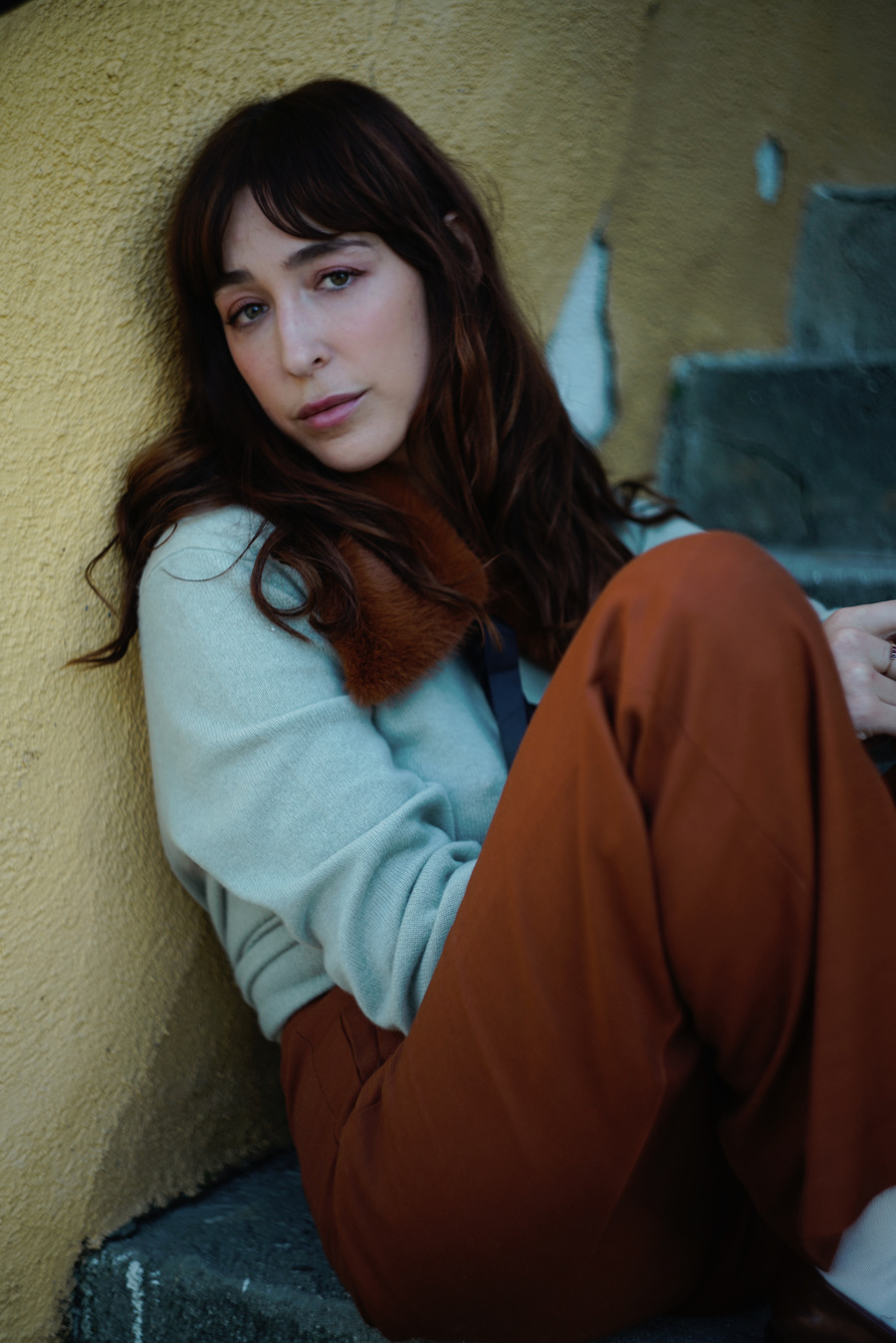
There’s something warm and inviting about Johanna Samuels’ music. Her songs have the feel of mid-70s singer/songwriter fare with a Laural Canyon edge, with guitars, bass, drums sitting alongside Wurlitzer, harmonium, Moog and Juno synthesizers. You can almost hear the room around the musicians and sometimes even the tape hiss. It’s an intimate, human sound that feels less polished than it does alive.
What makes the songs on Sorry, Kid even more interesting is how long they’ve been waiting to be heard. Samuels wrote most of them in early 20s and made demos of them at the time, but ultimately felt she wasn’t far enough along in her career to feel comfortable releasing them. They were better ideas than final product. Nearly two decades later, through her friendship with musician/producer Jonathan Rado, she found a collaborator who could help her return to those songs with a different, more mature perspective, and finally bring them to a resting place.
That sense of looking backward while still moving forward is fitting. Samuels’ came of age in the 2000s, absorbing the songwriting of artists like Aimee Mann, Elliott Smith and Ben Kweller along with the musical world surrounding Jon Brion and the Largo scene. All of those influences coexist on Sorry, Kid: classic California warmth, subtle playfulness, thoughtful modern songwriting and arrangements that can be lush without losing the intimacy of the songs. These songs began as literal snapshots of a young songwriter’s life, sat patiently for years, and have finally found their way into the world.
Shortly after returning from the Newport Folk Festival where she performed with friends, Samuels joined me for a conversation about how the album was conceived, the way the influences work their way into her music, and collaborating with good friends.
You recently played at the Newport Folk Festival. Is it the type of thing where you go, perform, and hang out for the whole thing, or was it a quick in-and-out—play your set and then leave for the next tour date or home?
JOHANNA: I was singing with a bunch of friends, so I was there all weekend. I feel like it ends up being a lot of work for the musicians, just because everyone ends up singing on other people’s stuff which is half the fun, but also extremely physically exhausting. It’s funny, I have a bunch of friends that I see every year there. I’ve gone for, I think, six years, and every year we’re like, “Oof, this year’s a little harder!” Last night I laid down in my bed, and I was like, it’s a lot. It was gorgeous weather, and spirits were high. It was lovely.
For someone who has never attended as a fan, do you have a secret tip you can pass along?
JOHANNA: Get Dell’s Frozen Lemonade. It’s really one of the most nourishing things ever. Also, I would say take breaks when you need to, but it’s a pretty small festival, everything’s very easy to get to. So really, you look at the schedule, and you see who you want to see… but the main tip is: if you’re staying, it’s on a fort on an island, leave a little before the headliner or the last set of the day so that you don’t get stuck in the ferry line. That’s my tip.
That is a great tip. I am old enough to have gone to Woodstock ’93. We had to park thirty miles away and get bused in. The night we left, I believe the Red Hot Chili Peppers were headlining. We decided to leave early to beat the crowd, but we still had to wait for the bus for two hours.
JOHANNA: 100%. There was a night this year where even, I’m best friends with one of the bookers of the festival, and she was like, “No one can get out.”
I want to talk about the record, but first, a couple of quick questions to get to know you a bit better. You’re doing this interview on a Wednesday. What is a typical Wednesday like when you’re not on tour? Do you have a day job, or do you hang out with friends?
JOHANNA: My day job is my music, so on a typical Wednesday I usually walk my dog in the morning, her biggest walk of the day, and then I sit down and do a bunch of emails and get stuff ready. I book myself and I manage myself, so I have a lot of organizational tasks that I have to do, and I usually do all my own posters and stuff like that. So oftentimes there are just things that need to get done almost every day. In the last six months or so, as I’ve been rolling out the record, there have been a lot of podcasts, interviews, and things like this, which I love. Then usually around three or four, I’m really tired, and I probably take my dog on another walk, or I go to the grocery store. This is all a version of a Wednesday that’s not when I’m touring.
If I ran into you while you were walking your dog, what is a subject I could bring up that would start an hourlong conversation?
JOHANNA: I love movies; I’m a big movie head. I love swimming, I love the beach, and I love the ocean. Also, I could talk about my dog for forty million hours, she’s the love of my life and the reason I’m somewhat sane. Whatever level of sane that I am, she is the sanity! I love art of all kinds. And, of course, I could talk about music for a long time.
You have a film school background, which ties into your love of movies. I suspect you probably appreciate the movie theater experience.
JOHANNA: I really do, and I love going to the movies by myself. Oftentimes on tour, that’s one of the things I do to take care of myself – peel off and go to a movie. Sometimes there’s someone with me who wants to go, but I’ve gotten pretty used to going solo. Because I’m usually a solo opener for financial reasons, I’m oftentimes traveling by myself, and that’s something I really like to do. It’s my favorite escape.
Do you have a car, and if so, do you mostly use it for utilitarian tasks like groceries and the post office, or do you use it for fun things?
JOHANNA: I use my car to get everywhere. I’ve toured in my car, and I run errands in my car. I live in LA, so I spend a lot more time in my car than I would wish!
Does your car have a CD player, or do you listen to music strictly
JOHANNA: I have both. I have a 2019 car, so it has a CD player, and I definitely have a couple of CDs that I can listen to all the way through. But my phone automatically connects to the stereo, and I charge it and have a little dashboard mount where I can look at my map.
I just sold my car that had a CD player, so I don’t have one anymore. But when I did, there were a few CDs I always left in the car as go-to driving music: the Tom Petty box set and Duran Duran’s greatest hits. Do you have CDs that permanently stay in your car?
JOHANNA: I do. Oftentimes, if a fan gives me a CD, that’ll be in my car for a while. I’ll listen once, and then sometimes I like it and keep it in rotation. I have Tom Petty’s Full Moon Fever in my car.
Can’t go wrong with listening to Tom Petty.
JOHANNA: Yeah, I love him to the moon. I weirdly have Purple Rain in my car. I love Prince, and that’s about it. Honestly, I should have more, but so much of it is sadly on my phone now.
I’ve heard you talk about how Largo was an important part of your life. I’m familiar with the club, but can you tell me more about it?
JOHANNA: Largo’s a venue in LA with a bunch of regulars, and I had a particularly impactful relationship with it. In the aughts, there was a weekly show hosted by Jon Brion where he would do all sorts of things. It was so inspiring and a super cool place. But it’s also home to a lot of LA comedians and very cool musicians who all sit in with each other. If it’s a Pete Holmes show or Judd Apatow doing comedy, there are a lot of musical guests and communal artist performances. It’s really fun.
You’ve cited Aimee Mann as a big influence, and I can definitely hear that. When I listen to the record, it reminds me of mid-70s music that wasn’t solely pop, country, or folk, but a little bit of all three. What decade do you think would be the ideal decade for your music to belong to?
JOHANNA: That’s a really hard one, because I feel like a New York black-and-white cookie of the 70s and early 2000s. The 70s are super important to me, and sonically, that’s the sound I most identify with. But something was going on with chord changes in the aughts that was very moving to me, equally so to the 70s. The Beatles changed my life, and so did Aimee Mann. I hope my music inhabits its own separate time and place, kind of like the alternate 1985 in Back to the Future Part 2.
There’s a quote in your bio about the way Sorry, Kid started. It says, “Between piano renditions of Ben Kweller tunes, the idea of recording together with Jonathan Rado surfaced organically.” Ben’s such a gifted songwriter and an equally great human being. I had the chance to go deep with Ben on a podcast where we both shared our stories of losing our children. It was very therapeutic for me, and I think it was for Ben as well. We have a connection that, thankfully, most people don’t and hopefully never will.
JOHANNA: I’m so sorry. With Ben Kweller, it sounds like you had a very deep connection, and I believe in those kinds of cosmic connections. People enter your life at certain times, before this and after this, and then they resurface, and these interesting connections can grow. Also, just on a fan level, I think a lot of people have this with Ben Kweller, if you really love Ben Kweller, and you hear that someone else really loves Ben Kweller, you’re kind of like, “You’re kind of my people” because he’s just such an authentic music maker, and so much of him is in what he makes. Watching him do press around the release of Cover the Mirrors, or even when the Sha Sha reissue came out, and the honesty he had in sharing about the loss of his son, I was reminded of his generosity in sharing himself with others, and how raw he is in terms of just being himself in both press and art. It really is something I think his fans really feast upon in a wholesome way, and I really admire him. He’s one of my favorite musicians out there, and I think that’s also probably because he’s a cool person. I’ve only met him a little bit, but he’s just the coolest person.
I found out about him a little before I found out about Aimee Mann, so it was pretty zeitgeisty in terms of my brain exploding as a teenager. It’s in there forever, him and Elliott Smith and Aimee. I found out about Elliott because of an interview Ben did. They were like, “What are some bands that you like?”, and he said Violent Femmes and Elliott Smith, and I was like, “Who’s that?” I checked out a song of his on the headphones at Blockbuster Music, and I was like, “Jesus Christ.” He’s an example of someone whose art is a ripple effect, it’s not always that his songs are so positive, it’s that he’s so real, and the music he makes is so infused with so much love, that I really do think he makes the world a better place by making his art. Not all musicians are like that. As someone who’s been touring for twenty years, and in this crazy scene, as Joni Mitchell calls it, it’s not all love and doves. It’s a lot of ego, and a lot of vanity, and a lot of ambition and calculation, and there can be some fakeness in there. There are people who, yes, they love the music, but there’s also a lot of other dark stuff in there too. Ben, I think, is really a true-blue musician. I really am a fan.
Let’s talk about your music. Some of these songs are ones you’ve been holding onto for a long time. Are they songs you planted ten or twelve years ago and let grow? Were they songs sitting in a drawer where you needed inspiration and remembered them and were able to pull them out? Or were you waiting for the right moment and the right person to record with?
JOHANNA: I was proud of them, but I kind of had to put in all my hours as a road dog before I could really get into the studio and meet people who wanted to work with me. I do remember doing recordings of all those songs, and looking back, I think I just felt that I wanted them to be stronger recordings. I was very young at the time, I was twenty, and it was my friend who was also twenty, and we didn’t use a real piano for a lot of them, and it all just dated itself, and it was very sweet that we did it. I knew that they were songs that meant a lot to me. Now I’m much closer to forty than I am to twenty, so it’s been about twenty years. Over the course of that time, I look at my younger self and think, “Oh my god,” I was just such an idiot. I was smoking pot all the time, and just tripping out, and I used so many chords, and I was so into all these things. I feel like I had to go through a bunch of different journeys in my writing, like making things so simple that I felt they were strong enough to stand alone, and then being like, “Well, actually. I know I really do love nuanced chords, I love passing tones, I love all these things.” I had to kind of return to myself in order to feel like they were songs worth loving again. Then, in working with Jonathan Rado, when I showed them to him, he was kind of my litmus test of, “Is this garbage?” And he was like, “No, this is so sick, let’s do this.” That was kind of my green flag to give them a new life.
I once talked to an artist in their 50s who had a major label deal in their early 20s. Things happened at the label, the band got dropped, and they broke up. Decades later, he recorded a new album with his old bandmate and mentioned how he almost wished he had started his career later, because he had no idea what he was doing when he was young and didn’t appreciate everything.
JOHANNA: 100%. It’s interesting, because I do think, and maybe I’m adding a layer to this, but I spent so many years, all of my 20s and most of my 30s, wishing I were farther along than I was. I’ve been doing this a really long time, and most people don’t know who I am, and given the slight motion in the ocean that is my music, I do feel extremely grateful that I’m 38 and know what I know, versus 22. I’ve witnessed people be 22 and skyrocket to the moon, and it’s really dark, you just don’t have the tools. I think, in general, being successful with your music is always going to be a really tough balancing act. You have to have people in your life who keep it real with you, and you have to have value in having roots, and loving your life, regardless of whether you’re succeeding or failing. I think you don’t know that when you’re 20, because how could you? There’s so much ego when you’re 20.
“Circles” is one of the older songs. To me, it feels like the track that the whole album centers around, like it’s the one you’re most invested in.
JOHANNA: It’s interesting. All the old songs have a very special place in my heart. I guess “Circles” is the one that’s gotten the most response from people. The people who helped me record it, and the people who have helped me put it out, all kind of cohesively said that’s the song they’re most excited about.
For me, whenever I put a record out, my views on what’s the thing, I’m not the person to ask. I never really know what anyone’s gonna like, so I kind of defer to whoever is helping me be palatable. “Circles” does mean a lot to me, and it’s been crazy to revisit, because the song is about revisiting, and it’s been wild. Time is a trip. I wrote that song, and then probably, what, five, six years later, Foxygen was all the rage, and I remember hearing them and thinking, ““That’s a cool sound, I really like that sound.” Then, when I met Rado, I didn’t even know who he was. So there was a whole circle there, and then a whole other circle, and then to be recording it, we did a live session for promo stuff, and we did it at his studio with all these new friends I didn’t even know existed when I wrote the song, and they’re some of my best friends in the whole world. I had this weird out-of-body experience where I was like, “I could have never predicted this for myself.” And even with this record, it went differently than I planned. I’m grateful.
Outside of the singles released prior to the album, what’s a track you hope listeners will spend time with? For me, it’s the two songs featuring Erin Rae. They feel warm and nostalgic, like being in the back seat of the family station wagon in the mid-70s. I really adore those songs.
JOHANNA: That makes me happy. Those are two of my favorite songs on the record. I think “Bats” has a really special place in my heart, because it’s just like, “This is a song about grief,” and I wasn’t afraid to turn that way, and it’s still a song on the record. In a weird way, I feel like it helps the record flow, because Rado added such a beautiful, fluid, secret-garden synth pad over it, and then Erin just fucking killed it with her kind of Judee Sill choir pad of harmonies.
It’s a song about the longest relationship I ever had, and how it takes a really long time to even grieve sometimes, how you go through your life, and you’re doing and you’re doing and you’re doing, and then six years later you’re like, “Wow, I’m in grief.” So, that’s a really personal song, and I love it.
I don’t listen to a ton of rap and hip-hop, but there seems to be a lot of features on albums in that world. You’ve got a lot of features on this record.
JOHANNA: Well, I have a history of loving to make music with my friends. I knew that I wanted them to contribute because I just think having these little time capsules is so precious to me, especially when I have such talented friends. I feel humbled by how talented my friends are. When it comes to Madi (Cunningham), and when it comes to Tyler (Ballgame), they were a big part of seeing the record through its long and complicated creation, and both Madi and Tyler know what all these songs are about. I think I knew for a long time that I wanted Madi to sing and play on “Rare”, because I know she felt that song in her own heart.
And Tyler very reflexively said that “Circles” was the song he wished he’d written. He definitely expressed his own attachment to being a part of that song. I knew I wanted Erin because I just love singing with Erin, we’ve covered a lot of songs together, and she’s someone I really love as a human. And my friend Courtney (Marie Andrews), I love having her harmonize on things.
So, yeah, it was intentional to give them credit as “featured” artists, because it all happened after the main tracks were recorded. Everyone came in separately, but it was also because I just want to make music with my friends.
You released videos for all the advance singles. Are those a reflection of your film school background? Were you able to make them on a limited budget?
JOHANNA: All those videos were zero-budget, and I think it’s really important for me, in terms of trying to lean into my authenticity as much as possible, after not being authentic and kind of feeling like I lost myself a little bit. I really like working, especially with female, or non-dude, filmmakers. I loved music videos when I was growing up. Like, I remember staying up late because Ben Kweller posted on his blog that he was gonna be on MTV2, the “Commerce TX” music video. I grew up on MTV, and I wanted there to be music videos. It’s been a ton of work and a lot of stress, but I have some very talented friends, so I felt like they were excited to do it, and everybody’s been really game to do it for no budget, which I think is a cool limitation sometimes.
You’ve done a lot of touring in the past, playing with everyone from Guster to Fruit Bats to Molly Parden to Daisy the Great. Did I see that you did some dates with Faye Webster?
JOHANNA: Yeah, I played in Faye’s band.
I interviewed her and really felt my age during that conversation. I kept thinking I’m probably older than her parents!
JOHANNA: Faye is an amazing person, she has an extremely youthful spirit, as well as being much younger. It was one of the most refreshing tours I ever did. I have this vivid memory of her manager. One of our first gigs was Bonnaroo, and they kind of wrangled her, and they were like, “Rolling Stone needs to talk to you, this interview’s in the tent, da-da-da-da,” and she said to her manager, this was one of my first days with her ever, she was like, “One of the people who invented one of these insane yo-yo tricks is over here, just tell Rolling Stone I don’t want to talk.” I was like, “Oh, that’s incredible.” I knew I liked her very much at that point.
Is there a song like that for you, where when you hear it, you close your eyes and you’re just transported right back to a moment?
JOHANNA: Totally. “Science vs. Romance” by Rilo Kiley is probably what takes me there. I’m in Erin’s room, I’ve probably smoked pot for, like, the sixth time ever, and I have a crush on a boy, and I’m probably so excited about the Ben Kweller concert I went to, and I’m fourteen, and I’m just right there, wondering how we’re gonna get a ride anywhere.
