


Posted in: Amazon MGM Studios, Horror, Interview, Lionsgate, Movies | Tagged: The Devil’s Mouth
The Devil’s Mouth Cinematographer on Wadlow, Lighting Inside Caves
Cinematographer James Kniest (Annabelle) spoke to us about his Prime Video horror film The Devil’s Mouth, director, cave lights & more.
Article Summary
- James Kniest explains what drew him to The Devil’s Mouth, from remote locations to a return to underwater cinematography.
- The Devil’s Mouth reunited Kniest with director Jeff Wadlow, whose deep prep and flexibility shaped the horror shoot.
- Kniest breaks down lighting The Devil’s Mouth caves with floating rigs, battery tech, hidden boats, and four cameras.
- The Devil’s Mouth used guide lanterns and actor headlamps as believable cave-light motivators to sustain tension.
Cinematographer James Kniest has developed a keen eye for horror, given his memorable work on Mike Flanagan‘s The Haunting of Bly Manor and The Midnight Club, Ryan Murphy‘s American Horror Stories, and the original Annabelle (2014). His latest challenge in Prime Video’s The Devil’s Mouth was not only capturing the terror of being isolated in a dark cave with a killer shark on the loose, but also finding enough proper lighting to make narrative sense. In part one, Kniest spoke with Bleeding Cool about reuniting with director Jeff Wadlow, getting back to his roots shooting underwater, and making sure the set was lit enough, with the actors providing the bulk of the lighting on set during the dark cave scenes. The film follows a group of friends who go on one last vacation in Thailand and explore exotic caves, not knowing a dangerous man-eating shark is lingering nearby.
The Devil’s Mouth Cinematographer on Working on Water Again, Jeff Wadlow, and Providing Adequate Lighting for Cave Scenes
Bleeding Cool: What intrigued you about ‘The Devil’s Mouth,’ and how did you get involved?
Kniest: The things that intrigued me about ‘The Devil’s Mouth’ is we’re shooting in a remote location out of the country, in the water. I got involved because I heard about this film and its developments. I had worked with Jeff (Wadlow) many years before, and we had a tremendous experience…at least I did, and I thought the work that we did could still stand up today. In fact, we dug up some of the stuff we shot together and laughed about, “Wow, that’s still pretty good.”
Years later, I felt really supported by the producers and the studio, so there was a comfort level there, and then working in the natural environment, working in the water, it’s something that I started to do in this business. I started as a 20-year-old doing underwater cinematography, and for it to come full circle is quite rewarding and exciting. It had been a little while since I’ve done underwater. The last few years, there have been water elements in a lot of the shows and movies I’ve been shooting, and I love those days when we get to shoot in the water. So, to be able to do it for the run of a show was really exciting.
What’s it like working with Jeff as a creative?
Just really good to work with. He works quite hard. He does all the preparation. No stone is left unturned, shoot holes and everything. He looks at all the potential downfalls and how we can mitigate those. He plans, plans, and plans, and then he’s able to adjust nimbly on set too, as things arise, which they always do, especially in real locations with weather and water issues. He’s very flexible, which is one of the advantages of doing deep prep work. You’re prepared when things change; it’s easy to shuck and jive when you must.
The bulk of the film takes place in the cave. What’s the biggest challenge of balancing enough light to see the actors and capture the uncertainty and terror of those scenes?
Lighting inside real caves is a challenge. Lighting inside the sets we built was a challenge because they were all-encompassing, with roofs and walls that were giant, and there’s water, so there really wasn’t any dry land to place lights on. We have developed a system to have floating lights, and I think our modern technology with batteries allowed us to be mobile and flexible, where we could put lights on little boats and hide them behind rocks, and we could move synergistically, as a team. As the whole thing moved, we had four cameras rolling all the time. We’re pretty much looking at 270 degrees at any given time.
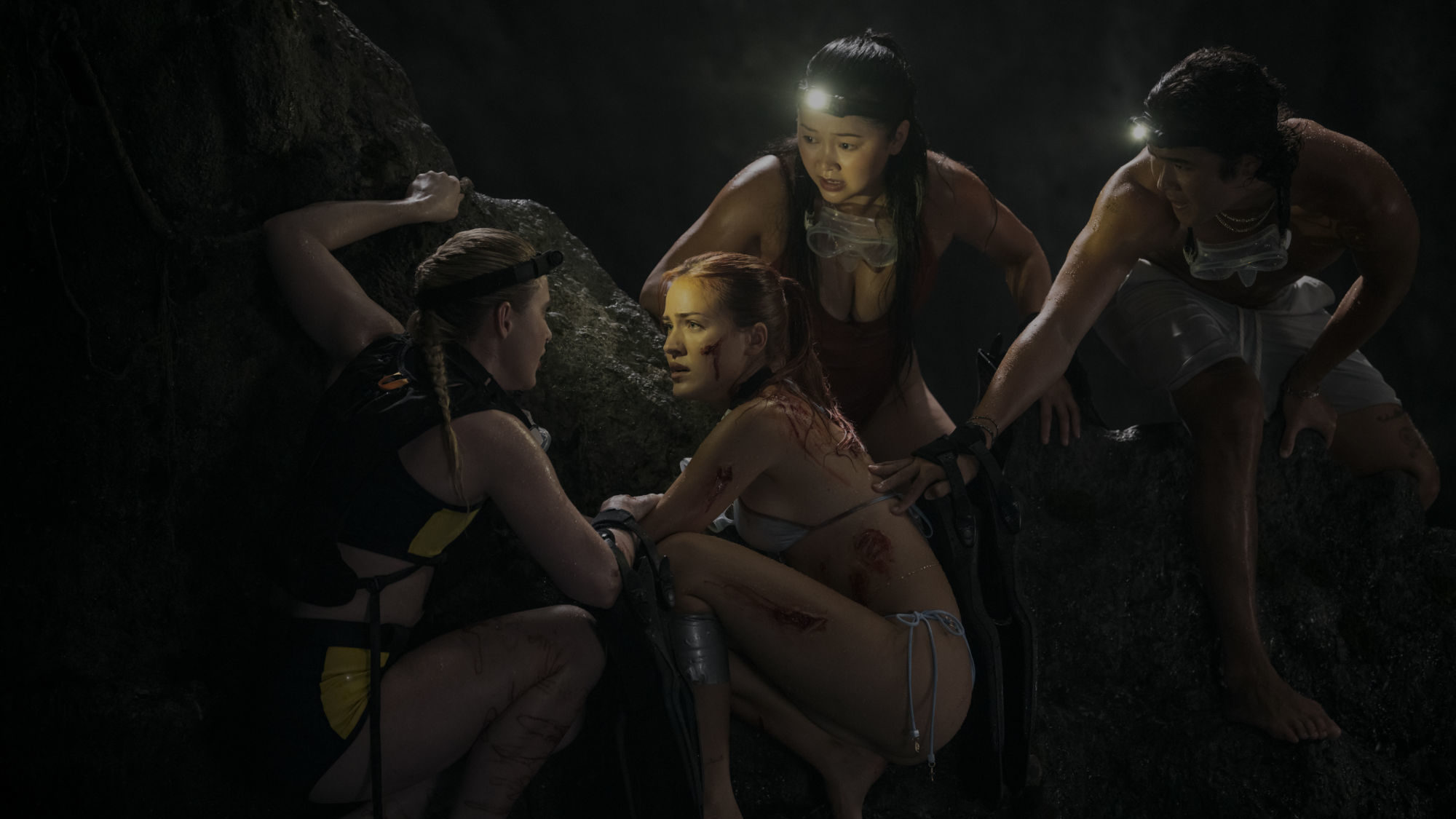
On stage, we had to break the roof into parts so that we could lower and raise it, and we could allow big soft light to come in. Sometimes, we put some hard light as if it were a shaft of light coming through a chimney in the real cave. The biggest challenge was figuring out what motivates the light, and then we could augment from there, so we had to establish some light motivator. One of the things that we came up with was that the guide would have a light, as he would be a guide who floated with [the group], so that there was always some sort of motivator there. He swims through the cave with a floating light that at least explains why there’s any ambiance in the cave, if there’s no sky or no holes in the cave. Also, we decided that the characters would all have headlamps on. Again, another motivator, but I was a little nervous about that because of their changing proximity to one another and what happens to the light.
If at one moment, they’re dark, and suddenly, they’re getting blasted by their neighbor’s headlamp. I was a little worried about that originally, but through some testing and working with the actors to not do that, they would adjust their lights accordingly, all the time- tilt them up, tilt them down a little bit. I think that it all worked and gave a reason for there to be light in a dark cave, because in scouting the real caves, it is pitch black. You see nothing there, and one of the ways that this idea came that their guide would carry a light was when we went into the real caves; the guide carried a soft lantern that they’d put on their little bamboo rafts. I think that nobody questions that, I hope.
Lionsgate and Thunder Road’s The Devil’s Mouth, which stars Kathryn Newton, Gavin Casalengo, Tommi Rose, Lana Condor, and Nico Hiraga, is available on Prime Video.
Enjoyed this? Please share on social media!
<a href="https://news.google.com/publications/CAAqBwgKMPHflgsw1IauAw?hl=en-US&gl=US&ceid=US:en” rel=”nofollow noopener” target=”_blank”>
Stay up-to-date and support the site by following Bleeding Cool on Google News today!
