


When it comes to Imtiaz Ali’s Main Vaapas Aaunga (MVA), let me say this: I get it, I really do… hence the disappointment.
A little backstory for context: I’ve spent years in India being loved by grandparents and great-grandparents, felt the pain and tears in unrelentingly long hugs of separation and braved the heartbreak of not being there when sickness and death came to them.
In Pakistan, I’ve seen both parents suffer debilitating illnesses, one from rapidly advancing dementia. So, in every sense, I am Imtiaz Ali’s main audience. MVA, therefore, should have broken this writer. Only, it made me reach for the fast-forward button. A.R. Rahman’s soundtrack didn’t help either.
Ali, the co-writer and director, is immovably stuck in his own circle of thought. His films are still about journeys, as he told Icon and this writer in 2015. Unlike his earlier work, this film is chock-a-block with superficial emotion, feigned sensitivity and an irksome flatness that one cannot merely blame on Sylvester Fonseca’s flatter cinematography.
Imtiaz Ali’s Main Vaapas Aaunga reaches for a bittersweet tale of love, loss and Partition, but its emotional journey never quite lives up to its destination
Nirvair Grewal (Diljit Dosanjh) — Nivi — is a young software engineer with British citizenship who has chucked his well-to-do career to pursue a living as a stand-up comic. That’s the film’s first big joke.
Nivi neither has the timing nor the material, confidence or natural instincts for comedy. In the film’s last leg, he literally takes the title to heart, deciding to use his software skills to benefit India… a country with nearly six million software engineers. No matter how well-intentioned, that’s the second joke of the film.
Nivi is a commitment-phobe, whether it’s with his job or the woman he’s involved with. When his live-in partner Kaveri (Banita Sandhu) pushes him to accept their boyfriend-girlfriend status, he throws a tantrum. He then runs away to India to see his dying grandfather, Ishar Singh Grewal (Naseeruddin Shah), a self-made man with apathetic offspring — the kind who have already given up on a parent’s failing physical and mental state.
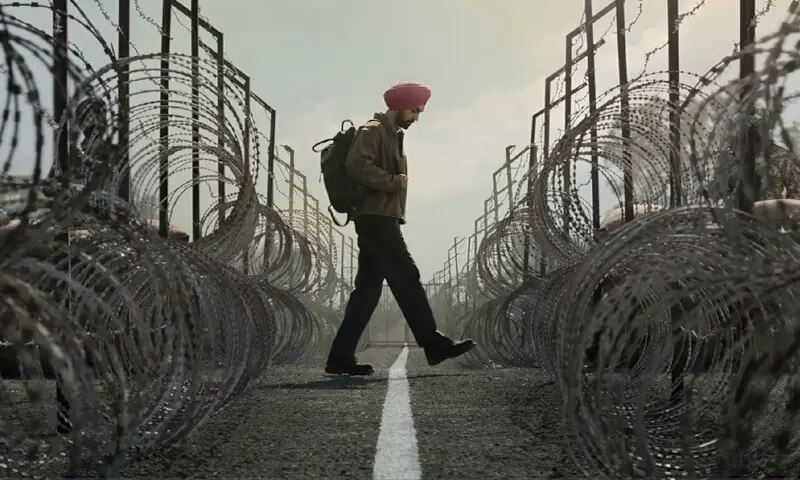
Ishar has advanced dementia — in which he believes he can travel to his birthplace in Sargodha (now in Pakistan) by walking across the border. When he suffers a stroke at the Attari-Wagah border, the family all but starts counting his last days.
However, Ishar is resilient and Nivi deduces that his grandfather is clinging to an old memory. This is where Imtiaz Ali rolls back to the pre-Partition era, when a young Ishar (Vedang Raina) fell in love with Jiya (Sharvari) — a Muslim girl. No need to tell you how that story goes.
Bollywood is not new to moving, harrowing, perhaps even brave stories set during the Partition era — Deepa Mehta’s Earth (1998), the screen adaptation of Amrita Pritam’s novel Pinjar (2003) and Hey Ram (2003) (the last because I watched it a few months back) — immediately come to mind. These are well-defined films, in which the characters’ deep personal motives support seemingly simple stories. MVA simply falls flat in comparison.
Anchoring the story on Jiya and Ishar — both depthless, one-tone characters — slows the film’s pace and emotional momentum, especially as bigger stories loom in the wings. One realises early that the young couple’s story has as much weight as Nivi’s in the present, and that both narrative anchors have much growing up to do.
Think of how rich a playground the core premise provides: Nivi represents Gen-Z, who have less of an emotional connection to the past than Millennials or Gen-X, while Ishar could have opened up a story that does not feel like an unimaginative version of Love Aaj Kal.
Instead, the film uses Nivi as a peg for the past to lean on, while the young Ishar only sees the loss of a girl and refuses to grow up.
Is romance, then, the only thing in life, especially as the world one knows collapses on itself? Apparently, in Ali’s film, it is!
Two chunks do help keep one’s interest at the tail end. First, when Ishar is forced away during Partition, and then, when Nivi finally understands that his grandfather’s story has an end in Pakistan. Duh! It’s an end one sees coming two hours and 45 minutes away.
Although it’s the bittersweet ending the film deserves, getting there requires a belief in love that never quite feels convincing in MVA.
Streaming on Netflix, Main Vaapas Aaunga is rated suitable for ages 16 and over, who need to see better films about romance and the Indo-Pak Partition
The writer is Icon’s primary film reviewer
Published in Dawn, ICON, September 6th, 2026
