


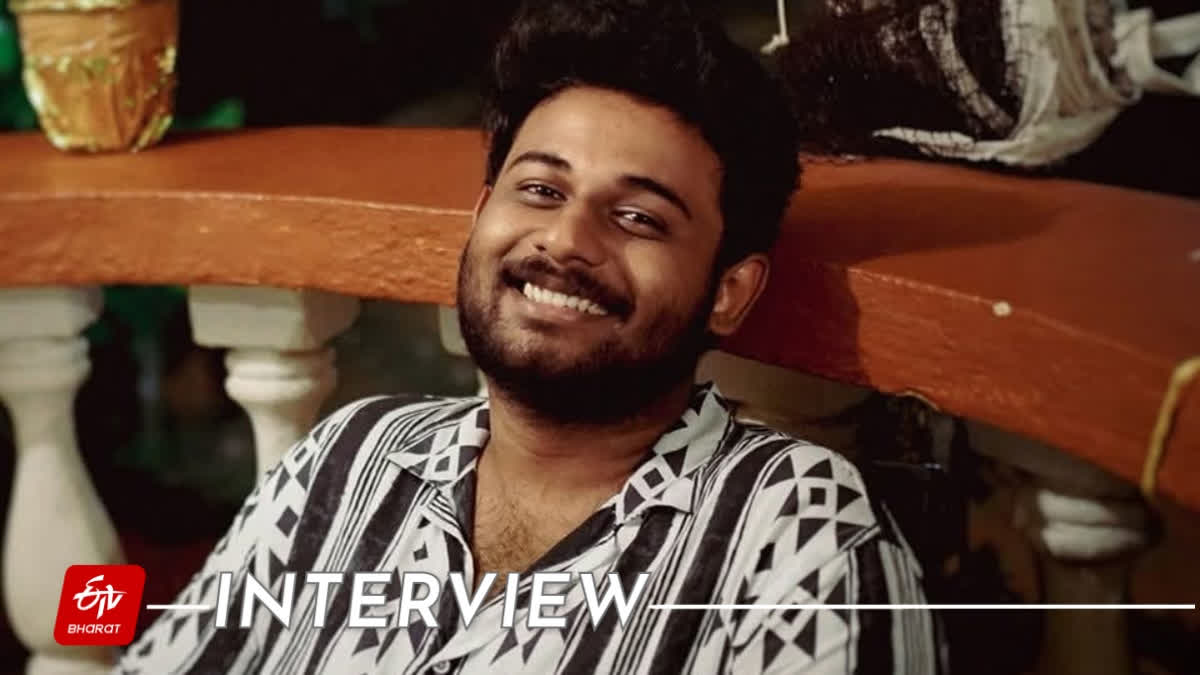
In conversation with Akhil Vinayak for ETV Bharat, director Safar Sanal discusses Aasha, Urvashi’s performance, Joju George’s contribution and the film‘s making.
Aasha Director Safar Sanal (Photo: Special Arrangement)
ByETV Bharat Entertainment Team

Hyderabad: Malayalam film Aasha has been getting attention for its story and strong performances, especially that of Urvashi, who plays the central character. The film marks the directorial debut of Safar Sanal and also features Joju George, Aishwarya Lekshmi and Vijayaraghavan in important roles. In an interaction with ETV Bharat, Safar opened up about the making of Aasha, his decision to cast Urvashi, Joju’s contribution to the film and some memorable moments from the sets.
Safar Sanal started his filmmaking journey by making short films. Some of his works received attention at the national level. He later made his writing debut with Peace, which starred Joju George and Siddique. The film was released during the lockdown.
Safar then began working on the idea that eventually became Aasha. He first had the basic idea in 2019, but the story took several years to develop.
“The idea came in 2019. We wanted to tell a realistic revenge story through the life of a woman. The character was inspired by the ordinary mothers we see around us,” Safar told ETV Bharat.
The filmmaker said the story went through several changes during the writing process. At one point, they even thought about making a much bigger film with a male lead. However, they eventually returned to the original idea of having a woman at the centre of the story.
Joju George later became part of the writing process, and the screenplay took around three years to complete. According to Safar, Joju played an important role in shaping the film. “Joju came into the project later as a screenwriter. We worked on the screenplay for almost three years,” he said.
Safar also credited Joju for helping the team bring together several experienced technicians for the film. Cinematographer Madhu Neelakandan was among those who came on board. “The scale of the film was decided by Joju. His support helped us bring in many good technicians,” Safar said.
Urvashi Was Always The Choice For Aasha
When it came to the central character, Safar said he had only one actor in mind: Urvashi. “I only had Urvashi in my mind for Aasha,” he said.
However, he was not sure if the veteran actor would agree to play the role. The character had several shades that were different from the roles she had usually played. “I was nervous because I was not sure whether she would say yes. She had not done a character like this with these negative shades before,” Safar said.
Urvashi, however, connected with the role. She had also been waiting for a film where the entire story depended on her character. Safar said the team wanted to show the audience a different side of the actor while still making Aasha feel like a real person. “We wanted to show an Urvashi that the audience had never seen before,” he said.
Urvashi’s Performance Left The Set Silent
One of the most memorable moments during the shoot came while filming a bank sequence. The scene required Urvashi to show a strong emotional outburst. The sequence was planned as a single shot. Urvashi hit the wall with her hands while performing the scene. Her performance became so intense that her hands actually turned red and swollen.
Safar said the entire set went silent after the performance. “I did not know where to say cut. Her performance was much bigger than what we had written,” he recalled. After the scene, Urvashi broke down and cried. She needed a long break before continuing with the shoot. Safar said this was one of the moments that showed how deeply Urvashi had entered the character.
A Difficult Scene With Joju George
Another challenging sequence was the vehicle accident scene involving Joju and Urvashi. It was also their first scene together in the film. The scene was shot over three nights on a busy road around midnight. The team had to manage traffic and crowds while also maintaining the mood required for the scene.
According to Safar, Joju performed the sequence with great intensity, while Urvashi matched his energy. “It was a very intense scene. Joju performed it with a lot of energy, and Urvashi matched him. She dominated the scene,” Safar said.
Why The Film Takes A Risk With Its Characters
Safar believes Malayalam cinema has changed a lot in recent years. According to him, filmmakers now have more freedom to experiment with stories and characters. He also feels the old difference between commercial cinema and parallel cinema is slowly disappearing.
“Malayalam cinema now has less risk when it comes to experimental ideas. The boundaries between commercial and parallel cinema have also changed,” he said.
With Aasha, the team wanted to tell a story where the audience could decide for themselves who was right and who was wrong. The filmmaker explained that the film does not directly take the side of any character. Instead, it looks at how circumstances can change the way people see good and evil.
“The villain is reality and circumstances,” Safar said. He also explained this idea through a simple example: “Killing a cockroach can make you a hero, while killing a butterfly can make you a villain.” According to him, the audience has to decide what is right and what is wrong after watching the film.
Vijayaraghavan Chose The Film For Its Screenplay
Vijayaraghavan is also part of Aasha. Safar said the actor agreed to the film even though his screen time was not as large as in some of his previous projects. For Vijayaraghavan, the screenplay mattered more than the size of the role. Safar praised the actor for being open to new kinds of cinema and for showing excitement towards younger filmmakers and different stories.
He also recalled a light moment from the sets involving Vijayaraghavan. In a kitchen scene, the actor was supposed to check whether the curry had enough salt. During the take, he added an expression suggesting that the curry was also spicy. Urvashi genuinely laughed at his performance. The reaction was natural, so the team decided to keep the take without shooting another one.
The Medical Examination Scene With Aishwarya Lekshmi
Safar also spoke about a scene involving Urvashi and Aishwarya Lekshmi. The sequence was designed as a single shot and required Urvashi to move through several emotions. The scene begins with her trying to understand what has happened. Her emotions then slowly change into a breakdown and finally an explosive reaction.
Safar said the scene was later edited, but Urvashi’s performance again left the team surprised. “With Urvashi, I often did not know where to say cut because her performance was 50 times bigger than what was written,” he said. Safar chose not to reveal more about the scene as it could give away important parts of the story.
Why Is The Film Called Aasha?
The title Aasha comes directly from the name of the central character. The team considered several names before settling on Aasha. Safar felt the name suited the character because Aasha is not someone who feels distant from the audience. “There are many Aashas around us,” he said.
The idea was to make the character feel like an ordinary woman while placing her in an unusual and difficult situation.
The team also carried out research before making the film. Since the story touches on policing and medical matters, the filmmakers spoke to professionals from these fields. Safar said this helped them make the situations in the film more realistic without making the story feel like a documentary.
Aishwarya Lekshmi also joined the project because she liked the screenplay. She described her character as “only a catalyst” for the story. Ramesh Girija, who worked with Safar on the screenplay, is also part of the cast. He has an important role in the film, and viewers familiar with Malayalam digital content may recognise him as Karikku Suni from Joju George’s directorial Pani.
