


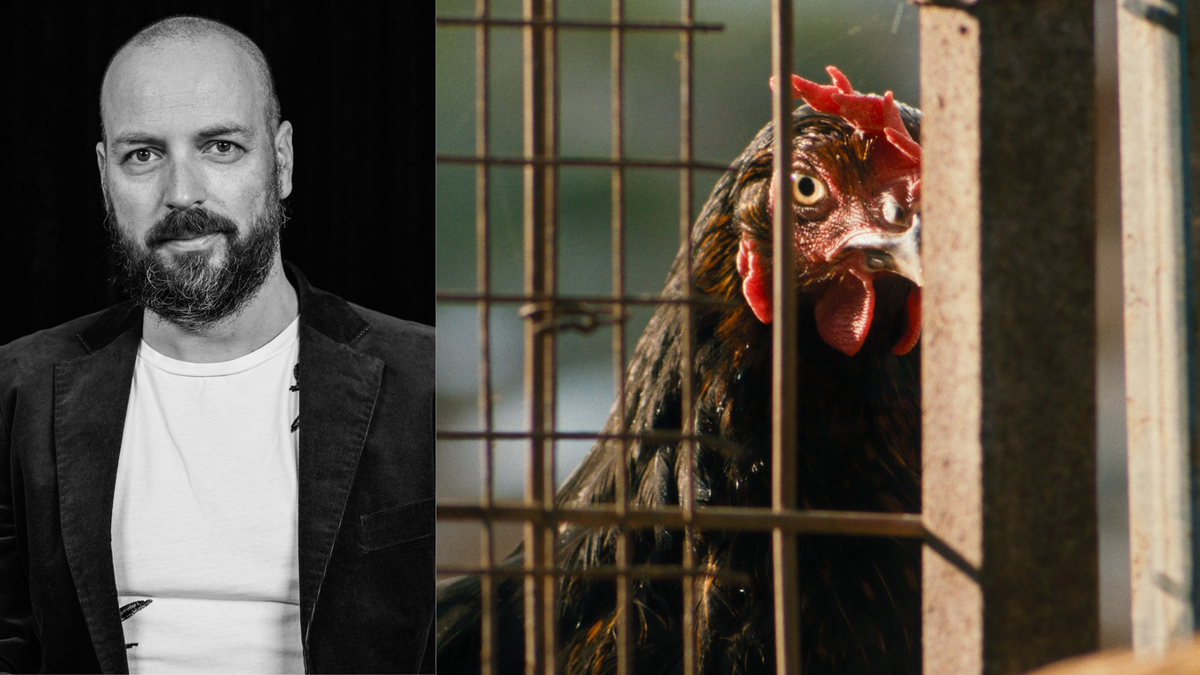
What happens when you take a story about migration, human trafficking, motherhood and moral compromise, and tell it almost entirely through the eyes of a chicken? For Hungarian filmmaker György Pálfi, the answer wasHen, an unconventional drama that follows a hen who escapes an industrial farm and finds herself at a Greek seaside restaurant where a much darker human story is unfolding in the background. The film, a Germany-Greece-Hungary co-production, premiered at the Toronto International Film Festival in 2025, where it received an Honourable Mention in the Platform competition.
The obvious question, then, is: why a chicken?
“There’s an animal hierarchy, sadly, in how we see animals,” Pálfi tells ELLE India. “It’s a dog, cat, horse, pig. And who is the last member of this hierarchy? The chicken.” Dogs and cats are given names, he points out, while very few people ever name a chicken. For him, that made the bird the perfect starting point. “I tried to find the smallest elements of this hierarchy. And I found this chicken.”
But the choice was not simply about making an unusual animal movie. Pálfi was interested in what happens when “the smallest and the biggest” meet. On one side is a chicken, an animal we live alongside but rarely stop to observe. On the other are enormous, complicated issues such as migration, refugees and human trafficking, problems far beyond the ability of any one person to solve. “The smallest and the biggest meet in the courtyard of the restaurant owner,” he says.
That collision also allowed Pálfi to play with one of cinema’s most fundamental tools: perspective. Rather than giving the audience a human character through whom to process the story, he wanted them to spend time inhabiting an entirely different way of seeing.
“I don’t believe the human has too much story. But I believe [it] has a lot of point of view,” he says. “How can we tell these stories? So I chose a chicken because that was the original point of view, a new point of view for me, and I hope for the audience too.”
There is another layer to that choice. The protagonist is specifically a hen, and her central desire is deeply tied to motherhood. Pálfi describes the film as having a “woman’s perspective” and, more specifically, a “mother’s perspective”. Her determination to raise a child becomes one of the film’s emotional anchors, even as the human world around her becomes increasingly violent and morally complicated. The film’s official synopsis similarly frames the story around a hen desperate to raise a family while a human tragedy unfolds around her.
The result is a perspective that is female without turning the chicken into a human caricature. She remains an animal, driven by instinct, while the audience is left to project meaning onto what she sees.
That became particularly important in the film’s visual language. Pálfi has previously spoken about wanting audiences to “become the chicken” during the opening stretch ofHen, and achieving that meant figuring out how to shoot an animal who, unlike a human actor, cannot simply hit a mark or perform a scene on command.
The filmmaker made one major decision early on: the chicken itself would remain real.
“When I saw how the chickens collaborated with us, I decided I wouldn’t use CGI or any trick during the shooting period,” he says.
That decision came with obvious complications. A chicken and a fast car cannot safely share the same frame. Neither can a chicken and a dog, or a chicken and fire. So rather than replacing the bird digitally, the production built the surrounding world around her.
For the car sequences, the team filmed the chicken and the vehicles separately, using the same camera angle before combining the material. The team created the fire through a similar process. The truck could be burned, but the team removed the chicken from the setup first. The dog was filmed separately, followed by the chicken, and the two were later brought together through visual effects.
“The role is performed by real chicken actresses,” he shares with a chuckle.There were eight chickens in total, with three specifically trained for more dangerous scenes, performing the lead character.
The irony is that Pálfi’s commitment to keeping the chicken real was so successful that the film even won a VFX prize in Greece. “I don’t think they knew. You cannot see the VFX in the movie,” he laughs. “I think the jury thought, ‘This is a fake chicken and the CGI made it.’ No, this is a real chicken.”
The technical challenge is part of what makesHenso disarming. The premise could easily have become a gimmick, but Pálfi is less interested in anthropomorphising his protagonist than in using her to expose the absurdity of the human world around her. The chicken does not understand migration policy, criminal networks or human moral compromise. She is simply trying to survive and protect what matters to her.
That simplicity becomes the film’s entry point to much bigger questions.
Pálfi is conscious thatHendeals with factory farming, migration, crime and moral compromise, but he did not want to make a film that dictated how an audience should interpret those subjects. Instead, he describes the movie as “multilayered storytelling”.
“The story needs a surface. This is the main level of the storytelling, which needs to be logical and emotional. The audience needs to join in, connect, and understand what’s happening in the first level,” he explains.
Then come the other layers. A viewer can watchHensimply as an adventure about a chicken. Another can look deeper into its political implications. Another might engage with its philosophical ideas or its underlying structure. Pálfi even points to an ancient Greek storytelling structure embedded within it.
“Everybody can decide how deeply [they are] going into the philosophy of the movie or not,” he says. “The movie is given a chance to be watched as just a chicken movie with adventures.”
For him, that freedom is part of the filmmaking. “The balance is important. This is an editing part. That is our job to find the balance.”
That approach also connects to Pálfi’s larger concerns about making films outside the commercial mainstream. Independent filmmaking, he says, remains difficult largely because of financing. Budgets are smaller, investors are harder to find, and filmmakers are constantly caught between an audience hungry for originality and an industry that still needs to justify where the money goes.
At the same time, technology has changed the equation. Phones and increasingly accessible cameras have made filmmaking more democratic, while AI has opened up new possibilities for filmmakers working without traditional re
“You have a phone, you have a camera, you have friends. Why don’t you make an independent movie?” he says. “And with AI, you can make a very, very cheap movie now.”
The catch is that “free” filmmaking does not really exist. Even inexpensive AI-generated material can accumulate costs when a feature requires thousands of shots. “It’s impossible to make a movie for free, because AI costs money too,” he says. “If you would like to make a shot of AI, that is one or five dollars. Very cheap, but you need to make 20,000 shots until your movie is ready.”
For Pálfi, that leaves independent cinema occupying an increasingly strange middle ground. There is no-money filmmaking, where new technology can lower barriers to entry; small-budget filmmaking, which still needs funding for everything from food and props to post-production; and the much larger commercial system, where investors expect their money back with a profit.
“Independent films somehow are in between, which is a very strange situation,” he says.
IfHenrepresents one experiment with the possibilities of animal-led storytelling, Pálfi may already have another one in motion. He has previously spoken about turning his fascination with animal protagonists into a trilogy, and now reveals that the next story could take him to India.
“I found a very good story in India with a monkey,” he says. The script is already ready, and he has met with independent producers in Mumbai. “We are waiting to travel there and start production on the next movie called Monkey.”
He admits that the project could be “bigger and harder to make” thanHen, but says it shares a surprising number of ideas with the chicken film while ultimately being a very different movie.
For a filmmaker who deliberately chose the animal at the bottom of humanity’s hierarchy to tell a story about some of its biggest failures, that may be the point. Change the perspective, and the familiar suddenly becomes strange. The human story remains the same, but from down at chicken height, it looks completely different.
Also, Read:
7 Art Exhibitions To Watch Out For This September
The Art Fashion Continuum: Inside South Asia’s New Sculptural Wave
India On Paper: Priya Paul’s Love Letter To Bazaar Art
