

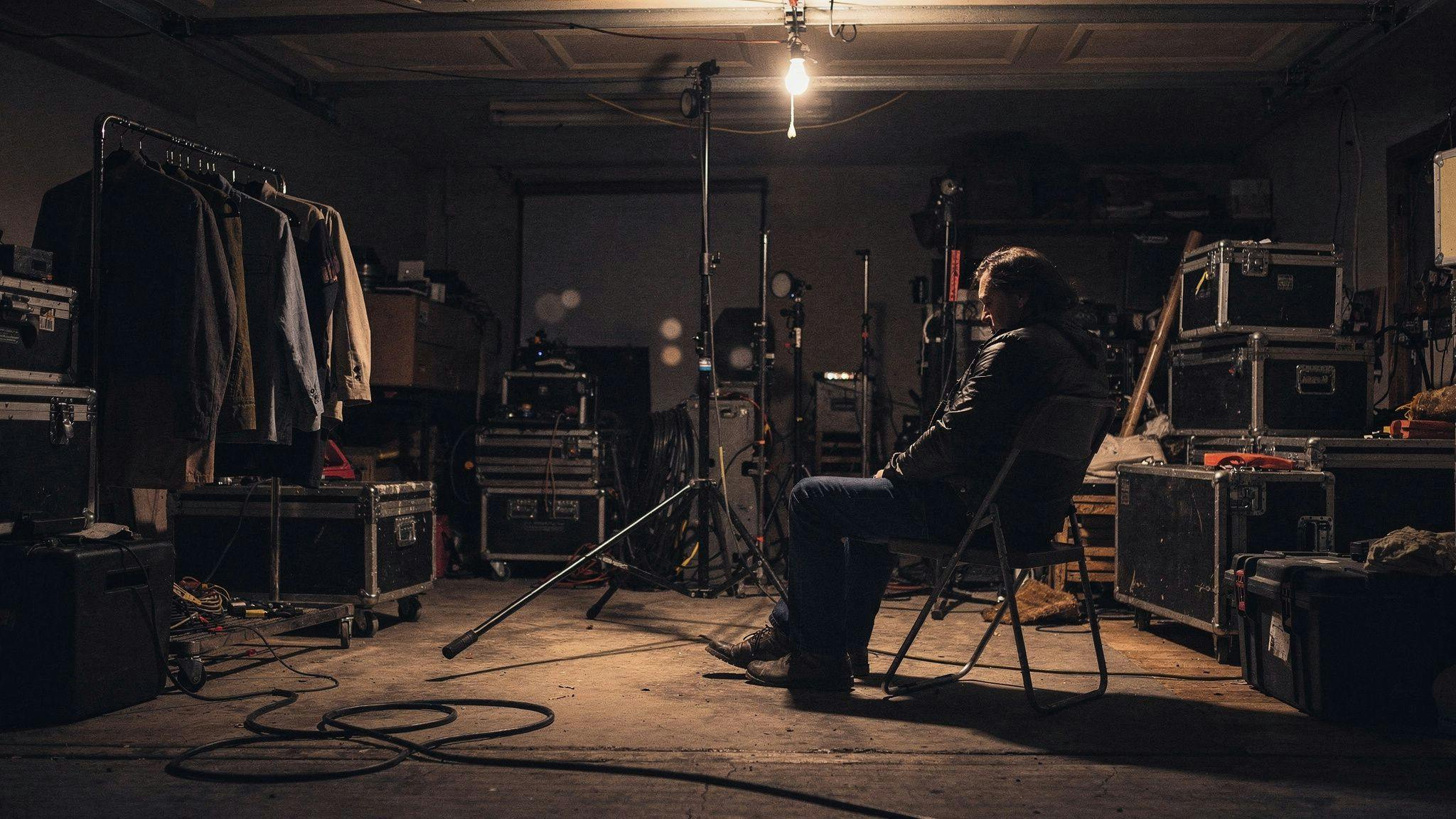
AI filmmaking burnout rarely comes from generating too many clips. It comes from quietly becoming your own set designer, colorist, sound editor, and producer at the same time, with nobody around to tell you that’s five jobs, not one.
I noticed it on a week when Lost Garden wasn’t even going badly. The shots were landing. The voice work was consistent. And I still ended most days flattened, unable to explain why, since on paper I hadn’t done anything harder than usual. I hadn’t shot anything. I hadn’t traveled. I’d sat at a desk generating video clips, which sounds like the easy version of filmmaking. It isn’t, and I want to explain why, because I don’t think I’m the only one hitting this wall.
A traditional short film crew splits its work by role: a director directs, a cinematographer lights, a costumer dresses the cast, an editor cuts. Each person carries one job well. AI collapses that crew into a laptop, but it doesn’t collapse the work. It just routes all of it through you.
Rebecca Bellan’s reporting for <a href="https://techcrunch.com/2026/02/20/ais-promise-to-indie-filmmakers-faster-cheaper-lonelier/?ref=hackernoon.com” rel=”nofollow noopener” target=”_blank”>TechCrunch on Google’s Flow Sessions cohort, where ten independent filmmakers made short films with Nano Banana Pro and Veo, put this plainly. The filmmakers she interviewed found themselves suddenly playing set designer, lighting director, costumer, roles requiring expertise they didn’t have. It was frustrating and draining, pulling them away from the work they actually cared about. One of them, Hal Watmough, said it without dressing it up:
“I know I’m a one-man band, and I just made all this by myself… but that should never be the way that anyone tells a story or makes a film.”
That’s the trap. AI expands what one person can technically produce, but it doesn’t expand what one person can sustainably decide. Every shot still needs someone to make the lighting call, the wardrobe call, the pacing call. On a crew, that load is distributed. Alone, it lands on you, shot after shot, with no one clocking out to hand off to.
What does the data actually say about creator burnout?
This isn’t a feeling unique to AI filmmakers. Adobe’s Future of Creativity study found that 48 percent of creators have already experienced burnout, and the rate climbs higher among people who depend on content as their main income. The World Health Organization formally classified burnout as an occupational phenomenon back in 2019, describing it as chronic workplace stress that hasn’t been successfully managed, not a personal failing.
What’s specific to solo AI filmmaking is how fast the role count stacks up. A YouTuber doing their own editing is already juggling filming, cutting, thumbnails, and captions. A solo AI filmmaker is doing all of that plus every job a physical crew used to hold: casting the look of a character, staging a shot, choosing a color palette, directing a voice performance, checking continuity between clips a model generated with zero memory of the last one. None of those disappear when you go from a camera to a prompt box. They just stop being anyone else’s job.
What are the burnout patterns to actually watch for?
Reporting on the wider creator economy from Bit Rebels, built on data from a video-editing service working with over 1,800 creators, names three recurring patterns. I’ve watched myself fall into two of them on Lost Garden before I had a name for what was happening:
- The quantity trap. You raise your output pace chasing growth or a deadline, without adding any infrastructure to support it. Volume goes up, energy and quality go down, and within a few months you’re either posting erratically or you’ve stopped.
- The pivot spiral. You keep changing format or approach because growth stalled, so you’re constantly relearning a new workflow on top of maintaining the old one. Every new AI tool release tempts a solo filmmaker into this one specifically, since switching models feels like progress even when it just resets your learning curve.
- The monetization pressure collapse. The moment a personal project turns into something that has to perform, every clip becomes a referendum on whether the work is worth it. This one is quiet and it’s the hardest to walk back from.
None of these are about working too many hours in a single day. They’re about a workload that never stops multiplying while the support system underneath it stays exactly the same size: one person.
What actually helps a solo AI filmmaker stay in this for the long run?
The advice that held up for me wasn’t about generating faster or figuring out how to prompt less. It was about treating some of the workload as infrastructure instead of craft, and being honest about which parts are actually mine to carry.
A few things changed how I run Lost Garden day-to-day:
- I stopped treating every clip as a fresh decision. Locking a character’s voice settings, lighting language, and color grade once and reusing that reference instead of re-deciding it every scene cuts an enormous amount of invisible labor. It’s the same principle behind reducing friction that researcher BJ Fogg’s habit work points to: sustainable output comes from removing repeated small decisions, not from gritting your teeth through them.
- I batch by task, not by scene. Generating every shot in a scene start to finish, one at a time, means constantly switching between director-brain, colorist-brain, and editor-brain. Batching all the wide shots, then all the color passes, then all the sound, keeps me in one mode longer and cuts the switching cost.
- I write down my own boring schedule and stick to it. Not six clips one week and none the next. A pace that’s boring on purpose, because a system I can actually repeat beats a burst of effort I can’t.
“The creators who will still be making content in five years are not the ones who worked the hardest in the next six months. They are the ones who built the most sustainable operations right now.”
That line from Bit Rebels’ Usman Qamar stuck with me because it applies just as much to a one-person film studio as it does to a YouTube channel.
This is also, honestly, the reason ScreenWeaver exists as more than a personal tool for me now. Keeping a scene’s script, storyboard, and shot intent attached in one place instead of re-explaining it to yourself every time you open a new generator tab is the same move as batching or locking a reference: it’s removing a decision you’d otherwise have to make again from scratch. If you’re building something solo, Lost Garden is the case study I keep testing all of this against, and it’s free to see how the workflow holds up on a real episode.
Is AI filmmaking actually lonelier than traditional filmmaking?
Not inherently, but it removes the built-in reason to collaborate. A traditional crew forces you to delegate. AI makes it technically possible to do everything alone, and that possibility quietly becomes an expectation, on yourself first.
How many hours a week is sustainable for a solo AI filmmaker?
There’s no universal number. The pattern that predicts burnout isn’t hours, it’s inconsistency, doubling output one week and crashing the next, per the Bit Rebels creator-economy data above.
Should I just hire help instead of doing every role myself?
Where you can, yes, even part-time or per-episode. But the more realistic fix for most solo creators is cutting the number of decisions you have to remake, through locked references, batching, and reusable systems, rather than the number of hours you work.
Is burnout a sign I should quit AI filmmaking?
Not on its own. It’s a sign the workload has outgrown the support system underneath it. That’s fixable with structure. It’s the absence of any structure that isn’t.
What’s actually burning you out on your own AI film or series? I’d rather hear the specific pattern than the general complaint, drop it in the comments.
