


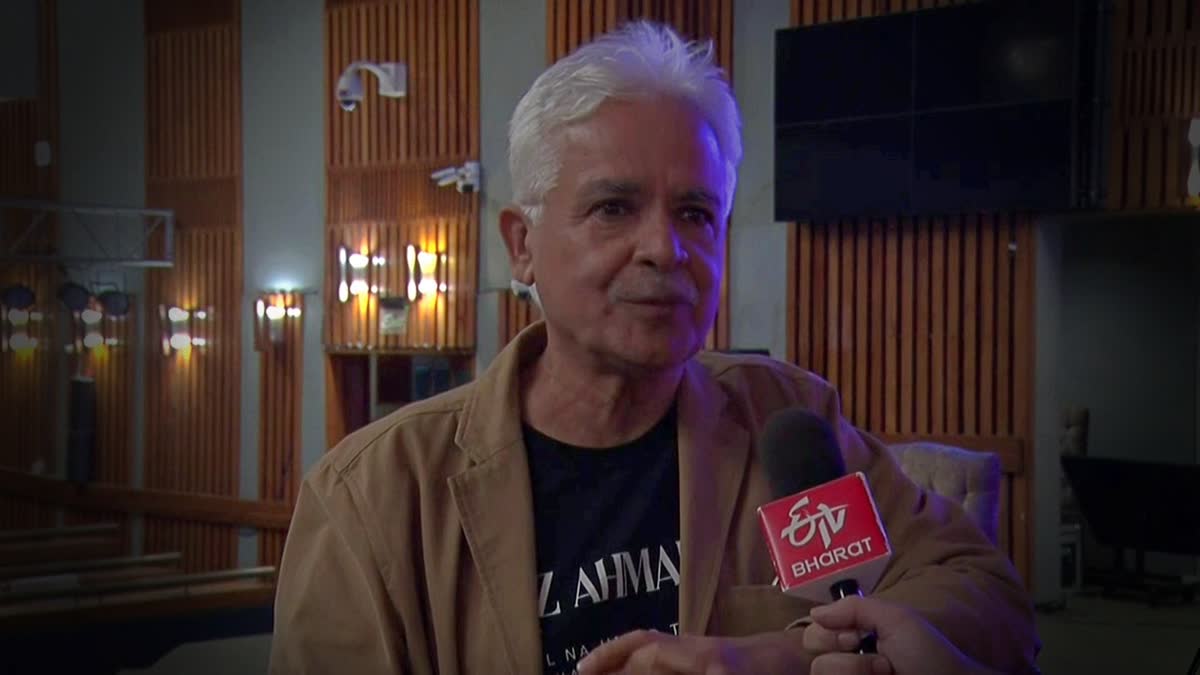
Speaking to ETV Bharat, the ace cinematographer counted his early collaborations with filmmaker Sanjay Leela Bhansali among the biggest learning experiences.
Cinematographer Anil Mehta (ETV Bharat)

Srinagar: Acclaimed cinematographer Anil Mehta has said his early collaborations with filmmaker Sanjay Leela Bhansali were among the biggest learning experiences of his career, while reflecting on the uncertainty of working in the film industry at the International Film Festival Jammu and Kashmir.
Speaking to ETV Bharat on the sidelines of the festival on Tuesday, Mehta said choosing cinematography as a career was itself a difficult decision because he had little idea where the profession would take him.
“When I decided that I wanted to do cinematography, I myself did not know where my journey would have started. It is such an uncertain profession,” Mehta said.
He recalled that the decision to enter films was not easy, particularly when he had to explain his career choice to his parents.
“It was very difficult to make a decision that I have to work in films, then I have to do cinematography and then I have to explain to my parents that this is what I want to do,” he said.
Mehta, whose filmography includes several major Hindi films such as Lagaan, Kabhi Alvida Naa Kehna, Veer Zaara, Rockstar and Jab Tak Hai Jaan, said his early association with Bhansali gave him valuable experience.
“My first two films were with SLB,” he said, referring to Bhansali. “Khamoshi” and “Hum Dil De Chuke Sanam” for me are very big learning experiences.”
Mehta said the appreciation received by his early work helped him find further opportunities in the industry.
“Because those films were made well, and because the second film, Hum Dil De Chuke Sanam, was appreciated in the industry, then I got more work because of that,” he said.
Mehta stressed that there is no fixed formula for building a career in cinema. Unlike professions where a predictable path may be followed, he said the film industry is defined by uncertainty.
“Everyone has their own path. So I can’t give anyone a formula that if you do this, it will happen,” he said.
“In films, the uncertainty is written very, very large. When does it start and when does it end? No one has an answer to this.”
The cinematographer also spoke about his relationships with directors and dismissed the idea that disagreements and fights are an essential part of filmmaking.
He said the cinematographer’s primary responsibility is to understand the director’s vision and work toward the film rather than approaching a project with the expectation of conflict.
“As a cinematographer, you are going there to work for the film,” Mehta said. “It is important to understand this thing from their point of view. And when you work with that spirit, then there are very few possibilities of fighting in this.”
One of the most revealing moments of the conversation came when Mehta was asked whether he revisits his films to analyse his work, particularly after the final cut reaches audiences.
The question drew a comparison with superstar Shah Rukh Khan, who has previously spoken about not watching his own films after they are released.
Mehta said he shares the same habit. “You have said a good thing that Shah Rukh does not watch his films,” Mehta said. “Because now Shah Rukh and I have one thing in common, that I do not go back and watch my films.”
Mehta explained that he watches his films repeatedly during the editing and finishing process. But once the final print is ready and he has experienced the film with an audience, he finds it difficult to watch it again.
“I have to watch the whole film again and again at the time of finishing the film. I watch that and complete it with all my heart,” he said.
“But once that print comes, the final print that will be shown in the theatre, once I watch that film with the audience, I find it very difficult to go back and watch my own films,” he added.
That habit, he said, extends even to films available on streaming platforms.
“Even if they are running on some OTT platform, I won’t go back,” Mehta said.
Asked to name the film he considers closest to him, Mehta avoided choosing a single favourite. Instead, he highlighted two projects he made with filmmaker Imtiaz Ali, “Rockstar” and “Highway”.
“Actually, it’s not a favourite film,” he said. “But there was a time in my career when I did Rockstar and Highway back to back with Imtiaz. And I found that experience and both those films very interesting.”
Mehta said the two films offered him a different creative experience despite being part of mainstream Hindi cinema.
“On one hand, I had worked with Yash ji till then, and these films, even though they were in mainstream cinema, were a little different, the way they were written, the way they were visualised,” he said.
“So for me, both those films are quite precious.”
Mehta’s career has been associated with a wide range of acclaimed productions. His cinematography credits include Lagaan, Kal Ho Naa Ho, Kabhi Alvida Naa Kehna, Veer Zaara, Jab Tak Hai Jaan, Rockstar, Highway and Badlapur, among others.
Several of the films he has worked on have also been major award-winning productions. Lagaan, directed by Ashutosh Gowariker, won the National Film Award for Best Popular Film Providing Wholesome Entertainment and was nominated for an Academy Award for Best Foreign Language Film. Mehta also shot Hum Dil De Chuke Sanam, which brought him an early breakthrough through his collaboration with Bhansali.
At the International Film Festival J&K, Mehta’s interaction also focused on the craft of cinematography and the patience required to work in cinema. He said patience is not something filmmakers simply develop while working. It has to be part of their mindset.
“If you want to be in films, patience should be in your mind,” Mehta said. “This is not that kind of work that happens in a hurry.”
