


There is no such thing as bad publicity
That adage has rung true with the widely mocked Chinese film Niu Lai (The Bull Comes), which has been hate-watched all the way to blockbuster status at China’s box office since opening on Aug 5.
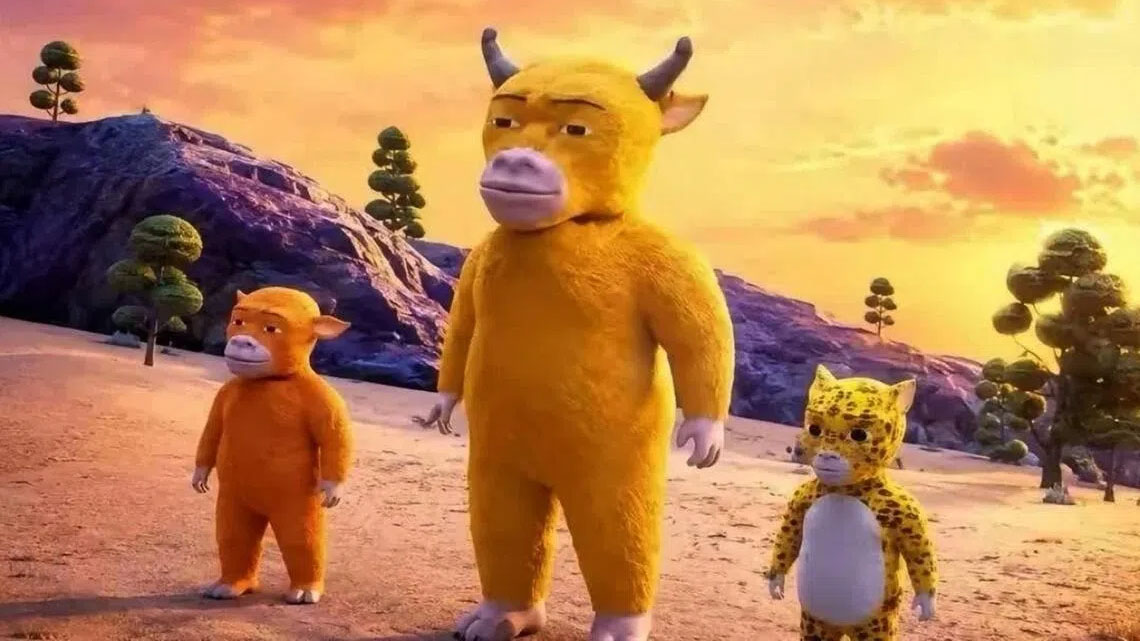
The 86-minute animated film initially received scathing reviews over its baffling plot and low-quality computer-generated imagery.
It tells the coming-of-age story of a newborn calf named Niu Lai who befriends a young orphaned leopard and faces challenges such as having to cross a desert and fight against a pack of wolves.
The film, reportedly made on a microbudget of a few thousand yuan by a 34-year-old landscape artist and his mother over five years, quickly went viral and earned a cult following for being “so bad, it’s good”. It began attracting curious young moviegoers eager to laugh at its crude visuals, awkward dialogue and stiff character design.
Despite flopping with just over 7,000 yuan (S$1,300) in earnings in its opening week, Niu Lai has grossed more than 59 million yuan at the domestic box office, making it the most profitable film of all time based on return-on-investment ratio, dethroning the 2025 American horror indie Obsession.
Caelan Moriarty, a 25-year-old American musician working in China, was quoted by AFP as saying “there’s some heart (put) into it, so you can’t hate that”. Artificial intelligence could make the movie in “10 seconds or even faster”, but “the fact that they didn’t use AI, they took time”, was impressive.
At cinemas in Beijing, hand-drawn banners of human-like cows with eyebrows stood in stark contrast to the glossy posters promoting Christopher Nolan’s Hollywood blockbuster The Odyssey (2026).
Barely any conventional marketing had been done to promote Niu Lai. And as it swiftly turned into a cultural touchstone, online retailers on platforms such as Taobao rushed to produce merchandise featuring the yellow protagonist, including T-shirts, figurines, keychains and even boxer shorts.
A check with Singapore exhibitors and distributors indicates there are no plans at present to release Niu Lai here.
Other headline-making works which have been notoriously hate-watched include American indie movie The Room (2003), American series Emily In Paris (2020 to present) and All’s Fair (2025), Taiwanese film Story In Taipei (2017) and reality series Singapore Social (2019), which was shot in Singapore.
Local media experts tell The Straits Times that Niu Lai’s triumph is most likely a fluke. It does not prove hate-watching is a feasible strategy to improve a movie’s ticket sales, nor is it a justification to make “bad” films.
Pei Sze Chow, an assistant professor from Nanyang Technological University’s Wee Kim Wee School of Communication and Information, says that although Niu Lai’s initial popularity might have been fuelled by hate-watching, there is something to be said about its continued success at the box office.
According to her, it may signal a growing discontent with media generated by AI, leading to a trend of intentional consumption of non-AI-generated media, even if it is seen as “bad”.
AI seeks to perfectly mimic or even surpass human creativity, a notion that increasingly does not sit well with audiences, she notes. “In my view, Niu Lai’s popularity speaks to this AI fatigue,” she says.
In today’s internet age, recommendations to hate-watch largely come in the form of online vitriol or cheeky memes, and there is certainly an effect of algorithmically driven hate-watching trends that are rooted in younger audiences’ increased use of social media, she adds.
“Content (linked to hate-watching) is rewarded by high engagement – through likes, clicks, views – and this content can become very popular despite it being (negative or) disliked. It is a slippery slope.”
Soh Kai Ruo, a lecturer at the Department of Communications and New Media at the National University of Singapore’s Faculty of Arts and Social Sciences, believes that no film is purposely made to be hate-watched.
She says: “It would be rare for investors to willingly spend hundreds of thousands, if not millions, of dollars to make a film and hope that enough people hate-watch it to make it financially
“It is like gambling. If the odds are not in your favour, who would confidently invest in a film-maker who is known to make terrible films? In addition, film-making is a craft, and to be criticised by the masses about your craft that you took time and pride in making is hurtful not just professionally, but also personally.”
Sally Wu, general manager of the Singapore Film Society, sees Niu Lai’s success as a unique cultural phenomenon due to a very particular combination of factors. These include the extreme contrast between the film and contemporary production standards, the overwhelming volume of online reactions, the audience’s desire to participate before the moment passed and the unexpected human backstory behind its creation.
Amateur director Xin Yumeng had no formal film-making training, and handled all the modelling, animation, editing and production for the movie by learning from online tutorials. His mother, Sun Lifang, who is in her 60s, supported him unwaveringly, writing Niu Lai’s script and composing the score. The mother-and-son duo voiced all the female and male characters, respectively, for their DIY passion project.
Wu says: “We now encounter thousands of highly polished images and videos, many of which have been digitally enhanced or generated with AI.
“Against that background, audiences may be developing a stronger appetite for work that feels raw, personal and visibly made by human hands.
“It reminds me of the ‘no-filter’ impulse among younger social media users. After years of carefully curated perfection, imperfection can feel more honest.”
In this context, Niu Lai’s appeal comes partly from the sense that its creators were sincere. They appear to have made the work they genuinely wanted to make, even if the result fell far below conventional industry standards.
“Hate-watching can be an unintended afterlife for a film, but it is not a reliable creative purpose or business plan,” Wu says. “People are looking for work that feels raw, unpretentious, but most of all, authentic. Something deliberately engineered to imitate those qualities may end up doing the opposite.”
In the Singapore context, one recent widely criticised film was Trace Project, an AI-generated sci-fi film released on Aug 9, which is Singapore’s National Day.
It had one screening at Golden Village VivoCity, during which most of the hall’s 215 seats were occupied, although those present claimed a significant number of tickets were given away.
The 64-minute movie, set in a fictionalised Singapore in the late 2030s and revolving around the country’s first astronaut to set foot on Mars, was widely derided by filmgoers.
Singaporean YouTuber Joshua Chua called it “AI slop” in a TikTok video, and said it was “worse than I could ever imagine”. He proceeded to tear the film apart – criticising its effects, audio, dialogue and visuals – and said it disfigured Singapore’s flag by rendering it with six or seven stars instead of five.
The 20-something also took issue with the film’s plot, which featured “at least a good eight concurrent stories… none of which had a complete start or ending”.
He said: “It is insane how this movie was never thought through. Trace Project is an utter disgrace to cinema. It is a disgrace to all the talented people that we actually have in Singapore.”
Singaporean director Marcus Lim, 43, who helmed the Singapore-Germany spy film The Man On The Other Side (2019), uploaded his review of Trace Project on YouTube channel MajulahPresents. He noted that the people seated behind him were laughing at the film throughout the screening.
Lim said: “A lot of the plot points you get (in the film) are the average of 50,000 sci-fi films you have seen… it doesn’t really shock you or surprise you.”
Trace Project was produced by Singapore-headquartered AI creator platform FizzDragon, whose founder and chief executive is Pax Chen, a 31-year-old Singaporean.
In an e-mail to ST, Chen says the backlash gave her an “extremely valuable” first-hand experience which reminds her that the media, the internet, public opinion and consumer demand are not simply forces that creators need to control, but are part of the cultural process itself.
She says: “What I have learnt is that negative attention is not necessarily meaningless. People criticising a work are still engaging with it, but as a creator, I also need to distinguish between confirmed requests for another screening and general online comments expressing curiosity or a desire to see the film.”
Trace Project has also changed the way she thinks about the word “film” itself. She adds: “I increasingly realise that ‘film’ is a label, and once something is labelled a film, audiences inevitably bring a set of preconceived expectations to it.”
Once a label is attached, the space for innovation can become smaller because people begin evaluating the work according to the rules of an existing category. She says: “This experience has made me much more interested in creating new categories rather than simply trying to fit new forms of storytelling into old ones.”
FizzDragon is now producing six interactive games – one based on a world-class intellectual property, and five developed in partnership with tourist attractions.
Although Trace Project did not go the way of Niu Lai, Chen concedes that film-makers looking to reproduce the latter’s formula may be out of luck.
“I see (the whole Niu Lai phenomenon) more as a signal that the relationship between production value, audience value and commercial value is changing. A film can attract attention because of controversy, but it needs something deeper to turn attention into participation.”
